No products in the cart.

Immersive Tech Reshapes Vocational Pathways, Redefining Institutional Skill Pipelines

Immersive AR/VR platforms are transforming vocational training into a data‑driven, adaptive ecosystem, reallocating career capital toward digitally certified skill sets and reshaping institutional power structures.

The surge of augmented and virtual reality (AR/VR) in vocational training is converting static curricula into adaptive, data‑rich ecosystems. By embedding immersive simulations into apprenticeships, firms and schools are rewiring the mechanisms that generate career capital and alter the mobility calculus for millions of workers.
Opening: A Growing Market, Structural Stakes
The global vocational training market is projected to reach $345.8 billion by 2027, driven largely by technology‑enabled delivery models [4]. Within that expansion, AR/VR adoption has climbed 30 % over the past two years, and 75 % of large enterprises plan to deploy immersive solutions within the next 24 months [3]. Meta‑analyses confirm that immersive instruction lifts knowledge retention by 25 % and compresses training cycles by 40 % [2].
These figures are not isolated performance metrics; they signal a structural shift in how institutional actors—community colleges, trade unions, and corporate training arms—allocate capital to skill formation. The convergence of declining hardware costs, cloud‑based content platforms, and policy incentives (e.g., the U.S. Department of Labor’s “Future of Work” grant program) creates a feedback loop that amplifies both supply and demand for immersive curricula. As the labor market pivots toward high‑skill, low‑entry barriers occupations—electric vehicle assembly, advanced manufacturing, and renewable‑energy installation—the capacity of AR/VR to scale experiential learning becomes a decisive factor in economic mobility.

Layer 1: Mechanics of Immersive Training
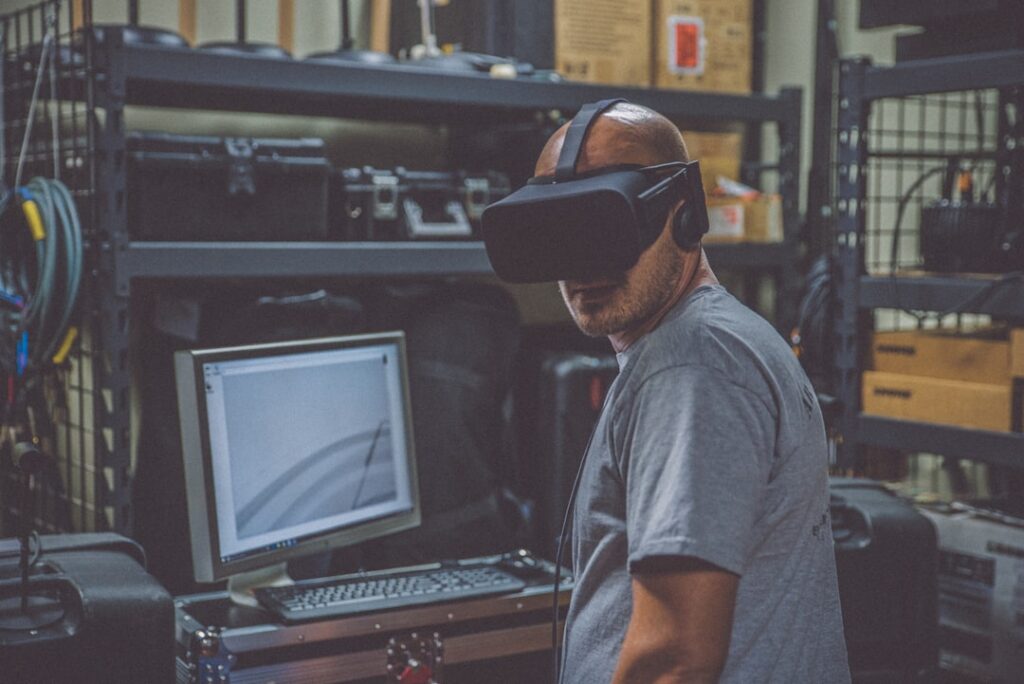
AR/VR technology reconfigures the learning environment from a passive, classroom‑centric model to a secure, data‑rich sandbox where trainees can repeat high‑risk procedures without physical consequences [1]. The core mechanism rests on three interlocking components:
- Real‑time Spatial Mapping – Head‑mounted displays and handheld AR lenses overlay digital schematics onto physical workspaces, enabling learners to visualize hidden systems (e.g., wiring diagrams inside a HVAC unit) while maintaining tactile feedback.
- Procedural Analytics – Sensors capture hand motion, gaze, and decision latency, feeding algorithms that benchmark performance against industry standards. This granular data creates a learning analytics layer that institutions can use to certify competence objectively.
- Modular Content Libraries – Cloud‑hosted asset repositories allow sector‑specific customization. For instance, Siemens’ “Digital Factory” suite offers plug‑and‑play VR modules for CNC machining, while the International Brotherhood of Electrical Workers (IBEW) pilots AR overlays for conduit routing in real‑world field trials.
 Data Science
The Art of Data Visualization: Crafting Stories from Numbers
Data visualization merges creativity with analytics, transforming complex information into engaging narratives that enhance public understanding.
Read More →The modularity of these solutions means that a single platform can be repurposed across disparate trades, from automotive body repair to solar panel installation, reducing marginal content development costs by an estimated 60 % according to a 2025 SHRM Labs survey [3]. Moreover, the ability to simulate regulatory compliance scenarios (e.g., OSHA lockout/tagout procedures) embeds institutional safety standards directly into the training loop, aligning skill acquisition with compliance risk management.
Moreover, the ability to simulate regulatory compliance scenarios (e.g., OSHA lockout/tagout procedures) embeds institutional safety standards directly into the training loop, aligning skill acquisition with compliance risk management.
Layer 2: Systemic Ripple Effects
Experiential Learning as a Norm
The diffusion of AR/VR forces a systemic reorientation toward experiential pedagogy. Traditional lecture‑based modules, which accounted for roughly 55 % of vocational curricula in 2019, have fallen to 38 % in programs that have integrated immersive tools, according to the OECD’s 2025 Skills Outlook [5]. This shift aligns curricula with the cognitive science finding that active, multimodal engagement drives deeper neural encoding, thereby raising the baseline of competency across the workforce.
Personalized, Adaptive Pathways
Immersive platforms generate continuous performance data, enabling adaptive learning pathways that adjust difficulty in real time. A pilot with the German Dual System of vocational education showed that learners who received AR‑driven adaptive feedback completed certification exams 12 % faster and with 8 % higher pass rates than peers in static programs [6]. The reduction in dropout rates—particularly among underrepresented groups who historically face barriers to hands‑on apprenticeships—creates a more inclusive pipeline of skilled labor and attenuates structural inequities in career advancement.
Collaboration Across Institutional Silos
AR/VR’s networked architecture encourages cross‑institutional collaboration. Community colleges now co‑author content with industry consortia, while labor unions contribute safety protocols directly into simulation scripts. This interdisciplinary approach mirrors the historical integration seen in the post‑World War II GI Bill era, when federal funding linked higher education to industrial needs, catalyzing the modern research university model. Today’s immersive ecosystem reproduces that alignment, but with real‑time data feedback loops that continuously calibrate curricula to evolving technological standards.
 Economics
Why You Should Confront Mortality, Ignore Strategists and Buy Coal
As market strategists advise caution, a bold perspective suggests that confronting mortality and investing in coal may be a wise…
Read More →Layer 3: Implications for career capital and Mobility
Who Gains
The reduction in dropout rates—particularly among underrepresented groups who historically face barriers to hands‑on apprenticeships—creates a more inclusive pipeline of skilled labor and attenuates structural inequities in career advancement.
- Tech‑Enabled Enterprises – Companies that internalize immersive training reduce onboarding costs by an average of $4,200 per employee and achieve 15 % higher first‑year productivity, per a 2024 Deloitte analysis [7]. The resulting efficiency gains translate into higher wage ceilings for workers who master advanced digital competencies.
- Future‑Ready Apprentices – Individuals who complete AR/VR‑augmented apprenticeships accumulate portable digital badges that are verifiable on blockchain‑based credentialing platforms. These badges function as career capital, facilitating lateral moves across firms and geographic regions without the friction of traditional licensure transfer.
- Policy Makers – Governments that subsidize immersive infrastructure can accelerate skill‑supply elasticity, narrowing the gap between labor demand and the supply of qualified technicians in high‑growth sectors such as renewable energy, where the International Energy Agency projects a need for 12 million new skilled workers by 2030 [8].
Who Loses
- Legacy Training Providers – Institutions that rely on physical labs and static curricula face declining enrollment as learners gravitate toward programs offering measurable outcomes and flexible delivery. Market consolidation is already observable: three major U.S. trade schools filed for Chapter 11 in 2025 after failing to integrate immersive solutions.
- Low‑Skill Segments – Workers whose jobs are not readily codifiable into digital simulations—such as certain manual labor roles in construction—may experience relative skill depreciation if employers prioritize digitally certified talent. This creates a dual‑track labor market where career mobility hinges increasingly on access to immersive training resources.
- Union Bargaining Power – As certification becomes data‑driven, unions risk ceding control over skill standards to proprietary platforms, potentially weakening collective bargaining leverage unless they secure data‑governance clauses in training agreements.
Closing: Projection to 2029 and Institutional Realignment
Over the next three to five years, the trajectory of AR/VR in vocational training is likely to intersect with three macro‑level forces:
- Hardware Democratization – With the average price of standalone VR headsets falling below $250 by 2027, adoption will spread beyond large enterprises to small‑ and medium‑sized manufacturers, expanding the total addressable market by an estimated $45 billion [4].
- Regulatory Standardization – The National Institute for Occupational Safety and Health (NIOSH) is drafting immersive training standards that will embed compliance metrics into certification pathways, effectively institutionalizing AR/VR as a de‑facto requirement for certain high‑risk trades.
- Labor Market Data Integration – Emerging APIs will link real‑time labor demand signals from platforms like Burning Glass and LinkedIn to curriculum updates, creating a feedback‑driven skill ecosystem that can pivot within weeks rather than years.
 Global Affairs
US bans new foreign-made drones and components
Washington, USA — The Federal Communications Commission (FCC) has taken a significant step in national security by banning the import…
Read More →If these dynamics unfold as projected, the institutional architecture of skill formation will shift from a static, siloed model to a fluid, data‑centric network. Workers who can navigate this network—by acquiring digital badges, leveraging adaptive learning, and participating in cross‑sector collaborations—will amass a new form of career capital that transcends traditional trade boundaries. Conversely, institutions that remain anchored to legacy delivery methods risk marginalization, potentially widening existing economic mobility gaps.
Key Structural Insights
[Insight 1]: Immersive technologies convert vocational training from a fixed curriculum into a data‑rich, adaptive ecosystem, redefining how career capital is generated and validated.
[Insight 2]: The systemic ripple effects—personalized pathways, cross‑institutional collaboration, and regulatory integration—reshape institutional power dynamics, favoring entities that can embed analytics into skill certification.
- [Insight 3]: Over the next five years, hardware democratization and standards adoption will accelerate a structural realignment, making AR/VR a prerequisite for economic mobility in high‑growth technical occupations.