No products in the cart.

The H‑1B Firestorm: How Rising U.S. Visa Tensions Could Redraw Indian Career Maps
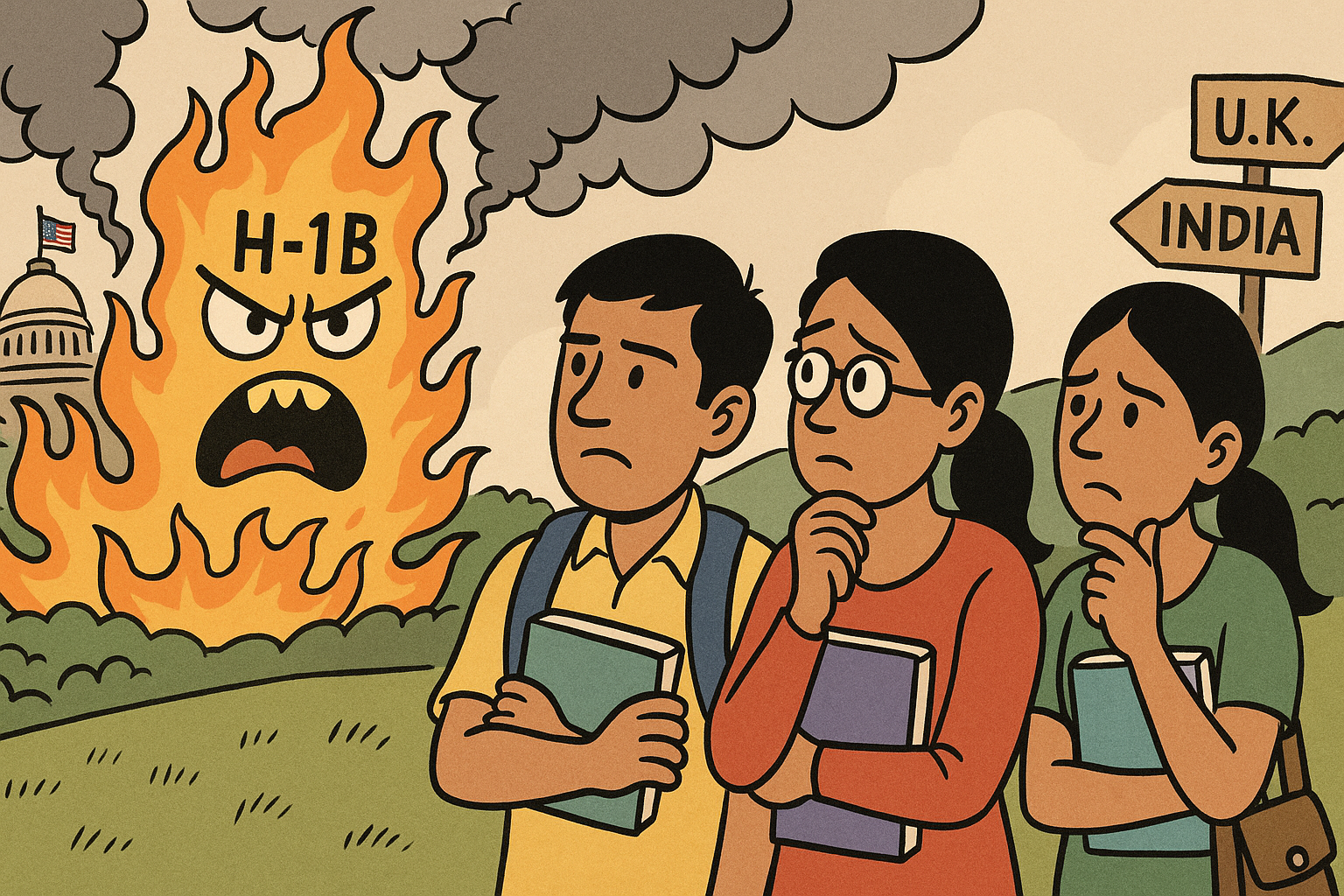
A controversial post calling for an end to Indian H‑1B visas has spooked Indian students. But amid rising uncertainty, many are pivoting to alternatives at home and abroad.

On August 4, 2025, U.S. Congresswoman Marjorie Taylor Greene reignited a raging debate by calling on social media to “end Indian H‑1B visas replacing American jobs.” Though no formal policy changes have followed, her remarks echoed long-standing immigration rhetoric and immediately reverberated across Indian student and professional circles.
The Trigger: A Statement That Sparked Anxiety
Greene’s message came amid escalating U.S.–India trade tension. She reposted a statement from former President Trump advocating higher tariffs on Indian goods, tying job protection directly to visa policy. Representing nearly 70% of all H‑1B petitions, Indians dominate the visa category many Indian students hope to enter upon graduation. Her words were brief—but pointed.
“Even if it’s just a tweet, it fuels uncertainty,” a graduate student in California noted. With political narratives evolving, what starts as rhetoric can influence future legislation: proposals are circulating for greater wage thresholds, lottery reforms, and general restraint in H‑1B allocation.
What This Means for Students
1. Visa Pipeline under pressure
Reports predict a 20–25% drop in Indian admissions for Fall 2025. A recent pause in F‑1 visa appointments, coupled with fears over changes in OPT, has left thousands of applicants in limbo—even after securing university admission. Many face tuition deadlines and housing obligations without certainty of entry.
 Career Development
How to Use Micro-Communities for Faster Career Growth in 2025
Discover how micro-communities can enhance your career growth in 2025. This guide offers actionable tactics for leveraging niche networks effectively.
Read More →Cascading Career Risks The Optional Practical Training (OPT) program, a post-study bridge for students, is scrutinized under proposed reforms, adding another layer of uncertainty to long-term planning.
2. Changes in University Hiring
Academic institutions—including universities previously exempt from the H‑1B cap—may now fall under standard visa quotas. Proposed regulations would force them into the annual lottery system, removing a known pathway for post-graduate employment.
3. Cascading Career Risks
The Optional Practical Training (OPT) program, a post-study bridge for students, is scrutinized under proposed reforms, adding another layer of uncertainty to long-term planning.
How Indian Students Are Adjusting
Looking Beyond the U.S.
Families and students are now seriously exploring destinations like Canada, the UK, Australia, and Germany, which offer clearer immigration paths and fewer political uncertainties.
Mapping Domestic Alternatives
Some ambitious students are choosing to stay in India, leveraging career-focused tracks including governmental schemes, vocational training hubs, and incubation support in Tier‑2 startups.
 Artificial Intelligence
AI Tool of the Week: Gemini's new feature creates interactive tools in chat
Mountain View, USA — Gemini, Google’s AI chatbot, has taken a significant leap forward with its new feature: mini-apps. This…
Read More →Diversifying Visa Options
professionals already in the U.S. report a shift in interest toward L-1 (intra-company transfer) and O-1 (extraordinary ability) visas, which carry fewer caps and offer greater stability than H‑1B. EB‑5 investor visas are also rising in demand among families with long-term relocation plans.
Voices on the Frontline
Subash Devatwal, a student adviser from Gujarat, describes widespread shock. “Parents have saved for years, sold valuables, taken loans—only to find their investments now at risk.” Many applicants are opting to defer a year—or pivot entirely—toward European or Middle Eastern universities instead.
Mapping Domestic Alternatives Some ambitious students are choosing to stay in India, leveraging career-focused tracks including governmental schemes, vocational training hubs, and incubation support in Tier‑2 startups.
At the same time, consultants like Nikhil Jain observe that students are shifting their focus from admission trophies to what comes after. “It’s less about getting into a U.S. university and more about demonstrating lasting value in ambiguous conditions,” he explains.
Verdict: What Should Indian Students Do Now?
- Diversify Study Destination: Assess alternatives with clear visa pathways and scholarship options. Germany and Canada are flourishing in STEM welcome initiatives.
- Sharpen Career Plan Locally: Explore opportunities with Indian firms, government-backed job schemes, and innovation hubs poised for growth in deep tech and entrepreneurship.
- Know Your Options for U.S. Entry: Learn about non-lottery visa categories such as L‑1, O‑1, and EB‑5—especially if sponsorship is unclear.
- Prepare for Uncertainty: Strengthen academic output, build diversified portfolios, and clarify contingency pathways before making irreversible investments.
Final Word
While no immediate policy changes have curtailed H‑1B visas, the amplification of anti-H‑1B rhetoric—and growing institutional uncertainty—have already disrupted what many saw as a seamless path from study to career in the U.S. For young professionals in India, the time to reassess is now.
 Business Innovation
The Future of Ultrasonic Jewelry Cleaning: Market Insights
The ultrasonic jewelry cleaning market is evolving, influenced by technology and consumer preferences. Explore insights and future trends.
Read More →Given the political volatility, building flexibility—both in geography and in career strategy—is no longer an option. It’s essential.