

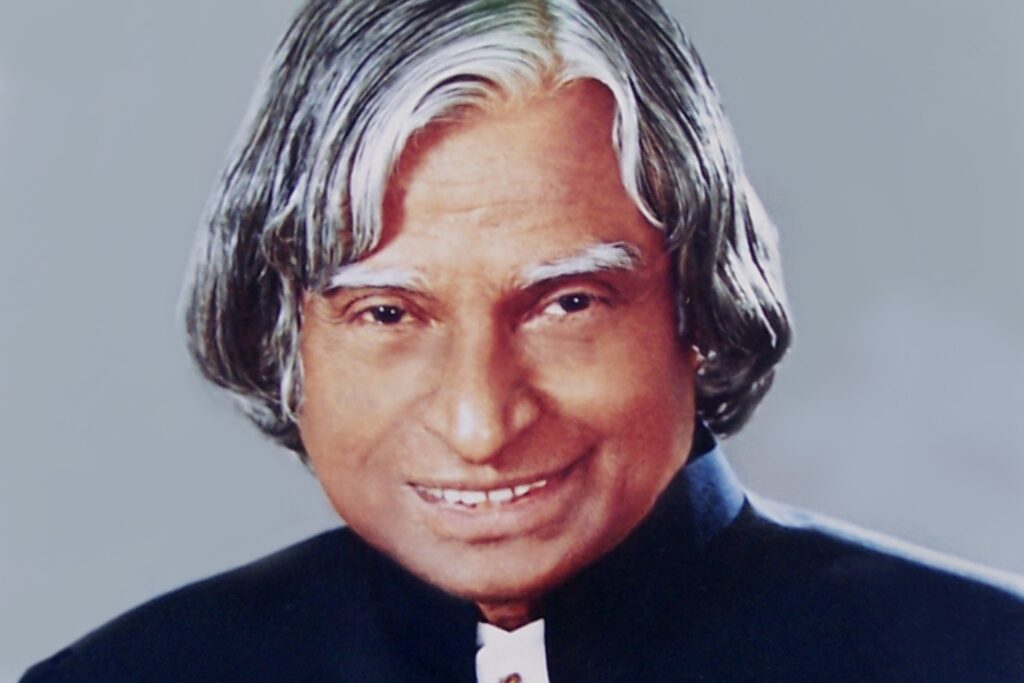
Ten sourced Kalam lines, with practical readings for exams, internships, campus placements, and first jobs.
A.P.J. Abdul Kalam was born on October 15, 1931 in Rameswaram, Tamil Nadu. He specialized in aeronautical engineering at the Madras Institute of Technology and later served as Project Director of India’s first indigenous Satellite Launch Vehicle (SLV-III), which placed the Rohini satellite in near-earth orbit in July 1980. He became the 11th President of India and served from July 25, 2002, to July 25, 2007.
For students and early-career professionals in India, roughly ages 16 to 35, his appeal is not only inspirational. It is procedural. He talks about missions, failure, stamina, and the daily discipline of aiming higher than the room expects. The ten passages below come from his autobiography and from two later speeches. Each entry names the source, then translates the line into something you can use this week: for an exam, an internship, a campus placement, or the first months of a job.
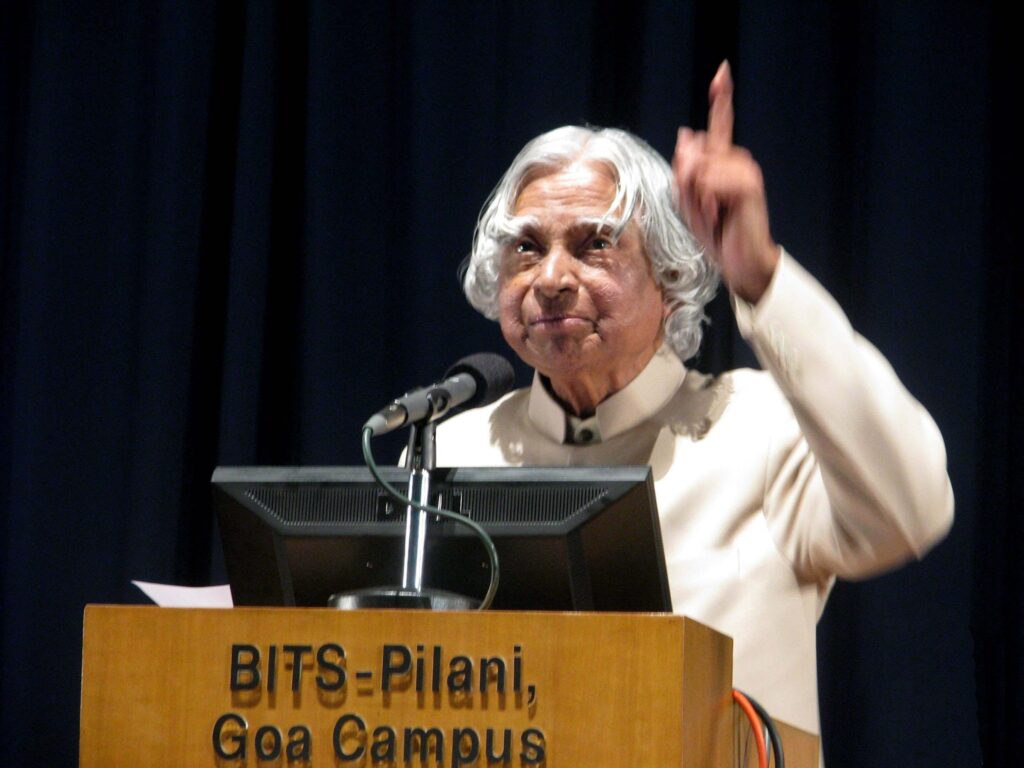
1. Give Wings to the Fire You Already Have
We are all born with a divine fire in us. Our efforts should be to give wings to this fire and fill the world with the glow of its goodness.
Source: A.P.J. Abdul Kalam and Arun Tiwari, Wings of Fire: An Autobiography (Hyderabad: Universities Press, 1999), author’s opening note.
Most students wait for permission before taking their interests seriously. Kalam treats that fire as already present, so your task is to train it. Give one existing interest a fixed weekly slot. Measure progress by finished work, not by how inspired you feel. A schedule, a mentor, or a finished project is the wing.
2. Choose One Mission and Defend Your Hours
To succeed in your mission, you must have single-minded devotion to your goal.
Source: Wings of Fire, in the section on his work leading India’s SLV program.
Single-mindedness is not working nonstop. It means choosing which goal deserves your best hours and defending them. During placements, pick two or three target roles and prepare deeply. Write your mission in one sentence, then list three weekly actions that move it forward. Review the list each Sunday.
3. Difficulty Is Part of the Price
Man needs his difficulties because they are necessary to enjoy success.
Source: Wings of Fire, in the same stretch on commitment and how the mind handles stress.
Difficulties are not proof that you chose the wrong path. They are often the price of a goal worth having, especially early in a career. If a project stalls, separate the setback from your identity: the draft failed, not you. Take a short recovery window, then return to the next concrete task. Treat friction as information and keep moving.
4. Build Strength for the Whole Climb
Climbing to the top demands strength, whether to the top of Mount Everest or to the top of your career.
Source: Wings of Fire, in the paragraph that follows the line on difficulties, where he warns that people have different energy reserves and that someone who burns out easily should reorganize their life early.
Ambition without stamina is a short campaign. Kalam notes that people have different reserves, so a plan that works for your friend may empty you by week three. If you burn out easily, reorganize early. Protect sleep before exam week, block recovery time after a placement drive, or ask for a realistic deadline. Strength at the top comes from repeatable habits, not one heroic sprint.
5. Do Not Let the Problem Close the File
We should not give up and we should not allow the problem to defeat us. The country doesn’t deserve anything less than success from us. Let us aim for success.
Source: Kalam’s address to more than 2,000 people from the DRDL-RCI community after working hours on May 8, 1989, as he later recorded it in Wings of Fire, during the Agni program after a failed launch attempt.
A failed attempt is a bad day, not a closed file. Kalam recorded this after a launch attempt went wrong, so the emphasis is on refusing defeat. After a failed mock test, review by topic instead of rereading everything. At work, document what broke, ask for a review, and return with a corrected plan. Target the problem, not a person.
6. Let Hardship Sharpen the Work
What I wanted to say was that no one, however poor, underprivileged or small, need feel disheartened about life. Problems are a part of life. Suffering is the essence of success.
Source: Wings of Fire, in the later Contemplation section, where he explains why he decided to write about the people and circumstances that shaped him.
Early-career life can make ordinary disadvantages feel permanent. This line refuses that logic without denying the problems. If money, language, or a tier-three campus shapes your options, focus on the next controllable step: a certification, a writing sample, or a referral conversation. Keep a record of difficulties you have survived, because it becomes evidence when confidence drops.
7. The Billion Minds Are a Local Resource
Think of the billion ignited Indian minds. This is the most powerful resource compared to any resource on the earth, above the earth and below the earth.
Source: his address “Interaction With Students at the Children Science Congress,” Chandigarh, January 5, 2004, in the President of India archives.
This is an argument about scale, and students can use it locally. The person beside you in a lab, hostel, or first-job cubicle is part of the same resource base. Study groups, peer code reviews, and shared interview notes multiply what one person can do alone. If you lead a small team, ask who is quiet and what the group has not used yet.
8. Set an Aim That Stretches You
I insist that small aim is a crime.
Source: his address “Ignited Minds of the Youth Are the Greatest Resource for the Nation,” Bandaranaike Centre for International Studies, BMICH, Colombo, January 21, 2012, published by the High Commission of India, Colombo.
A small aim feels safe because it limits the size of a possible failure. It also limits the feedback, skills, and attention your work attracts. In a first job, volunteer for a project slightly above your level and ask for a review cycle. As a student, choose a final-year project that requires one new tool.
9. Fight to Become Your Own Version
The challenge, my young friends, is that you have to fight the hardest battle, which any human being can ever imagine to fight; and never stop fighting until you arrive at your destined place, that is, a UNIQUE YOU!
Source: the same Colombo address of January 21, 2012; in the preceding lines he describes family and school pressure to be like the neighbor’s children or the top five rankers.
Much of the pressure you feel is comparison wearing a deadline. Kalam’s context is family and school pressure to match the neighbor’s children or the top five rankers. A unique path is not random. It is a deliberate mix of your strengths, constraints, and the problems you want to solve. Keep the goals you would choose if no one were watching, and drop the borrowed scoreboard.
10. Treat the Future as a Next Step
I would like to assert that ‘No youth today need to fear about the future’.
Source: the same Colombo address of January 21, 2012.
Fear about the future often comes from staring at the whole staircase. Name the next landing instead: one exam, one application, one conversation with a supervisor. The line is not a promise that everything will be easy. It is a claim that young people have enough agency to begin. Work what you control this month, ask for help with the rest, and collect evidence of progress.
Read these lines as a working set, not a wall poster. The common thread is agency with structure: choose a mission, expect difficulty, protect your energy, and return to the next concrete task. Kalam’s biography supplies the scale, but the daily work is yours. Start with one line that fits your current season, apply it for a month, and keep what proves useful.
Sources
- A.P.J. Abdul Kalam and Arun Tiwari, Wings of Fire: An Autobiography (Hyderabad: Universities Press, 1999).
- A.P.J. Abdul Kalam, “Interaction With Students at the Children Science Congress,” Chandigarh, January 5, 2004, President of India archives, https://presidentofindia.nic.in/dr-apj-abdul-kalam/speeches/interaction-students-children-science-congress.
- A.P.J. Abdul Kalam, “Ignited Minds of the Youth Are the Greatest Resource for the Nation,” Bandaranaike Centre for International Studies, BMICH, Colombo, January 21, 2012, text published by the High Commission of India, Colombo, https://www.hcicolombo.gov.in/section/press-releases/address-by-dr-a-p-j-abdul-kalam-former-president-of-india-ignited-minds-of-the-youth-are-the-greatest-resource-for-the-nation-at-bcis-bmich-on-21-january-2012/.