


Supervisors say most large European banks already use AI. The binding rules that govern that use are arriving on different clocks.
Partner content: This article contains one partner link, in the Partner perspective box below. Career Ahead’s editors researched, wrote and fact-checked the rest of this story independently.
In a keynote in Frankfurt am Main on February 24, 2026, Pedro Machado, the European Central Bank’s representative to the Supervisory Board, put a number on a shift that bank job descriptions still often treat as experimental. ECB Banking Supervision’s annual data collection, he said, shows that more than 85% of large banks under European supervision already use artificial intelligence in some form, and that adoption is still rising, particularly with generative and agentic AI (1). The useful question is who is accountable when a model scores a borrower, flags a transfer, or writes production code, and whether the bank can show how that system is challenged, monitored and, if it fails, contained.
That test is arriving on a staggered clock. The European Union’s Digital Operational Resilience Act (DORA) has applied since January 17, 2025 (3), and the first annual report on major information and communication technology incidents under that law appeared in June 2026 (2). The EU AI Act’s high-risk duties for systems that evaluate a person’s creditworthiness now apply from December 2, 2027, after the Digital Omnibus on AI amended the timetable (4). The next open banking and payments rules, the third Payment Services Directive (PSD3) and the Payment Services Regulation (PSR), exist as Council first-reading texts adopted on October 29, 2026. They are not yet formally adopted law (5).
Supervisors Say the Models Have Left the Lab
Machado said supervisors used to focus on AI in credit risk assessment, fraud detection and transaction monitoring. Those uses remain important. Generative AI, he said, is also being deployed in IT operations, legal and document analysis, and front-line tools such as customer support (1). Banks have written AI policies and set up committees or centers of expertise, but he said governance remains uneven. They still need unambiguous accountability for AI-driven decisions, effective senior management oversight, and challenge from risk, compliance and internal audit. A recurring concern is fragmented ownership across IT, data science, business lines and control functions. “AI does not dilute responsibility. If anything, it raises the bar,” he said (1).
On generative AI, he pointed to concentration: systems often come from a small number of major third-party providers, rely on cloud infrastructure, and sit on general-purpose models that are not fully transparent to users, a pattern he linked to DORA and third-party technology risk. Within the ECB’s supervisory priorities for 2026-28, he said supervision will keep monitoring AI, with a more focused approach to generative AI (1).
DORA’s First Incident Report Is Large. The Authorities Say That Is Not the Point
On June 3, 2026, the European Supervisory Authorities published their first annual overview of major ICT-related incidents under Article 22(2) of DORA (2). Financial entities reported 3,383 major incidents in 2025, an average of 0.18 per entity subject to the regulation, most of them in the credit and payments sectors (2). The authorities were explicit that the headline number should not be read as evidence of structural weakness. Operational incidents are, they wrote, to some extent unavoidable in a more digital financial system. Two thirds of the major incidents resulted in no or minor disruption to clients and transactions (2).
Around one third had a cross-border impact. Almost one third originated from failures attributable to third parties, including ICT third-party providers, other financial entities and infrastructure providers. System failures accounted for 51% of major incidents, external events 27%, and payment-related incidents 18%. Cybersecurity-related incidents accounted for 10% (2). The report said that relatively low cyber share appears to show that existing safeguards often limited those incidents, while warning that firms still need to keep cybersecurity standards high enough to keep pace with “highly capable AI-driven tools” (2). A major incident requires an initial notification within four hours of being classified as major, and no later than 24 hours after the firm became aware of it (2).
The European Rulebook Is in Force, in Pieces
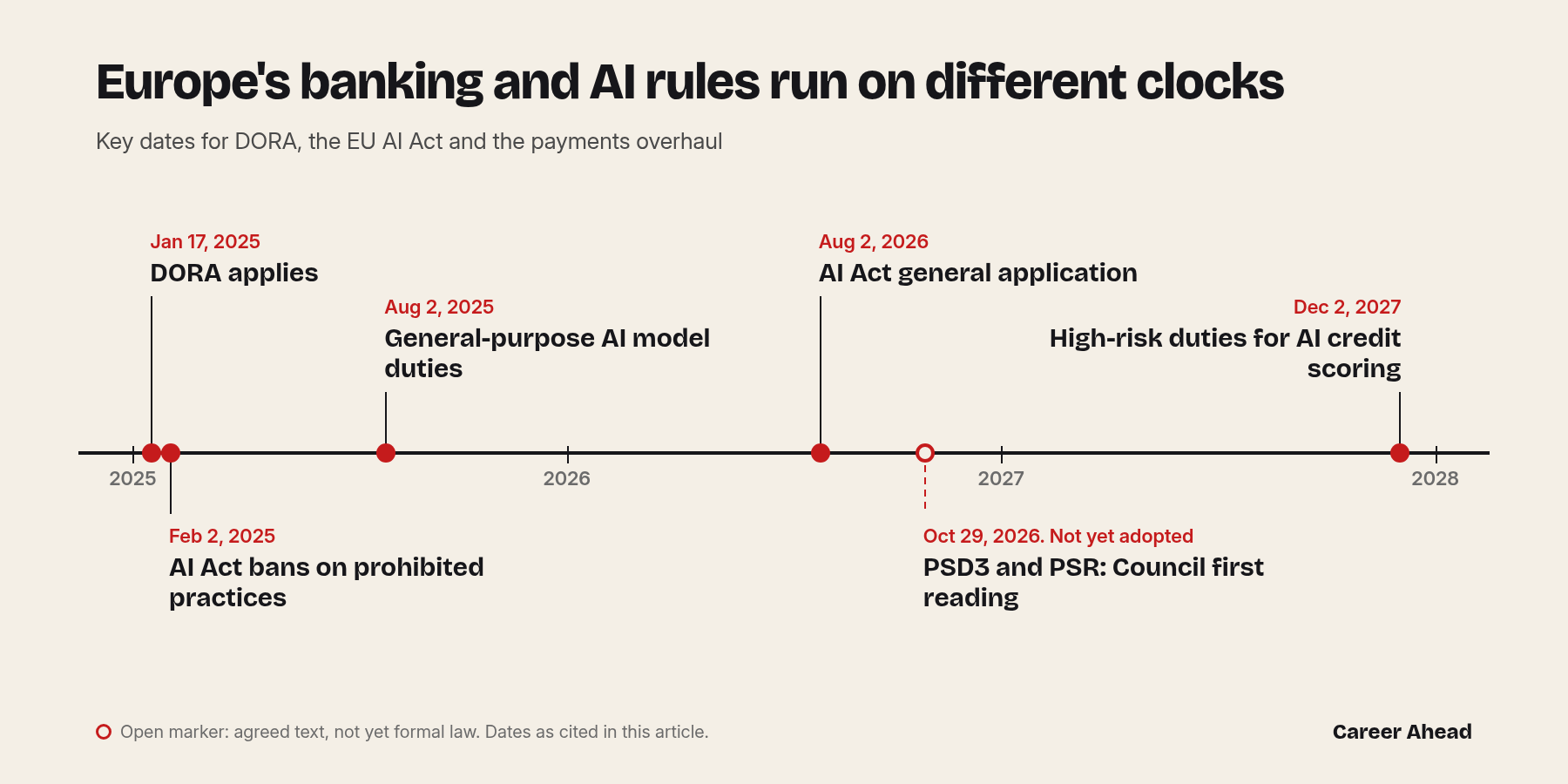
DORA has applied since January 17, 2025, with no transitional period (3). The Commission’s AI Act Service Desk presents Article 113 as amended by the Digital Omnibus on AI, in a consolidation dated July 27, 2026 (4). Most prohibited practices have applied since February 2, 2025, and obligations for general-purpose AI models since August 2, 2025. The Act’s general application date of August 2, 2026 includes transparency duties in Article 50. The heavier requirements for Annex III high-risk systems apply from December 2, 2027. That Annex includes, at point 5(b), AI systems “intended to be used to evaluate the creditworthiness of natural persons or establish their credit score,” except systems used to detect financial fraud (4). Germany’s Federal Financial Supervisory Authority, BaFin, states the same credit-scoring date (4). The Digital Omnibus delay is the same change that postponed high-risk duties for AI used in hiring until December 2027.
The payments overhaul is later still. The Commission proposed PSD3 and the PSR on June 28, 2023. The Council’s statement of reasons records a political agreement on November 26, 2025, approval of the agreed text by Parliament’s Economic and Monetary Affairs Committee on May 5, 2026, and the Council’s first-reading positions on October 29, 2026 (5). Those texts have not yet been formally adopted by Parliament at second reading, and they have not been published as adopted legislation in the Official Journal. Until the new acts apply, the current Payment Services Directive remains the law. The Council’s PSR text would enter into force on the twentieth day after publication and would generally apply 21 months later. Articles 51 and 58, on matching a payee’s name and unique identifier and on liability if that verification service is applied incorrectly, would apply after 27 months (5).
Banks, fintechs and their foundations or CSR arms face the same need to evidence controls, even when a reporting standard was written for nonprofit organizations rather than for banks.
- DORA, the Digital Operational Resilience Act, has applied since January 17, 2025 and requires financial entities to manage ICT risk, report major incidents and oversee third-party technology providers (3).
- PSD3 and the PSR are the agreed overhaul of the EU’s payments and open banking rules. They exist as Council first-reading texts of October 29, 2026 and are not yet formally adopted law. Once in force, the PSR would generally apply 21 months later (5).
- The EU AI Act already bans certain practices and regulates general-purpose models. Its high-risk duties for systems used to evaluate a natural person’s creditworthiness apply from December 2, 2027 (4).
Washington Is Publishing Tools, Not a Single Statute
On February 19, 2026, the US Department of the Treasury released two resources intended to guide AI use in the financial sector: a shared Artificial Intelligence Lexicon and the Financial Services AI Risk Management Framework. Treasury said the documents were developed through the Financial and Banking Information Infrastructure Committee and the Financial Services Sector Coordinating Council’s AI Executive Oversight Group, and that the framework adapts the National Institute of Standards and Technology’s AI Risk Management Framework (6).
In March, Treasury and the Office of the Financial Stability Oversight Council opened a public-private AI Innovation Series. A March 4, 2026 readout of the first roundtable recorded participants saying that a firm’s failure to adopt AI tools can itself be a financial stability risk, and that they wanted principles-based supervision, including human-in-the-loop controls for agentic AI and stronger validation for generative AI (6). In a March 23, 2026 release, Treasury Secretary Scott Bessent said the department was “moving from a posture focused on constraint toward one that recognizes failure to adopt productivity-enhancing technology as its own risk” (6). Those documents are guidance tools and convenings, not a US equivalent of the AI Act.
India’s Framework Is a Committee Report, Plus a Draft
The Reserve Bank of India constituted its Committee on the Framework for Responsible and Ethical Enablement of Artificial Intelligence, known as FREE-AI, on December 26, 2024. The committee submitted its report on August 13, 2025 (7). The report sets out seven guiding “sutras,” including that accountability rests with the entities that deploy AI and “cannot be delegated to the model and underlying algorithm,” and 26 recommendations under six pillars, among them a board-approved AI policy, capacity building at the board and in the workforce, and informing customers when they are interacting with AI (7). That is not yet a final Reserve Bank rulebook. In its annual report chapter dated May 29, 2026, covering 2025-26, the Reserve Bank said the Department of Regulation was “undertaking an assessment of the Committee’s report and recommendations, which will help in formulation of more specific guidance” (7). On June 24, 2026 it issued draft “Guidance on Regulatory Principles for Model Risk Management,” covering all models used by a listed set of regulated entities, including third-party and AI and machine-learning models, with comments due by July 24, 2026 (7). As of November 24, 2026, that text remains a draft.
What That Means Early in a Finance or Tech Career
The through-line in these jurisdictions is evidence. Machado’s list is practical: who owns an AI-driven decision, whether the second line of defense can challenge it, and whether senior management still has oversight after a tool is in production (1). The DORA report adds a clock: a major incident has to be notified in hours, not in a weekly wash-up (2). When the AI Act’s high-risk duties apply, they turn on documentation, data quality, human oversight and transparency, including making it clear when a person is interacting with an AI system (4). India’s committee lands in a similar place: do not delegate accountability to the model, and build capacity at the board and in the workforce (7).
The next public tests are already on the calendar. Parliament still has to complete its second reading of PSD3 and the PSR (5). The AI Act’s high-risk creditworthiness duties apply from December 2, 2027 (4). In India, the open question is whether, and in what form, the Reserve Bank finalizes the model-risk guidance it circulated in draft in June (7). The banks, on Machado’s figures, are not waiting for those dates to use the tools (1).
Sources
- Pedro Machado, “Technology is neutral, governance is not: AI adoption in the banking sector,” keynote speech at the KPMG RiskTech Conference, Frankfurt am Main, February 24, 2026, European Central Bank Banking Supervision, https://www.bankingsupervision.europa.eu/press/speeches/date/2026/html/ssm.sp260224~6c5b64a77a.en.html.
- European Supervisory Authorities, “2025 Report on major ICT-related incidents,” JC 2026 16, June 3, 2026, and the accompanying EBA press release of the same date, https://www.esma.europa.eu/sites/default/files/2026-06/JC_2026_16_ESAs_2025_report_on_major_ICT-related_incidents.pdf; https://www.eba.europa.eu/publications-and-media/press-releases/esas-publish-first-report-dora-major-ict-related-incidents.
- European Securities and Markets Authority, “Digital Operational Resilience Act (DORA),” and ENISA, “EU financial entities cybersecurity upgrade: DORA is now alive and kicking,” January 17, 2025; European Supervisory Authorities, public statement JC 2024 99, December 4, 2024, https://www.esma.europa.eu/esmas-activities/digital-finance-and-innovation/digital-operational-resilience-act-dora; https://www.enisa.europa.eu/news/eu-financial-entities-cybersecurity-upgrade-dora-is-now-alive-and-kicking.
- Regulation (EU) 2024/1689 (AI Act), Article 113 and Annex III, point 5(b), as presented on the European Commission’s AI Act Service Desk, consolidated as at July 27, 2026 and amended by the Digital Omnibus on AI (Official Journal L, 2026/1744); BaFin, “European Artificial Intelligence Act,” https://ai-act-service-desk.ec.europa.eu/en/ai-act/article-113; https://ai-act-service-desk.ec.europa.eu/en/ai-act/annex-3; https://www.bafin.de/EN/die-bafin/aktuelles-presse/presse-social-media/pressematerial/ki-verordnung/ki-verordnung_node_en.html.
- Council of the European Union, first-reading position on the Payment Services Regulation, document ST 8543/26, October 21, 2026, including Article 124; first-reading position on PSD3, document ST 8535/26; Statement of the Council’s reasons, ST 8543/1/26 REV 1 ADD 1, adopted October 29, 2026, https://data.consilium.europa.eu/doc/document/ST-8543-2026-INIT/en/pdf; https://data.consilium.europa.eu/doc/document/ST-8535-2026-INIT/en/pdf; https://data.consilium.europa.eu/doc/document/ST-8543-2026-REV-1-ADD-1/en/pdf.
- US Department of the Treasury, “Treasury Releases Two New Resources to Guide AI Use in the Financial Sector,” February 19, 2026; “READOUT: AI Innovation Series – Roundtable on Strategy and Governance,” March 4, 2026; “Treasury Launches the Artificial Intelligence (AI) Innovation Series,” March 23, 2026, https://home.treasury.gov/news/press-releases/sb0401; https://home.treasury.gov/system/files/261/FSOC-20260304-AI-Roundtable-Readout.pdf; https://home.treasury.gov/news/press-releases/sb0421.
- Reserve Bank of India, FREE-AI Committee report, published August 13, 2025; Annual Report, Chapter VI, May 29, 2026; press release 2026-2027/528, “RBI issues draft ‘Guidance on Regulatory Principles for Model Risk Management,'” June 24, 2026, https://www.rbi.org.in/Scripts/PublicationReportDetails.aspx?ID=1306; https://rbi.org.in/SCRIPTS/AnnualReportPublications.aspx?Id=1466; https://www.rbi.org.in/SCRIPTs/BS_PressReleaseDisplay.aspx?prid=63006.