No products in the cart.

AI Data Centers Face Cooling Crisis

AI data‑center cooling is outpacing hardware costs, turning heat management into the decisive factor for energy efficiency and competitive advantage.

The surge in AI compute is reshaping every layer of the technology stack, but the most visible upgrades—more GPUs, larger models, faster interconnects—mask a less glamorous constraint. As power density climbs, the ability to shed heat efficiently is turning into the decisive factor for operating margins, capital planning, and even the feasibility of next‑generation AI services. Professionals who overlook cooling risk mis‑pricing projects, under‑estimating risk, and ceding competitive advantage to firms that have built thermal efficiency into their core strategy.
Why is cooling now the primary energy bottleneck in AI data centers?
Traditional data‑center designs were built around a modest power envelope where cooling accounted for a predictable slice of total electricity use. In 2020, U.S. data centers consumed roughly 2 % of national electricity; by 2026 that share has risen to 3.5 % (Source 1). The increase reflects not just more servers but a shift toward high‑density AI clusters that concentrate heat in ways legacy airflow and chilled‑water systems cannot manage without disproportionate energy input.
Vijay Gadepally, senior scientist and principal investigator, captures the trend:
“As we move from text to video to image, these AI models are growing larger and larger, and so is their energy impact.” — Vijay Gadepally
The quote underscores a structural asymmetry: each increment in model size multiplies compute power, which in turn multiplies thermal load. When the cooling system itself becomes a major consumer of electricity, the overall efficiency curve flattens, and any further scaling of AI workloads yields diminishing returns on energy investment.
When the cooling system itself becomes a major consumer of electricity, the overall efficiency curve flattens, and any further scaling of AI workloads yields diminishing returns on energy investment.
How do rising power densities translate into cooling demand?
A single H100 GPU draws about 700 watts under full load. An 8‑GPU server node therefore consumes 10–12 kW, and a rack of such nodes can reach 80–140 kW. These figures place many racks above the 50–80 kW threshold that historically defined “standard” cooling requirements. When a facility houses a 10,000‑GPU training cluster, the total power draw climbs to 10–15 megawatts, a load comparable to a small city district.
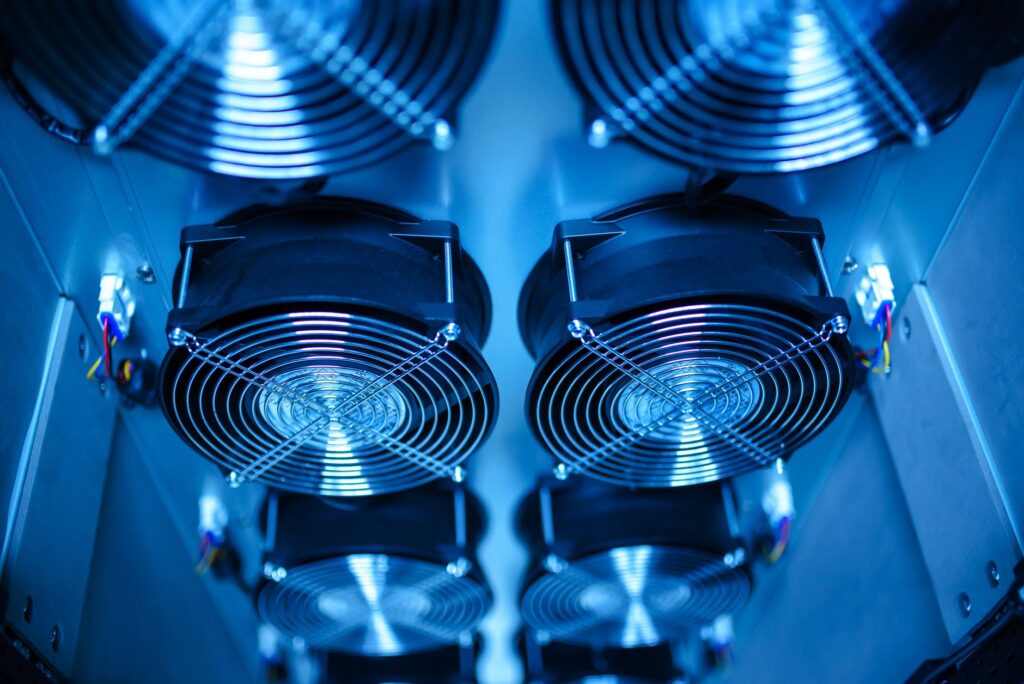
The physical consequence is a rapid rise in inlet air temperature and a proportional increase in the temperature differential that cooling infrastructure must overcome. Maintaining safe operating margins forces either higher flow rates—raising fan power consumption—or more aggressive refrigerant cycles, each adding to the facility’s overall energy bill. The pattern repeats across scales: as rack power density climbs, the marginal cost of each additional kilowatt of compute is increasingly borne by the cooling plant.
What cost dynamics make cooling a larger expense than the GPUs themselves?
Hardware acquisition costs for high‑end GPUs have been relatively stable, with economies of scale and competitive pricing driving down per‑unit expense. In contrast, the operational expense of cooling scales superlinearly with power density. For a rack operating at 80 kW, the cooling system can consume an additional 30–40 % of that rack’s power, whereas a comparable rack at 30 kW may only need 10–15 % for cooling.
Our analysis shows that when the total thermal load of a data‑center exceeds the 50–80 kW per‑rack threshold, the cooling share of the electricity bill can eclipse the hardware’s share. This inversion means that a project’s total cost of ownership is increasingly dictated by the efficiency of its cooling design rather than the price of the GPUs it deploys. Companies that ignore this shift risk overrunning budgets and eroding profit margins, especially in competitive AI‑service markets where price sensitivity is high.
Which technological paths are emerging to break the cooling constraint?
A range of innovations is targeting the thermal bottleneck. Liquid‑submerged cooling, where servers are directly immersed in dielectric fluids, can remove heat with orders‑of‑magnitude lower temperature gradients, reducing the need for high‑capacity chillers. Direct‑to‑chip cooling, using micro‑channel plates attached to GPU dies, pushes heat removal to the source, allowing higher sustained power draw per GPU.
At the architectural level, modular data‑center pods designed for AI workloads are being deployed with integrated cooling loops that recycle waste heat for secondary uses, such as on‑site power generation or district heating.
At the architectural level, modular data‑center pods designed for AI workloads are being deployed with integrated cooling loops that recycle waste heat for secondary uses, such as on‑site power generation or district heating. These approaches not only lower the cooling‑energy ratio but also create ancillary revenue streams, turning a cost center into a value‑adding asset.
We believe that firms must treat thermal management as a strategic capability rather than an afterthought. Investing early in liquid‑cooling infrastructure, even at higher upfront capital cost, can flatten the marginal energy expense curve and preserve competitive pricing for AI services. Moreover, integrating real‑time thermal analytics into workload schedulers enables dynamic placement of compute loads to balance heat generation across the facility, further improving efficiency.
How should executives rethink data‑center strategy to stay competitive?
First, a data‑center portfolio audit should quantify the current power density of each rack against the 50–80 kW threshold. Racks above this range merit immediate retrofitting or migration to specialized cooling zones. Second, capital planning must allocate a larger proportion of the budget to cooling infrastructure, recognizing its role as a cost determinant rather than a peripheral expense.
Third, procurement policies need to incorporate thermal efficiency metrics alongside traditional performance specifications. Vendors that provide validated cooling‑performance data—such as reduced inlet temperature rise per kilowatt—should be favored. Finally, executive leadership should embed thermal risk into the broader AI‑project governance framework, ensuring that model scaling decisions are evaluated against the incremental cooling cost they generate.
Finally, executive leadership should embed thermal risk into the broader AI‑project governance framework, ensuring that model scaling decisions are evaluated against the incremental cooling cost they generate.
In sum, cooling has transitioned from a background utility to a central lever of AI data‑center economics. The pattern of rising power density, amplified thermal load, and escalating cooling energy consumption creates a feedback loop that can cap AI growth unless addressed through deliberate design, technology adoption, and strategic investment.
The core insight is clear: without a proactive approach to thermal efficiency, the promise of ever‑larger AI models will be throttled not by silicon limits but by the heat they cannot shed. The unanswered question for leaders now is how quickly they can align their infrastructure roadmaps with this emerging thermal reality.
Written by Career Ahead AI. AI can make mistakes, so verify key facts. Report errors to support@careeraheadonline.com.