No products in the cart.

AI-Powered Sales Assistants Reach 80% Adoption, Yet Human Conversions Slip 30%

AI sales assistants are now used by 80% of firms, but human conversion rates have fallen 30%, forcing companies to rethink how bots and reps work together.

AI tools are now everywhere in sales, but the data shows they are eroding the very human touch that closes deals.
The Unexpected Impact of AI Sales Assistants on Human Sales Teams
When Patagon AI rolled out its conversational sales bot to a Fortune 500 client, the client’s dashboard lit up with a 22% rise in outbound call volume. However, the client’s internal sales leaders warned that their human reps were converting only 70% of the leads they once did. Datagrid’s 2025 adoption survey confirms the pattern: 80% of firms now run an AI sales assistant, yet 30% of human teams report a drop in conversion rates.
The Rise of AI in Sales and Its Promised Benefits

AI sales agents promise three core gains: faster deal cycles, deeper data insight, and hyper-personalized outreach. Techsommet’s December 2025 report shows that top-performing teams use AI to parse CRM histories and predict buying intent with 85% accuracy. Patagon AI’s own case studies claim a 15% reduction in average sales cycle length when AI drafts initial proposals.
Companies have sunk billions into AI platforms and training programs, betting on a future where bots and humans collaborate seamlessly.
The Human Factor in AI-Augmented Sales
The 30% conversion dip suggests that the “sparkle” may be getting smothered. If AI scripts dominate early touches, prospects may feel talked to by a machine, reducing trust. Companies have sunk billions into AI platforms and training programs, betting on a future where bots and humans collaborate seamlessly. A misstep could translate into lost revenue, lower market share, and a workforce disillusioned by tools that hinder rather than help.
Strategies for Mitigating the Negative Impact of AI on Human Sales Teams

- Redefine the human role: Assign AI to gather facts and schedule meetings, while reps focus on relationship-building moments.
- Invest in complementary skills: Training programs should focus on empathy, storytelling, and complex problem-solving, areas where AI still lags.
- Implement continuous feedback loops: Use AI analytics to flag when a bot-generated email leads to a low response rate, then adjust the script.
- Create joint KPI dashboards: Measure both bot efficiency and human effectiveness to spot friction early.
Career Angle
For aspiring sales professionals, the message is clear: AI fluency is now a baseline skill, but the differentiator will be the ability to weave human insight into AI-generated data.
The Future of AI-Augmented Sales and Human performance
You may also like
 Business
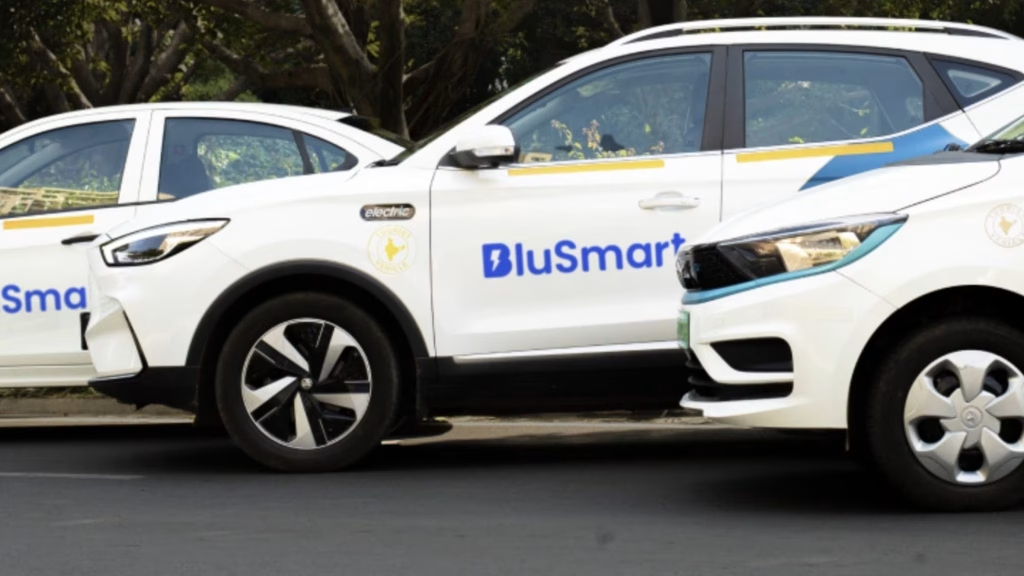
When the Wheels Stop: BluSmart’s Collapse and What It Means for India’s EV Ambitions
BluSmart’s 2025 shutdown has rocked India’s EV sector, leaving drivers jobless and vehicles unsold. What does this mean for sustainable mobility?
Read More →AI technology will continue to sharpen its predictive algorithms and natural-language capabilities. Future bots may detect emotional cues and suggest real-time empathy prompts to reps. The competitive edge will belong to firms that treat AI as a teammate, not a replacement.