No products in the cart.

AI Uncovers Secrets of Scientists’ Lab Skills
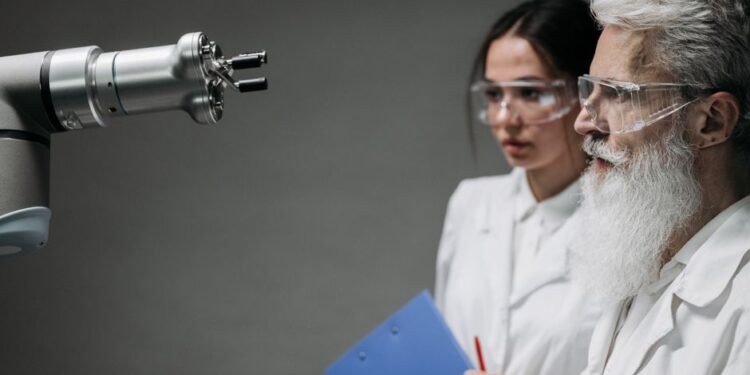
This innovation is particularly timely as the scientific community grapples with challenges related to reproducibility. Many experiments in various fields have faced scrutiny due to inconsistent results. By utilizing AI to dissect the successful techniques employed by top researchers, laboratories can develop a more standardized approach to experimentation.

AI is now learning from successful scientists in laboratories. This development, reported on August 27, 2026, shows how AI can analyze the actions and methods of researchers. It aims to identify what leads to successful experimental outcomes. Such advancements could greatly improve training for lab professionals and enhance the reproducibility of scientific research.
This innovation comes at a crucial time. The scientific community faces challenges related to reproducibility. Many experiments in various fields have inconsistent results. By using AI to analyze successful techniques of top researchers, labs can create a more standardized approach to experimentation.
AI’s Role in Analyzing Experimental Techniques
Integrating AI into laboratory research represents a major shift. AI systems can observe and learn from the subtle techniques that experienced scientists use. For example, AI models are being trained to analyze video footage of experiments, capturing details that even seasoned scientists might miss. This ability is vital, as small variations in technique can lead to different outcomes in experiments.
According to Career Ahead’s analysis, AI can process large amounts of data. This allows it to find patterns in successful experimental outcomes. Such capabilities can lead to predictive models that help researchers replicate successful experiments more accurately. The potential for AI to streamline research is huge, as it can reduce trial and error, saving time and resources. The New York Times highlights that AI is learning to recognize the ‘magic hands’ of experienced researchers, which are essential for consistent lab results.
AI can also help optimize experimental conditions. By analyzing past experiments, AI can suggest the best combinations of variables for success. This not only makes research more efficient but also allows scientists to focus on innovation instead of repetitive tasks. Researchers are already seeing improvements in the reliability of their results thanks to AI.
As AI continues to evolve, its role in labs will likely grow. Researchers may collaborate more closely with AI systems, leading to a new era of hybrid research. In this partnership, human intuition and AI analysis will work together. This could redefine scientific discovery and push the limits of what is possible. Integrating AI into research methods is not just an enhancement; it marks a fundamental shift in scientific inquiry.
By analyzing past experiments, AI can suggest the best combinations of variables for success.
However, AI’s integration into laboratory research has challenges. Ethical issues regarding data privacy and potential biases in AI algorithms must be addressed. Yet, the benefits of using AI to improve scientific understanding and experimental techniques are compelling. Experts note that AI could revolutionize scientific practices, but it needs careful implementation and oversight to ensure responsible use.
Impact on Training for Laboratory Researchers
The implications of AI learning from successful lab techniques go beyond immediate research outcomes. As AI systems become essential to research, the training of laboratory researchers must adapt. Career Ahead research shows that educational institutions need to include AI literacy in their curricula. This shift is crucial as the demand for professionals who can effectively use AI tools in research grows.
Training programs can use AI tools to give students hands-on experience in analyzing experimental data. This approach enhances their understanding of scientific methods and equips them with valuable skills for the job market. By merging traditional lab training with AI technologies, educational institutions can create a new generation of scientists skilled in both experimental and computational challenges. A report by Go2tutors highlights that incorporating AI into education can lead to more engaging and effective learning experiences.
Moreover, AI can provide personalized learning experiences for researchers. By assessing individual performance and learning styles, AI systems can tailor training programs to meet specific needs. This customization can lead to more effective skill development, ensuring researchers are well-prepared for modern scientific inquiry. As AI plays a larger role in labs, researchers will need to continuously adapt their skills. Working alongside AI systems will become increasingly important, making it essential for scientists to stay updated on technological advancements.
This customization can lead to more effective skill development, ensuring researchers are well-prepared for modern scientific inquiry.
The potential for AI to transform training methodologies is significant. Institutions that embrace this shift will likely lead in scientific education, attracting top talent and fostering innovation. Consequently, the landscape of laboratory research could change dramatically, with AI as a cornerstone of training and development. The educational paradigm is shifting, and those who adapt will be better positioned to lead the future of scientific discovery.
As researchers explore AI’s capabilities, new methodologies and techniques may emerge. This could lead to a better understanding of the scientific process. The collaboration between human researchers and AI systems may result in breakthroughs once thought unattainable, reshaping the future of scientific inquiry.
The issue of reproducibility in scientific research has gained significant attention recently. Many studies have failed to replicate, raising questions about the reliability of findings. AI’s ability to analyze and learn from successful techniques offers a promising solution.
By identifying key factors that lead to success, AI can help establish best practices for researchers. For instance, AI can highlight specific procedural steps or environmental conditions that consistently yield positive results. This knowledge is invaluable for guiding researchers in designing their experiments. Career Ahead analysis finds that implementing AI-driven methods could significantly improve the reproducibility of scientific research. As labs adopt these techniques, the scientific community may see a shift toward more reliable findings, enhancing public trust in research.
Furthermore, integrating AI into the research process can improve documentation and reporting of methods. AI systems can ensure that all relevant details are captured, reducing the chances of overlooking important information. This thoroughness can further enhance reproducibility. As researchers increasingly rely on AI to guide their methods, the potential for innovation in scientific discovery expands. The collaboration between human researchers and AI systems could lead to breakthroughs that were once thought unattainable, reshaping the future of scientific inquiry.
Career Ahead’s analysis shows that AI models identify specific procedural steps and environmental conditions that lead to successful outcomes.
Frequently Asked Questions
What techniques are AI models identifying as successful in lab research?
Career Ahead’s analysis shows that AI models identify specific procedural steps and environmental conditions that lead to successful outcomes. By analyzing data from past experiments, AI can find patterns that improve reproducibility.
How can laboratory researchers leverage AI to improve their methods?
Laboratory researchers can use AI by integrating it into their experimental design and analysis. AI can provide insights into optimizing conditions and improving efficiency, leading to more reliable results.

What should laboratory research scientists do about AI advancements in their field?
Laboratory research scientists should stay informed about AI advancements and consider using AI tools in their research. Embracing these technologies can enhance their methods and contribute to the evolving landscape of scientific inquiry.
Related Articles
- The Impact of OpenAI’s Jalapeño Chip on AI Workflows
Written by Career Ahead AI. AI can make mistakes, so verify key facts. Report errors to support@careeraheadonline.com.