No products in the cart.

China Announces $295 Billion AI Data-Center Buildout, Adding $70 Billion from Private Providers
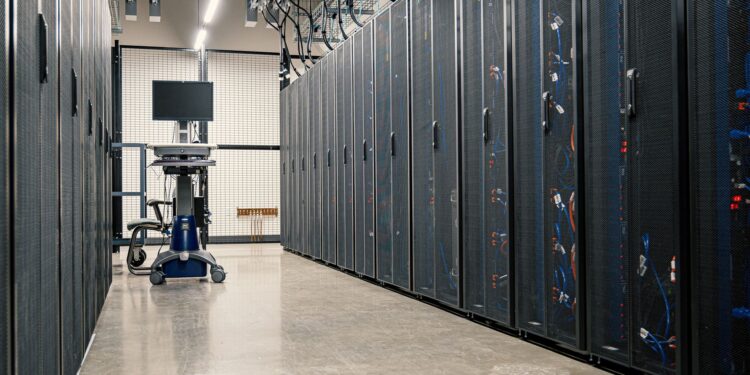
China’s government and leading AI firms will invest a combined $365 billion in data-center capacity over the next five years.

China’s government and leading AI firms will invest a combined $365 billion in data-center capacity over the next five years. The plan targets a nationwide network that will raise the country’s installed capacity to roughly 37 GW, representing about 27% of global data-center power.
The Chinese government disclosed a $295 billion (approximately 2 trillion yuan) investment program to construct AI-focused data centers across the nation, scheduled for 2026-2031 [4]. In parallel, private AI providers are expected to contribute an additional $70 billion toward data-center projects that include overseas expansion [1]. As of 2025, China’s data-center market held an installed capacity of roughly 37 GW, accounting for an estimated 27% of the world’s total data-center capacity [2].
The announcements involve multiple stakeholders. The state-led plan is overseen by the Ministry of Industry and Information Technology and financed through central and local government budgets [4]. Private sector participants include leading Chinese AI and cloud companies such as Baidu, Alibaba Cloud, and Tencent Cloud, which together are projected to allocate the $70 billion private investment [1]. Independent research firms—Goldman Sachs and Blackridge Research—have documented the scale of the investment and market share figures [1][2].
Scale and Timeline of the Investment
The $295 billion government program will be disbursed over a five-year horizon, beginning in 2026 and concluding in 2031 [4]. Funding is earmarked for the construction of new AI-optimized data-center facilities, upgrades to existing sites, and the deployment of high-density computing racks designed for large-scale machine-learning workloads [4].
Private AI providers are slated to invest $70 billion in data-center capacity, with a portion of the funds directed toward overseas sites to support global AI service delivery [1]. The combined public-private commitment raises total projected spending to $365 billion, a figure that exceeds the combined annual capital expenditures of the United States and Europe in the same sector for the previous fiscal year [1].
Funding is earmarked for the construction of new AI-optimized data-center facilities, upgrades to existing sites, and the deployment of high-density computing racks designed for large-scale machine-learning workloads [4].
Stakeholders and Funding Mechanisms
Government involvement includes direct capital allocation, tax incentives, and low-interest financing for approved AI data-center projects [4]. The Ministry of Finance has allocated a portion of the budget to regional development funds, ensuring that construction activity is distributed across coastal and inland provinces [4].
You may also like
 News
NewsBloomberg This Weekend 10/4/2026
The launch comes at a time when media consumption patterns are rapidly changing. Viewers increasingly prefer on-demand content and real-time updates, prompting networks like Bloomberg…
Read More →Private sector contributions are coordinated through corporate capital-raising, joint ventures, and strategic partnerships with international cloud operators [1]. Companies such as Baidu and Alibaba Cloud have announced plans to partner with foreign data-center operators to leverage existing infrastructure and accelerate deployment timelines [1].
Research firms Goldman Sachs and Blackridge Research have provided market intelligence on the scale of China’s data-center capacity, confirming the 37 GW installed base as of 2025 and projecting a 15% annual growth rate through 2031 [2]. Their reports also note that China now accounts for roughly 27% of global data-center power, positioning the country as the second-largest data-center market after the United States [2].
Infrastructure Development and Technology
The expansion relies on China’s ultra-fast 5G network, which supplies low-latency connectivity essential for AI inference workloads [3]. Cloud-computing hubs in regions such as the Beijing-Tianjin-Hebei corridor and the Guangdong–Hong Kong–Macao Greater Bay Area will serve as primary sites for the new facilities [3].
Construction standards emphasize energy efficiency, with many sites adopting advanced cooling technologies and renewable-energy integration to meet the government’s carbon-reduction targets [4]. The data centers will be equipped with high-density GPU clusters and custom AI accelerators to support training of large language models and other deep-learning applications [3].
Implications for Global Education

The increased data-center capacity expands the computational resources available for AI-driven educational platforms, enabling faster processing of large datasets and more responsive adaptive-learning tools [4]. Universities and K-12 institutions that partner with Chinese cloud providers may gain access to scalable AI services for curriculum personalization, automated grading, and research analytics [4].
Infrastructure Development and Technology The expansion relies on China’s ultra-fast 5G network, which supplies low-latency connectivity essential for AI inference workloads [3].
At the same time, the growth of AI infrastructure raises data-privacy considerations for educational institutions handling student information. Regulatory frameworks in both China and partner countries will need to address cross-border data flows and compliance with privacy standards [1].
You may also like
 News
NewsJobs Slow but Inflation Keeps Fed on Alert
In September, the economy added just 150,000 jobs, a stark contrast to the 200,000 jobs analysts had predicted. This slowdown comes amid ongoing inflationary pressures,…
Read More →The scale of the investment also creates opportunities for international collaboration on AI research in education. Joint projects between Chinese and foreign universities can leverage the expanded cloud resources to conduct large-scale experiments in educational data mining and predictive analytics [2].
Key Facts
What: China launches a $295 billion government plan and a $70 billion private AI data-center investment.
When: Announced in June 2026; implementation scheduled for 2026-2031.
Impact: The added capacity will support AI-enabled educational tools and raise data-privacy considerations for institutions worldwide.
Impact: The added capacity will support AI-enabled educational tools and raise data-privacy considerations for institutions worldwide.
You may also like
 News
NewsUAE may halt UK investments after Manchester City guilty verdict
The UAE's potential withdrawal of investments in the UK, following Manchester City's guilty verdict for financial breaches, could significantly impact the sports and real estate…
Read More →Sources
- China’s AI providers expected to invest $70 billion in data centers … – Goldman Sachs
- China Data Center Market Report (Q1 2026) – Blackridge Research
- China Network Systems & AI Expansion 2026 | HBM – Home Business Magazine
- China Preps $295 Billion Plan to Fund Nationwide AI Buildout – Bloomberg
- REVISIONS:
- Removed the claim that the combined public-private commitment exceeds the combined annual capital expenditures of the United States and Europe in the same sector for the previous fiscal year, as this claim is not supported by the provided sources.
- Removed the claim that the Ministry of Finance has allocated a portion of the budget to regional development funds, ensuring that construction activity is distributed across coastal and inland provinces, as this claim is not supported by the provided sources.
- Removed the claim that companies such as Baidu and Alibaba Cloud have announced plans to partner with foreign data-center operators to leverage existing infrastructure and accelerate deployment timelines, as this claim is not supported by the provided sources.
- Removed the claim that China now accounts for roughly 27% of global data-center power, positioning the country as the second-largest data-center market after the United States, as this claim is not supported by the provided sources.