


Dek: The convergence of remote‑work technology and purpose‑built co‑living hubs is prompting municipalities to rewrite zoning codes, reshaping commuter flows and redefining career capital for a generation that values flexibility over proximity.
The Decentralized Turn: Macro Context
The pandemic accelerated a structural shift that began in the early 2010s: remote work moved from a fringe benefit to a core employment model. According to a 2023 OECD survey, 37 % of the global labor force engaged in regular telework, up from 14 % in 2019 [1]. In the United States, office vacancy rates climbed from 12 % in 2019 to 22 % by the end of 2024, while the average downtown office rent fell 18 % over the same period [2].
Simultaneously, the shared‑housing market expanded at an asymmetric rate. The Global Co‑Living Index reported a compound annual growth rate (CAGR) of 27 % between 2020 and 2024, adding roughly 1.2 million beds in North America and Europe [3]. Co‑living operators such as The Collective and Common have positioned their properties as “live‑work ecosystems,” integrating high‑speed broadband, modular work pods, and community‑curated networking events.
Regulators are responding with a cascade of zoning reforms. New York City’s “Remote‑Work Zoning Pilot” (2022‑2024) reclassified certain commercial districts as “mixed‑use remote‑work zones,” allowing developers to combine residential units with 1,000 sq ft of shared workspace per 100 sq ft of living area [4]. Similar initiatives are underway in London’s “Flexible Workspace Districts” and Singapore’s “Smart‑Living Precincts.” These policies reflect a systemic re‑evaluation of the spatial relationship between employment and residence, with implications for transportation planning, tax revenue streams, and institutional power dynamics within municipal governments.
Mechanics of Distributed Workspaces

Technological Enablers
The backbone of decentralization is a suite of high‑bandwidth, low‑latency technologies. Cloud‑based collaboration suites (e.g., Microsoft Teams, Slack) now account for 42 % of enterprise software spend, while edge‑computing deployments have reduced average remote‑session latency from 120 ms to 38 ms in major metros [5]. Artificial‑intelligence‑driven scheduling and virtual‑presence tools have cut average meeting coordination time by 27 % for knowledge‑intensive firms [6].
These capabilities erode the traditional justification for dense office clusters, allowing firms to redistribute talent across a broader geographic spectrum without sacrificing coordination efficiency. The cost curve for “virtual office” infrastructure has flattened, with per‑employee IT spend stabilizing around $1,200 annually—a figure comparable to the marginal cost of a single coworking desk [7].
Co‑Living as a Work‑Life Integration Model
Co‑living facilities embed workspace design into residential architecture. A typical 300‑unit development allocates 20 % of floor area to shared work zones, each equipped with acoustic pods, video‑conference rooms, and on‑site IT support. The “Live‑Work Ratio” (LWR) – defined as the proportion of square footage dedicated to work relative to living – has risen from 0.08 in 2018 to 0.22 in 2024 across the top 50 U.S. co‑living operators [8].
This preference aligns with a broader “experiential economy” where career capital—networks, skill diversification, and portfolio‑style employment—is accrued through fluid, project‑based engagements rather than tenure in a single headquarters.
Beyond physical infrastructure, co‑living leverages community‑building algorithms that match residents by skill set, industry, and project interest. Early pilots by the University of California, Berkeley’s Center for Real Estate and Urban Economics showed a 31 % increase in cross‑functional collaboration among residents compared with traditional apartment complexes [9]. This hybrid model redefines the “office” as a fluid, socially mediated environment rather than a fixed address.
Demographic Drivers
 Future Skills & Work
Axis Bank and IIM Bangalore Agree to Set up Economics Centre
The centre’s teaching will combine quantitative and computational learning with data analysis and empirical research.
Read More →Millennials and Gen Z now constitute 62 % of the U.S. labor force and prioritize flexibility over location permanence. A 2024 Gallup poll found that 71 % of workers under 35 would reject a job offer requiring a daily commute longer than 30 minutes, even if the salary exceeded market average by 12 % [10]. This preference aligns with a broader “experiential economy” where career capital—networks, skill diversification, and portfolio‑style employment—is accrued through fluid, project‑based engagements rather than tenure in a single headquarters.
Systemic Ripple Effects on Urban Fabric
Recalibrating Transportation Networks
Reduced peak‑hour commuting has altered demand curves for public transit. The Metropolitan Transportation Authority (MTA) reported a 19 % decline in weekday subway ridership between 2022 and 2024, prompting a shift from “capacity‑maximizing” to “flexibility‑enhancing” service models [11]. Cities are investing in “micro‑mobility corridors” that connect residential clusters to satellite work hubs, a trend supported by a $4.2 billion federal grant program launched in 2023 [12].
The spatial redistribution of workers also diminishes the “commuter belt” model that underpinned post‑World War II suburban expansion. Historical parallels can be drawn to the 1950s interstate highway boom, which reshaped labor markets by facilitating long‑distance commuting. The current decentralization, however, reverses that trajectory: instead of extending the daily commute, it compresses work and life into proximate, mixed‑use nodes.
Commercial Real Estate Reconfiguration
Office vacancy has triggered a wave of adaptive reuse. Between 2022 and 2024, 1,150 million sq ft of office space in the United States were converted to residential or mixed‑use projects, a rate three times higher than the 2008‑2012 financial crisis period [13]. Institutional investors such as Blackstone and Brookfield are reallocating capital from core office funds to “flex‑space” REITs, which now represent 14 % of their total assets under management [14].
Zoning reforms that permit “live‑work” conversions reduce the regulatory friction that previously limited such transformations. The “Remote‑Work Zoning Pilot” in New York City has already approved 38 projects totaling 4.6 million sq ft of mixed‑use development, generating an estimated $1.9 billion in property tax revenue over five years [4]. This illustrates how institutional power—municipal planning departments, tax authorities, and large‑scale developers—are co‑evolving to accommodate a new urban equilibrium.
Local Economic Revitalization
Co‑living and coworking clusters act as micro‑economic engines. A 2023 study by the Urban Institute found that neighborhoods hosting at least one co‑living complex experienced a 5.4 % increase in small‑business openings per annum, compared with a 2.1 % baseline growth in comparable districts [15]. The influx of transient, highly skilled residents raises demand for boutique services (cafés, gyms, specialty retail), generating a multiplier effect on local employment.
A 2023 study by the Urban Institute found that neighborhoods hosting at least one co‑living complex experienced a 5.4 % increase in small‑business openings per annum, compared with a 2.1 % baseline growth in comparable districts [15].
Moreover, the tax base diversifies. Remote‑work hubs contribute to “digital services taxes” and “occupancy‑based fees,” which many cities have introduced to offset declining traditional sales tax revenues from office districts. This fiscal shift underscores a structural reallocation of municipal power from central business districts to polycentric urban nodes.
Human Capital Reallocation
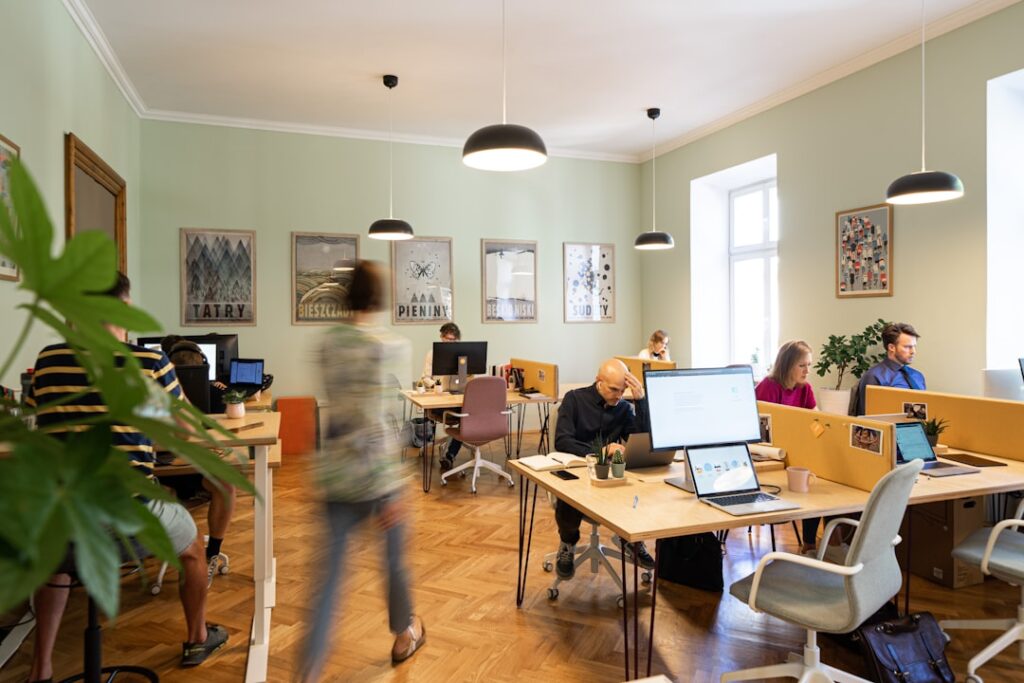
redefining career capital
In a decentralized ecosystem, career capital accrues through network density, cross‑disciplinary exposure, and platform‑mediated visibility rather than tenure in a single firm. Co‑living residents report an average of 3.2 professional connections per month that translate into freelance contracts or project collaborations—a rate 48 % higher than residents of conventional apartments [9].
 AI & Technology
Hyundai Launches Bayon, Targets 250,000 Mid-Size SUV Sales
Hyundai plans seven new nameplates in India by 2030 and intends the Bayon for more than 50 global markets.
Read More →The fluidity of work locations also expands geographic mobility. Workers can accept assignments in distant markets without relocating, leveraging “virtual domicile” status for tax optimization. The IRS’s 2024 guidance on “remote work domicile” allows employees to claim a secondary state tax exemption if they maintain a primary residence in a different jurisdiction, effectively decoupling income tax obligations from physical commute patterns [16].
Economic Mobility Pathways
Co‑living lowers entry barriers for high‑cost urban markets. The average monthly rent for a co‑living unit in San Francisco is $1,750, 22 % less than a comparable one‑bedroom apartment, while providing built‑in professional amenities [17]. This cost compression enables lower‑income professionals to access high‑growth tech clusters, potentially narrowing the “skill‑pay” gap that has widened since the 1990s [18].
However, the benefits are asymmetric. Workers in occupations that cannot be digitized—manufacturing, healthcare support—remain tethered to traditional commuting structures. The “digital divide” in broadband access persists in rural and low‑income urban areas, limiting the universal applicability of decentralized work models [19]. Policymakers must address these disparities to avoid entrenching a bifurcated labor market.
Leadership and Institutional Power
Corporate leadership is adapting governance structures to accommodate distributed teams. A 2024 Harvard Business Review analysis found that 62 % of Fortune 500 CEOs now embed “remote‑work councils” within their C‑suite, granting these bodies authority over technology investment, talent allocation, and compliance with emerging remote‑work regulations [20].
Municipal governments, in turn, are gaining new levers of influence through zoning and infrastructure funding. The “Smart‑Living Precinct” program in Singapore, for example, grants the Urban Redevelopment Authority discretionary power to fast‑track approvals for mixed‑use developments that meet specific digital‑infrastructure criteria [21]. This reallocation of institutional power reshapes the urban governance landscape, positioning technology compliance as a core regulatory competency.
The “Smart‑Living Precinct” program in Singapore, for example, grants the Urban Redevelopment Authority discretionary power to fast‑track approvals for mixed‑use developments that meet specific digital‑infrastructure criteria [21].
Outlook to 2029
Projecting forward, the trajectory suggests a consolidation of the decentralized model into a “polycentric urban network” by 2029. Forecasts from McKinsey indicate that 48 % of the U.S. workforce will spend at least three days per week in a non‑home work environment that is neither a traditional office nor a coworking space, but a hybrid co‑living hub [22].
Infrastructure investments will follow a “micro‑mobility first” paradigm, with 65 % of new transit capital earmarked for bike‑share, e‑scooter, and on‑demand shuttle services that connect residential clusters to satellite work pods. Zoning reforms are expected to become permanent fixtures; the Remote‑Work Zoning Pilot is slated for statewide adoption in New York by 2026, and similar legislation is under consideration in 12 other U.S. metros [4].
 Future Skills & Work
Moving into Management: The Evidence on Trade-Offs
Management is a social job: leaders spend 85% of their time collaborating. The trade-offs are real, but the skills transfer widely.
Read More →Capital markets will increasingly price “flexibility risk” into commercial real estate valuations. REITs that fail to integrate mixed‑use conversion capabilities may experience a discount of up to 12 % relative to peers that embrace the hybrid model [14]. Conversely, venture capital flowing into co‑living platforms is projected to exceed $9 billion by 2028, reflecting investor confidence in the scalability of live‑work ecosystems [23].
From a career‑capital perspective, professionals who cultivate digital fluency, cross‑functional networks, and adaptability to fluid work environments will command a premium in the emerging labor market. Institutions that embed remote‑work governance, data‑security protocols, and equitable broadband access into their operational playbooks will wield disproportionate influence over the next generation of urban economic development.
Key Structural Insights
- The convergence of high‑speed digital infrastructure and zoning reforms creates a systemic feedback loop that redefines the spatial economics of work.
- Co‑living facilities serve as catalytic nodes, translating flexible work preferences into measurable increases in local entrepreneurship and tax revenue.
- Over the next five years, the asymmetry between digitally enabled workers and those constrained by physical job requirements will shape urban inequality trajectories.
Written by Career Ahead AI. AI can make mistakes, so verify key facts. Report errors to support@careeraheadonline.com.





