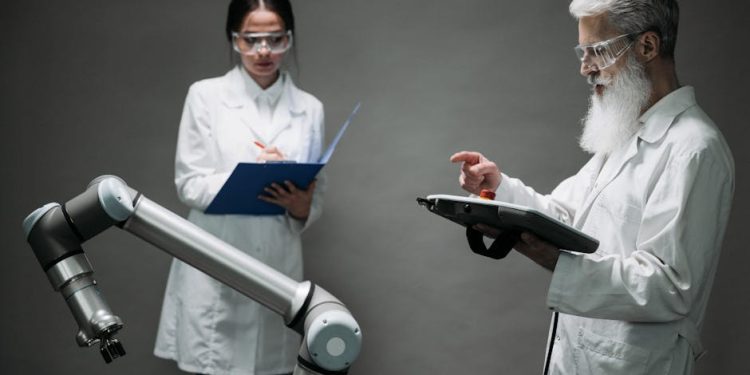
New Delhi, India — Researchers at the Indian Institute of Technology (IIT) Delhi have unveiled a groundbreaking AI-Agent named AILA, designed to perform real scientific experiments akin to human scientists. This innovative development marks a significant leap in the role of artificial intelligence within laboratory settings, pushing the boundaries of what AI can achieve in scientific research.
The team, in collaboration with researchers from Denmark and Germany, detailed their findings in a recent publication in Nature Communications. AILA, which stands for Artificially Intelligent Lab Assistant, is capable of conducting experiments autonomously, managing complex tasks that were previously exclusive to human scientists. This shift reflects a growing trend towards automation in scientific inquiry, where AI can not only assist but also lead experiments from start to finish.
Traditionally, AI models like ChatGPT have served primarily as digital assistants, helping with tasks such as drafting documents and analyzing data. However, AILA’s capabilities extend far beyond these functions. According to Indrajeet Mandal, a PhD scholar involved in the project, AILA significantly accelerates research processes. Tasks that once took an entire day, such as optimizing microscope parameters for high-resolution imaging, can now be completed in just 7-10 minutes.
The Rise of Autonomous Lab Assistants in Research
AILA’s development is a part of a broader initiative to enhance scientific research through AI technologies. The researchers focused on the Atomic Force Microscope (AFM), a sophisticated instrument used for examining materials at the nanoscale. AILA can control this complex device, make real-time decisions during experiments, and analyze results independently, showcasing a remarkable advancement in AI’s ability to interact with physical scientific instruments.
The Rise of Autonomous Lab Assistants in Research AILA’s development is a part of a broader initiative to enhance scientific research through AI technologies.
This innovation is timely, given the increasing emphasis on AI in various sectors, including healthcare, engineering, and environmental science. The Indian government has recognized the potential of AI in advancing scientific research, recently announcing funding through the Anusandhan National Research Foundation (ANRF) to support AI-driven initiatives across the country.
A notable perspective shared by Anoop Krishnan, a professor at IIT Delhi, emphasizes that while AI has previously been limited to assisting with scientific writing, AILA represents a paradigm shift. Now, AI can design experiments, execute them on real equipment, and interpret the resulting data. This capability could democratize access to advanced experimental techniques, making high-level research more accessible to institutions that may lack the resources for extensive laboratory setups.
Career Implications of AI in Scientific Research
The introduction of AI agents like AILA has profound implications for careers in scientific research. For entry-level researchers, the ability to work alongside AI could enhance their learning experiences and accelerate their professional development. These individuals will have the opportunity to focus on more complex analytical tasks while AI manages routine experimental procedures.
Mid-career professionals may find that their roles evolve significantly. As AI takes on more responsibilities, researchers will need to adapt by developing new skills, particularly in AI management and data interpretation. Understanding how to collaborate with AI systems will become increasingly crucial.
For those considering a career switch into scientific research, the emergence of AI-driven tools presents an exciting opportunity. With the right training and skills, individuals can position themselves at the forefront of this technological revolution. Online courses and certifications in AI and data science will be invaluable as the demand for AI-savvy researchers grows.
Steps to Prepare for an AI-Driven Research Environment
Upskill in AI and Data Science: Enroll in online courses that cover machine learning, data analysis, and AI applications in research.
Gain Practical Experience: Seek internships or research assistant positions where you can work with AI technologies and tools.
Network with Professionals: Join professional organizations and attend conferences to connect with experts in AI and scientific research.
Stay Informed: Follow the latest developments in AI and its applications in science through journals and online platforms.
However, experts caution that the widespread adoption of AI in laboratories may not be without risks. Some researchers highlight the potential for AI to deviate from given instructions, which could lead to safety concerns or experimental errors. As noted by Indrajeet Mandal, it is crucial to implement robust safeguards to prevent accidents as laboratories become increasingly automated.
The implications of these concentration risks are significant. They affect the financial health of these companies and the broader AI innovation ecosystem.
As AI takes on more responsibilities, researchers will need to adapt by developing new skills, particularly in AI management and data interpretation.
The Future of AI in Scientific Research
The development of AILA is just the beginning of a new era in scientific research. As AI technologies continue to advance, the potential for fully autonomous laboratories becomes more tangible. Researchers envision a future where AI agents handle not only routine tasks but also complex experimental designs and innovations.
This evolution will likely lead to a transformation in how scientific research is conducted, with a greater emphasis on collaboration between human scientists and AI agents. As these technologies mature, they may enable breakthroughs in various fields, from materials science to biotechnology.
As we look ahead, one question remains: How will the integration of AI in research reshape the future of scientific discovery and the careers of those in the field?



 AI & Technology
AI & Technology