Government and government‑aided schools fell from 1.17 million to 1.08 million between 2019 and 2026, and the share of students in these schools dropped to 49.24 % in 2024‑25.
The Ministry of Education released Unified District Information System for Education Plus (UDISE+) data on 7 July 2026 showing a reduction of 84,000 government schools nationwide over the past seven years [1]. The same period saw the proportion of students enrolled in government schools fall from 71 % in 2005 to 49.24 % in the 2024‑25 academic year [3]. The findings were highlighted in a NITI Aayog report published in May 2026, which described the trend as a “crisis” for the public education system [3].
The decline involves multiple actors: the Ministry of Education, which compiles and publishes UDISE+ statistics; NITI Aayog, which analyzed the data and issued policy recommendations; and the network of government and government‑aided schools that serve the majority of India’s 24.69 crore (246.9 million) school‑age children [2]. The reduction in schools resulted from a combination of school rationalisation policies and demographic shifts that led to closures, while families increasingly opted for private‑school alternatives [1].
Scale of Decline in Government Schools
Across all states and union territories, the total number of government and government‑aided schools decreased from 1.17 million in 2019 to 1.08 million in 2026, representing an 84,000‑school loss [1]. The overall school count, including private institutions, stood at 14.71 lakh (1.471 million) in the latest reporting period [4]. The contraction reflects both policy‑driven rationalisation—intended to consolidate resources—and changing population patterns, such as lower birth rates in certain regions [1].
The UDISE+ dataset released on 7 July 2026 recorded a total student population of 24.69 crore, with government schools accounting for 12.15 crore students (49.24 % share) and private schools for the remaining 12.54 crore (50.76 %) [2][3]. This marks a reversal from the 2005 baseline, when government schools enrolled 71 % of all students [3]. The decline in enrolment is not uniform; some high‑population states reported sharper drops, while others showed modest changes, but the national average indicates a systemic shift [4].
The UDISE+ dataset released on 7 July 2026 recorded a total student population of 24.69 crore, with government schools accounting for 12.15 crore students (49.24 % share) and private schools for the remaining 12.54 crore (50.76 %) [2][3].
Enrollment Shift Toward Private Institutions
India’s Government School System Records Sharp Decline in Schools and Enrolment Over Seven Years
The same UDISE+ release documented a steady increase in private‑school enrolment, rising from 29 % of total students in 2019 to over 50 % in 2024‑25 [2][3]. The trend aligns with earlier observations that families are seeking perceived quality advantages, better infrastructure, and more consistent instructional delivery in private settings [1]. Private schools, both unaided and aided, expanded their footprint, absorbing students displaced by government‑school closures [4].
The launch comes at a time when media consumption patterns are rapidly changing. Viewers increasingly prefer on-demand content and real-time updates, prompting networks like Bloomberg…
The NITI Aayog report noted that the enrollment shift has implications for the National Education Policy (NEP) 2020, which envisions universal access to quality education through the public system [3]. With less than half of school‑age children now in government schools, the policy’s targets for equitable access and resource allocation face heightened challenges [3][4].
Immediate Implications for Stakeholders
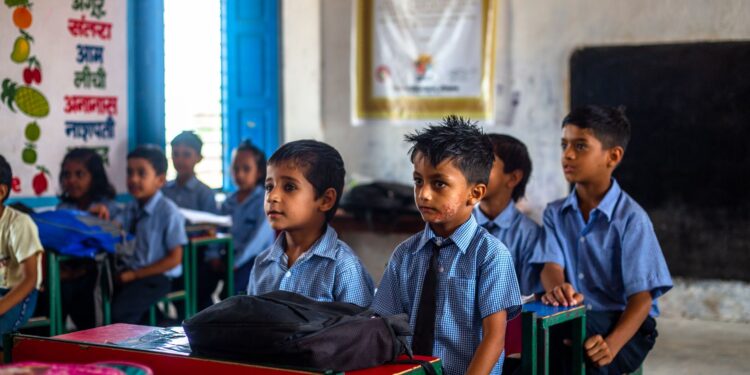
Students currently enrolled in government schools may experience larger class sizes, reduced access to extracurricular facilities, and potential disruptions due to school mergers [1]. Educators in the public sector face redeployment or job insecurity as schools consolidate, prompting concerns about teacher retention and morale [2]. For policymakers, the data underscores an urgent need to reassess funding formulas, infrastructure investment, and quality‑improvement initiatives to align with the evolving enrollment landscape [3][4].
Parents weighing school options must consider the trade‑off between cost and perceived quality, as private‑school fees continue to rise while public‑school resources are strained [1]. Higher education institutions may also feel downstream effects, given that the composition of secondary‑school graduates influences admission pipelines and diversity goals [2].
Key Facts
What: Government and government‑aided schools in India fell by 84 000 and enrolment share dropped to 49.24 % in 2024‑25.
The NITI Aayog report noted that the enrollment shift has implications for the National Education Policy (NEP) 2020, which envisions universal access to quality education through the public system [3].
When: Data released July 7 2026; trend covers 2019‑2026, with enrolment figures for 2024‑25.
Impact: Students, teachers, and policymakers must adjust to reduced public‑school capacity and a growing shift to private education.
In September, the economy added just 150,000 jobs, a stark contrast to the 200,000 jobs analysts had predicted. This slowdown comes amid ongoing inflationary pressures,…
From basic amenities to distance barriers: The growing crises facing govt school education in India – LiveMint
India’s School Education Crisis: What UDISE+ Data Reveals – Frontline (The Hindu)
NITI Aayog 2026 Report on School Education System: Declining Government Enrolment to 49.24% and Serious Implications for NEP 2020 – Education for All in India
NITI Aayog School Education Report 2026: Comprehensive Temporal … – MeriShiksha



 News
NewsNews