Indonesia will embed artificial intelligence in its $15 billion free-meal scheme, targeting 83 million children and pregnant women, with rollout planned from 2026 to 2029.
The Indonesian government will embed artificial intelligence in its $15 billion free-meal scheme, aiming to roll out region-specific nutrition plans for 83 million beneficiaries between 2026 and 2029.A presidential regulation draft awaiting President Prabowo Subianto’s signature outlines the AI integration and projected economic impact.
Jakarta announced that the national free-meal program, valued at approximately US $15 billion, will incorporate artificial-intelligence tools to design meals and monitor delivery across the archipelago. The initiative is scheduled for implementation from 2026 through 2029 and is part of a broader effort to embed AI in key government programs. The draft presidential regulation detailing the plan is currently pending the signature of President Prabowo Subianto.
The plan is led by the Ministry of Social Affairs in coordination with the Ministry of Education, Culture, Research, and Technology, and the Ministry of Health. The AI components will be supplied by domestic tech firms and international partners, with data-analytics platforms intended to tailor nutrition menus to regional dietary habits and to track distribution efficiency in real time.
AI Integration and Operational Design
The AI system will process demographic, geographic, and health data to generate region-specific meal formulas that meet nutritional standards for children and pregnant women. Machine-learning models will predict supply-chain bottlenecks, enabling proactive adjustments to procurement and logistics.
Implementation will follow a phased rollout. In the first year (2026), pilot districts in Java and Sumatra will receive AI-generated menus, while a centralized monitoring dashboard will be tested for real-time reporting of meal distribution metrics. Subsequent years will expand the system to all provinces, with periodic audits to verify data integrity and program outcomes.
The integration of AI is also intended to reduce administrative overhead. By automating beneficiary verification and meal-allocation calculations, the government expects to cut processing time by up to 30% compared with the current manual system.
Implementation will follow a phased rollout.
Legislative Process and Timeline
Indonesia to Deploy AI in $15 Billion Free-Meal Program Targeting 83 Million Children and Pregnant Women
The presidential regulation draft, titled “Regulation on the Integration of Artificial Intelligence in National Social Programs,” was prepared by the Coordinating Ministry for Human Development and Cultural Affairs. The draft was circulated to relevant ministries in April 2026 and submitted to the Presidential Secretariat in early June 2026. It is slated for presidential approval within the next 30 days, after which the law will be published in the State Gazette and become enforceable.
The rollout schedule aligns with the government’s five-year development plan (2026-2030). The free-meal component is earmarked for full operational status by the end of 2029, coinciding with the conclusion of the AI integration phase for other major programs such as health insurance and disaster relief.
Projected Economic and Social Impact
The draft regulation estimates that AI-enhanced efficiency could lift Indonesia’s gross domestic product by 12%—approximately US $366 billion—by 2030, primarily through reduced waste, improved health outcomes, and increased productivity among school-age children.
The launch comes at a time when media consumption patterns are rapidly changing. Viewers increasingly prefer on-demand content and real-time updates, prompting networks like Bloomberg…
Direct beneficiaries include an estimated 83 million school-age children and pregnant women, representing roughly one-third of the nation’s population. By ensuring consistent access to nutritious meals, the program aims to improve school attendance rates and maternal health indicators.
The AI component is also projected to generate demand for data-science expertise, potentially creating up to 15,000 new technical jobs within the public sector and associated contractors over the next five years.
Direct beneficiaries include an estimated 83 million school-age children and pregnant women, representing roughly one-third of the nation’s population.
Impact on Students, Educators, and Institutions
Indonesia to Deploy AI in $15 Billion Free-Meal Program Targeting 83 Million Children and Pregnant Women
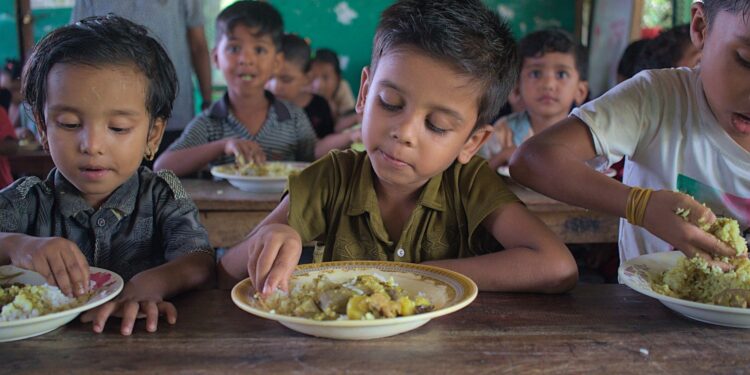
Students in participating schools will receive daily meals calibrated to regional dietary preferences and nutritional requirements, reducing the incidence of undernutrition that has historically affected school performance. Educators will gain access to a digital dashboard that reports meal delivery status, allowing them to coordinate classroom activities around meal times more efficiently.
Higher-education institutions with programs in data science, nutrition, and public policy may see increased collaboration opportunities with government agencies, as the AI system will require ongoing model refinement and impact assessment. Existing school feeding contracts will be renegotiated to incorporate AI-driven procurement guidelines, affecting suppliers and logistics providers nationwide.
For policymakers, the initiative provides a test case for scaling AI across other social services, offering real-world data on cost-benefit outcomes that could inform future legislative decisions.
Key Facts
What: Indonesia will embed AI in its $15 billion free-meal program for 83 million children and pregnant women.
What: Indonesia will embed AI in its $15 billion free-meal program for 83 million children and pregnant women.
In September, the economy added just 150,000 jobs, a stark contrast to the 200,000 jobs analysts had predicted. This slowdown comes amid ongoing inflationary pressures,…



 News
News
News