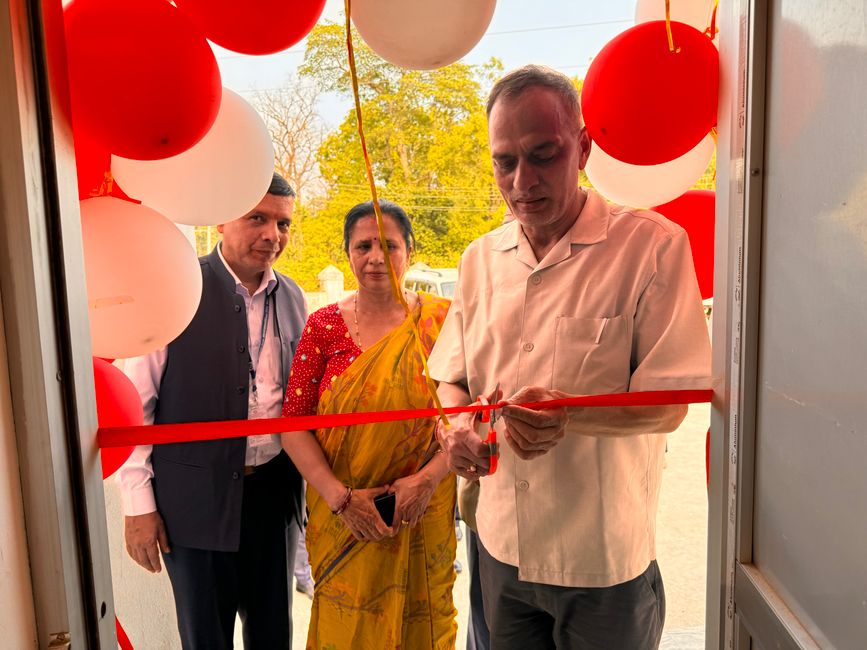
At an ICMAI student convention, M Jagadesh Kumar, former UGC chairperson and chairperson of the Board of Governors of IIM-Calcutta, said universities and colleges must graduate students with portfolios of practical work rather than degrees alone. The instruction sets a test for institutions: graduates should leave with evidence of applied work alongside their qualification.
Kumar links education policy to institutional capacity
Kumar, a Padma awardee educationist who chairs the review committee for the National Education Policy 2020, addressed newly qualified students of the Institute of Cost Accountants of India at a convention themed “Shaping Gen Z for Viksit Bharat.” He said that by the time India reaches 2047, today’s students will be around 40 to 45 years old. His remarks placed the convention’s education discussion against the working lives this generation will have built by then.¹²
Kumar said his experience as a former UGC chairperson and professor at IIT had shown him that policies succeed or fail depending on the capacity of institutions. That makes the institution’s ability to deliver central to the policy question: a stated aim alone does not establish what students can do when they graduate. In Kumar’s formulation, colleges and universities need to equip students with practical work, so a qualification is accompanied by evidence of what they have learned to apply.¹²
Kumar’s point about institutional capacity connects the policy question to the practical-work requirement: institutions need the ability to turn an education aim into work students can take with them.
A practical-work portfolio gives the degree an applied counterpart
A practical-work portfolio is the evidence Kumar wants institutions to put beside a degree. The two serve different purposes in his recommendation: the degree records a course of study, while the portfolio shows work the student has completed. The convention remarks do not prescribe a format or specify which assignments should count. They do make the intended outcome clear: colleges and universities are responsible for ensuring students graduate with practical work collected into a portfolio.¹
 Education & University Insights
How Students Can Choose Scholarships That Fit Their Courses
Students can compare funding by course, eligibility and added support, while checking document rules and avoiding application-fee demands.
Read More →That responsibility rests with the institution, rather than being left as an individual student’s extra step after graduation. Kumar’s point about institutional capacity connects the policy question to the practical-work requirement: institutions need the ability to turn an education aim into work students can take with them. His remarks do not name a particular portfolio model, assessment method or discipline. The emphasis is on the graduation outcome, and on making applied work part of what students leave with.¹²

ICMAI’s convention recognised more than seven hundred students
The Institute of Cost Accountants of India is the largest cost and management accounting body in the world by student and member scale. It has more than six lakh students and one lakh qualified professionals across the globe. That scale formed the setting for Kumar’s remarks to newly qualified students: the convention brought together graduates of a professional qualification within an organisation that spans students and qualified professionals internationally.¹²
More than seven hundred qualifying students were felicitated at the convention, which was organised by the Northern India Regional Council of ICMAI. The event therefore combined recognition of students who had qualified with an address on what institutions should deliver beyond a degree. Kumar’s recommendation focused on graduates’ practical work, while the convention itself marked students’ qualification. Those are distinct outcomes in his remarks: completing a course and leaving with work that demonstrates its application.¹²
Hiring tests and technology curricula are shifting towards applied skills
Kumar Rajagopalan, Vice President of Strategic Initiatives and Country Head India at Dexian, said modern hiring evaluations have shifted towards system design, critical thinking and checking AI outputs. He described the change as a move away from testing whether candidates can write code from scratch and towards whether they can use AI tools to solve real-life problems. The evaluation therefore places weight on how candidates frame and assess a solution, as well as on the use of the tools themselves.¹²
Vidit Jain, SVP and Head of Scaler Schools (Tech & Business), said industry and colleges need to co-own the curriculum. At Polaris School of Technology, coursework moves from basic programming in year one to LLM engineering, AI infrastructure and MLOps by year three. Scaler School of Technology also overhauls its syllabus within weeks in response to live market feedback. Scaler teamed up with industry experts to design and launch a Forward Deployed Engineers specialisation within three months. These examples show curriculum changes at different speeds: a progression across years and syllabus revisions within weeks.²
 Education & University Insights
Sri Lanka High Commission Builds Education and Youth Bridges with India
Twenty Sri Lankan education administrators trained at NIEPA in New Delhi, while young leaders from six South Asian nations met at the Sri Lanka High…
Read More →Kumar’s recommendation focused on graduates’ practical work, while the convention itself marked students’ qualification.
Build applied proof, not just credentials
Hiring now tests system design, critical thinking, and checking AI outputs rather than coding from scratch. That means your visible work matters more than your degree alone. Collect evidence of applied projects, especially ones where you frame and assess solutions with AI tools, because that is what evaluators weigh. If you are choosing a course, prefer one that builds a practical portfolio alongside the qualification, since institutions with capacity deliver that outcome.¹²
Curricula are moving fast: one school progresses from basic programming to LLM engineering and MLOps by year three, while another revises its syllabus within weeks on live market feedback. If you are picking a role, target fields where applied AI skills are taught and tested, and ask about how quickly the program updates. A specialisation designed with industry experts in three months signals that employers value ready-to-deploy engineers over theoretical grounding alone.²
Sources
- indiatimes.com — https://education.economictimes.indiatimes.com/news/higher-education/universities-colleges-must-move-beyond-being-degree-granting-institutions-former-ugc-chairperson/135144732
- livemint.com — https://www.livemint.com/ai/beyond-coding-ai-boom-and-tech-hiring-trends-are-rewriting-traditional-engineering-degree-syllabus-heres-how-11792741192424.html
Written by Career Ahead AI. AI can make mistakes, so verify key facts. Report errors to support@careeraheadonline.com