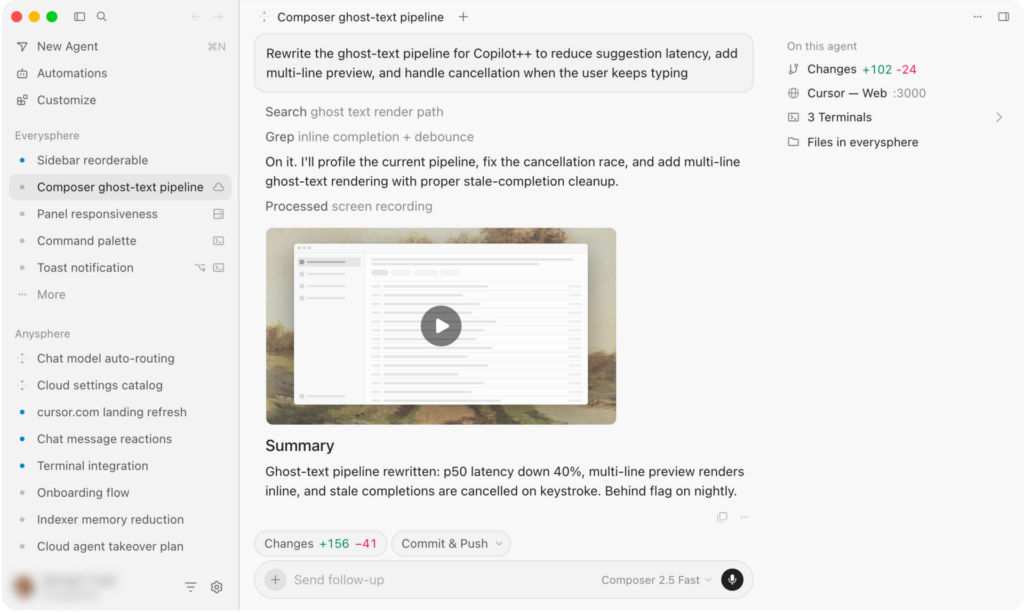
Microsoft CEO Satya Nadella said AI agents should be treated like employees and need identity, security and governance structures.
Nadella calls for rules and oversight around each agent
Nadella said each agent needs an identity, a sandbox and policies to govern it. He also said agents must be fully inspectable and fully auditable. Together, those requirements describe controls around an agent’s activity: an identity marks the agent, a sandbox provides an operating boundary, and policies set rules for its use. The requirement for inspection and audits means organizations need a way to examine and review what their agents do.¹²
Microsoft has built a suite of tools for those controls. Agent 365 includes Entra, Microsoft’s digital identity and network access platform; Defender for security monitoring; and Purview, which classifies and governs data created by AI agents. The tools address distinct parts of agent management: identity and access, security monitoring, and the handling of data. Nadella described them as parts of a suite rather than as a single control.¹²³
Nadella said businesses need to pay attention to how people and their digital estate work together. He connected that interplay to the trajectories that train models firms keep as IP, or leak. He warned that leaking a model is a one-way door. His account links the governance of agents with decisions about the models organizations train and retain: oversight extends beyond an agent’s access to data and includes the handling of the models themselves.¹²
Nadella said businesses need to pay attention to how people and their digital estate work together.
The workplace model puts employees and agents in one loop
 Future Skills & Work
IT Survey Finds AI Governance Gaps Despite Broad Use
Only a minority of employees say governance policies are followed very consistently, while governance, security or compliance slow AI deployment.
Read More →Nadella framed the scale of the change with a hypothetical workplace of twenty thousand employees and two million or twenty million agents, all in a loop. The figures were examples, not a description of a specific company. The scenario shifts the management question from how employees use one tool to how people and large numbers of agents operate together. It also makes oversight a practical issue when many agents are part of the same working environment.¹²³
He described the shift as a move from building operating systems and devices for apps to building for agents. Nadella also called AI the future of the firm and a fundamental change to it. His reasoning was that AI could know what it needs to know about an industry, changing how firms are structured. In this framing, agents are tied to the organization’s operating model, not just added as another technology employees use.¹²
Nadella said he uses one hundred AI coding agents, and that guiding them through a chat interface is an uphill task. He described the cognitive load of managing them as high. His example puts a limit on the simple idea that more agents automatically mean less work for the person directing them: managing and guiding a large group of coding agents can itself require substantial attention.¹²³

Views on AI’s effects on work remain mixed
Nadella pushed back against dismissing AI-generated content as low-quality noise. He framed AI instead as “bicycles for the mind,” describing it as cognitive support that can enhance human potential rather than replace it. The exchange came weeks after Merriam-Webster named “slop” its word of the year. Those competing descriptions capture a live argument about whether AI output should be treated as useful assistance or as a flood of low-quality material.¹²³
Warnings about job displacement sit alongside estimates and labor-market findings that point in different directions. In May, Anthropic CEO Dario Amodei warned AI could displace half of all entry-level white-collar jobs within five years, potentially pushing unemployment to between ten and twenty per cent. MIT’s Project Iceberg estimates AI can presently perform about eleven point seven per cent of paid human labor. Vanguard’s 2026 economic forecast found that roughly one hundred occupations most exposed to AI automation were outperforming the broader labor market in job growth and real wage increases.³
 Future Skills & Work
Decentralized Labor Governance Is Redrawing the Map of Work
Meanwhile, 40% of gig workers now operate outside formal labor codes, embedding themselves in decentralized networks where algorithmic sovereignty.
Read More →Microsoft laid off more than fifteen thousand employees in 2025, while reporting record revenues and profits for its fiscal year ending in June. Across the U.S. tech sector, AI was linked to nearly fifty-five thousand layoffs that year. Amazon, Salesforce and Microsoft were among companies cutting jobs while accelerating AI spending. These figures describe job cuts and AI investment happening at the same time; they do not establish that every layoff was caused by AI.²³
His example puts a limit on the simple idea that more agents automatically mean less work for the person directing them: managing and guiding a large group of coding agents can itself require substantial attention.¹²³
Agent Management Skills Are Now a Job Requirement
Nadella's own experience managing 100 AI coding agents shows that directing agents is a real job skill, not a side task. The cognitive load he describes suggests that roles involving agent oversight will demand new abilities in setting identities, sandboxes, and policies. If you work in operations, security, or compliance, learning to configure and audit agents—using tools like Entra, Defender, and Purview—becomes a concrete differentiator. Build experience in agent governance before employers formalize these roles.¹²³
The workplace shift toward millions of agents alongside employees means pay and role expectations should reflect new management duties. Nadella's framing of agents as employees implies organizations will need people to oversee agent behavior, inspectability, and audit trails. When negotiating, ask for responsibilities tied to agent governance and model protection, since leaking a model is a one-way door. Also, the mixed labor data—AI performing 11.7% of paid work while exposed occupations outperform—suggests building skills in agent control, not fearing displacement.¹²³
Sources
- livemint.com — https://www.livemint.com/technology/tech-news/satya-nadella-says-ai-agents-will-need-identities-security-and-governance-like-employees-11780817915320.html
- windowscentral.com — https://www.windowscentral.com/artificial-intelligence/satya-nadella-ai-agents-deserve-real-identities
- storyboard18.com — https://www.storyboard18.com/digital/ais-2026-identity-crisis-satya-nadella-rejects-slop-label-as-job-fears-collide-with-fresh-data-87029.htm
Written by Career Ahead AI. AI can make mistakes, so verify key facts. Report errors to support@careeraheadonline.com