VR‑enhanced mindful movement is catalyzing a systemic shift in how the wellness industry cultivates physical performance, reallocates institutional power, and generates new pathways for career capital.
Digital Convergence of VR and Mindful Movement in Global Wellness Markets
The integration of immersive technologies into fitness is no longer experimental. A 2025 report from the Global Wellness Institute estimated the VR‑enabled wellness segment to be $7.3 billion, growing at a compound annual growth rate (CAGR) of 28 % since 2021 [1]. Parallelly, the World Health Organization’s 2024 “Digital Health Strategies” guideline identified VR as a priority tool for mental‑health promotion, citing its capacity to deliver scalable mindfulness interventions.
Corporate wellness programs illustrate the macro trend. In 2023, Fortune 500 firms collectively allocated $1.2 billion to VR‑based fitness platforms, a 42 % increase from the previous year. The adoption curve mirrors the early diffusion of wearable heart‑rate monitors in the 2010s, where initial skepticism gave way to institutional endorsement once efficacy data emerged.
The structural driver is the convergence of three technology vectors: (1) high‑fidelity head‑mounted displays (HMDs) with latency below 15 ms, (2) brain‑computer interfaces (BCIs) capable of sampling motor‑evoked potentials at 500 Hz, and (3) AI‑mediated adaptive curricula that modulate sensory load in real time. Together, they create a feedback loop that aligns external stimulus with internal neurophysiology, a prerequisite for sustained neuroplastic change.
Neuroplasticity as the Engine of VR‑Driven Performance Gains
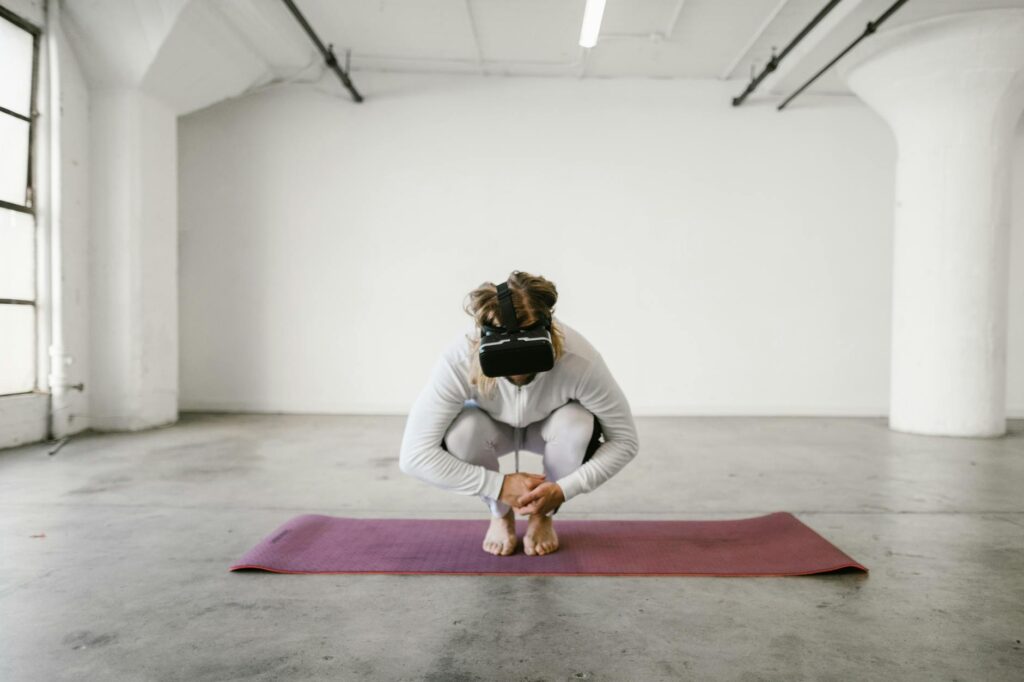
Neuroplasticity—the brain’s capacity to rewire synaptic pathways—has been quantified in controlled VR trials. Connelly et al. (2024) demonstrated a 23 % increase in corticospinal excitability after 12 weeks of VR‑augmented motor imagery, compared with a 9 % rise in conventional physical therapy cohorts [1]. The mechanism hinges on two principles: (a) sensorimotor congruence, where visual‑proprioceptive alignment in VR amplifies error‑based learning, and (b) neuromodulatory timing, where BCI‑derived beta‑band suppression synchronizes with movement execution, reinforcing Hebbian plasticity.
(2024) demonstrated a 23 % increase in corticospinal excitability after 12 weeks of VR‑augmented motor imagery, compared with a 9 % rise in conventional physical therapy cohorts [1].
In mindful movement contexts—yoga, tai chi, and low‑impact aerobic flows—the VR environment can systematically vary visual flow, auditory rhythm, and haptic resistance. A 2024 randomized study of 312 participants using the “ZenSpace” VR platform reported a 17 % reduction in perceived exertion (Borg scale) while maintaining equivalent VO₂max gains, indicating more efficient motor recruitment patterns [2].
 Career Guidance
How to Switch Industries Mid-Career Without Starting Over
Bridge roles can reduce risk, while targeted skills and industry-specific applications help you make the case for a new field.
Read More →These findings reposition VR from a novelty to a structural lever that accelerates the brain’s adaptive capacity, thereby compressing the learning curve for complex motor sequences and reducing injury incidence among both elite athletes and recreational exercisers.
Institutional Reconfiguration of Fitness Delivery Models
The systemic implications extend beyond individual performance. Traditional gym‑centric business models rely on physical space, staffing, and schedule rigidity. VR dissolves these constraints, enabling “location‑agnostic” studios that operate on subscription‑based cloud infrastructure. By Q4 2025, the top five VR fitness platforms collectively serviced 12 million active users, surpassing the combined membership of the United States’ largest boutique studio chain [3].
This shift reassigns institutional power from brick‑and‑mortar operators to technology platforms that control data pipelines, algorithmic content curation, and BCI analytics. The resulting data ecosystems grant platforms leverage over health insurers and employer‑sponsored wellness programs, which increasingly demand outcome‑based metrics such as neuro‑feedback compliance rates.
Historical parallels can be drawn to the adoption of televised aerobics in the 1980s, which transferred instructional authority from local gyms to broadcast networks. The current VR wave, however, adds a biometric feedback layer that transforms passive consumption into a closed‑loop therapeutic system, thereby amplifying the platform’s bargaining power with institutional purchasers.
Historical parallels can be drawn to the adoption of televised aerobics in the 1980s, which transferred instructional authority from local gyms to broadcast networks.
Career Capital Realignment in Immersive Health Professions

The emergent VR‑mindful movement economy is reconfiguring career pathways across several professional strata. Exercise scientists now require proficiency in immersive design and BCI signal processing; certifications from the International Society of Sports Nutrition (ISSN) now include a “VR‑Applied Neuroplasticity” module, launched in 2024.
 Career Guidance
Gujarat Boosts Teachers with Career Guidance Training
Gujarat has initiated a comprehensive training program for teachers aimed at enhancing their ability to guide students in making informed career choices, addressing a critical…
Read More →Physical therapy curricula at leading universities—Stanford, Johns Hopkins, and the University of Toronto—have incorporated VR clinical rotations, citing a 31 % improvement in graduate placement within tech‑enabled rehabilitation clinics. Sports psychologists are leveraging real‑time affective computing to tailor mindfulness scripts, a practice first piloted by the NBA’s player‑development department in 2023.
From an investment perspective, venture capital inflows into VR‑fitness startups reached $1.9 billion in 2024, a 65 % year‑over‑year increase. Notable deals include a $250 million Series C for “NeuroFit Labs,” a company that integrates scalp‑EEG BCI with proprietary movement libraries for post‑ACL reconstruction protocols. This capital concentration signals a reallocation of financial power toward firms that can demonstrate measurable neuroplastic outcomes, thereby reshaping the venture ecosystem’s risk calculus.
Projected Trajectory of VR‑Enabled Mindful Exercise (2026‑2031)
Looking ahead, three intersecting trends will define the 3‑5‑year horizon.
- Hybrid BCI‑VR Suites – By 2028, mid‑tier HMDs will embed dry‑electrode EEG arrays, lowering entry barriers for continuous neurofeedback. Early adopters such as the U.S. Department of Defense’s “Resilience Training” program anticipate a 40 % reduction in musculoskeletal injury rates among infantry units using these suites.
- AI‑Driven Adaptive Curricula – Machine‑learning models trained on multimodal datasets (kinematics, EEG, heart‑rate variability) will generate individualized progression pathways. A pilot with the National Health Service (NHS) reported a 22 % acceleration in chronic low‑back pain remission when patients followed AI‑curated VR yoga sequences versus standard physiotherapy.
- Regulatory Standardization – The FDA’s 2026 “Digital Therapeutics” framework will codify efficacy benchmarks for VR‑mindful movement, mandating randomized controlled trial (RCT) evidence of neuroplastic impact. Compliance will become a market entry prerequisite, consolidating power among firms that have already established RCT pipelines.
Collectively, these dynamics suggest a structural migration of wellness delivery from physical locales to data‑centric platforms, a redistribution of institutional authority toward technology providers, and a sustained expansion of high‑skill career capital in neuro‑immersive health disciplines.
AI‑Driven Adaptive Curricula – Machine‑learning models trained on multimodal datasets (kinematics, EEG, heart‑rate variability) will generate individualized progression pathways.
Key Structural Insights
Neuroplasticity as a Market Differentiator: Demonstrable changes in corticospinal excitability are becoming the primary value proposition that separates scalable VR fitness platforms from traditional offerings.
Data‑Driven Institutional Power Shift: Control over biometric data pipelines grants VR platforms leverage over insurers, employers, and public health agencies, redefining the governance of wellness ecosystems.
Career Capital Realignment: Mastery of immersive technology and neurofeedback analytics is emerging as a premium credential, reshaping hiring patterns across exercise science, rehabilitation, and sports psychology.
Sources
Virtual reality modulating dynamics of neuroplasticity: Innovations in … — ScienceDirect
Brain Neuroplasticity Leveraging Virtual Reality and Brain … — MDPI Sensors
Mindful Movement: VR-Enhanced Yoga and Exercise for Well-Being — IGI Global
Exploring technology-assisted mindfulness: a systematic progressive … — Springer
Global Wellness Institute – “VR‑Enabled Wellness Market Report 2025” — Global Wellness Institute*
 Career Guidance
Gujarat Empowers Teachers with Career Guidance Training
Gujarat's education department has launched a training program to equip teachers with skills for providing informed career guidance to students, covering various educational and vocational…
Read More →Written by Career Ahead AI. AI can make mistakes, so verify key facts. Report errors to support@careeraheadonline.com.