No products in the cart.

When Algorithms Weave: How Emerging Tech Is Re‑engineering Craftsmanship for Sustainable Fashion

Emerging technologies are converting centuries‑old textile knowledge into data‑driven design engines, reshaping supply chains, career pathways, and regulatory frameworks toward a sustainable, heritage‑centric fashion economy.

The fusion of generative AI, blockchain‑verified provenance and low‑impact digital tooling is converting heritage techniques into scalable, carbon‑light value chains, reshaping career capital and institutional power across the global fashion system.
The Heritage‑Tech Convergence Matrix
The last five years have witnessed a measurable pivot from mass‑produced fast fashion toward “heritage‑tech” collaborations. According to the Business of Fashion‑McKinsey sustainability index, the proportion of collections citing artisanal partnerships rose from 5 % in 2020 to 12 % in 2025, while the overall sustainable‑apparel market expanded from $9.8 billion to $13.4 billion—a compound annual growth rate (CAGR) of 6.6 % [2].
Two structural drivers underpin this shift. First, regulatory pressure: the European Union’s Green Deal and the forthcoming “Circular Textiles” directive (expected 2027) mandate lifecycle‑assessment reporting for all garments sold above €150, effectively pricing waste into design decisions [3]. Second, consumer asymmetry: the 2024 Transparency Index shows that 71 % of Gen‑Z shoppers prioritize provenance verification, a metric that digital ledgers can deliver at scale.
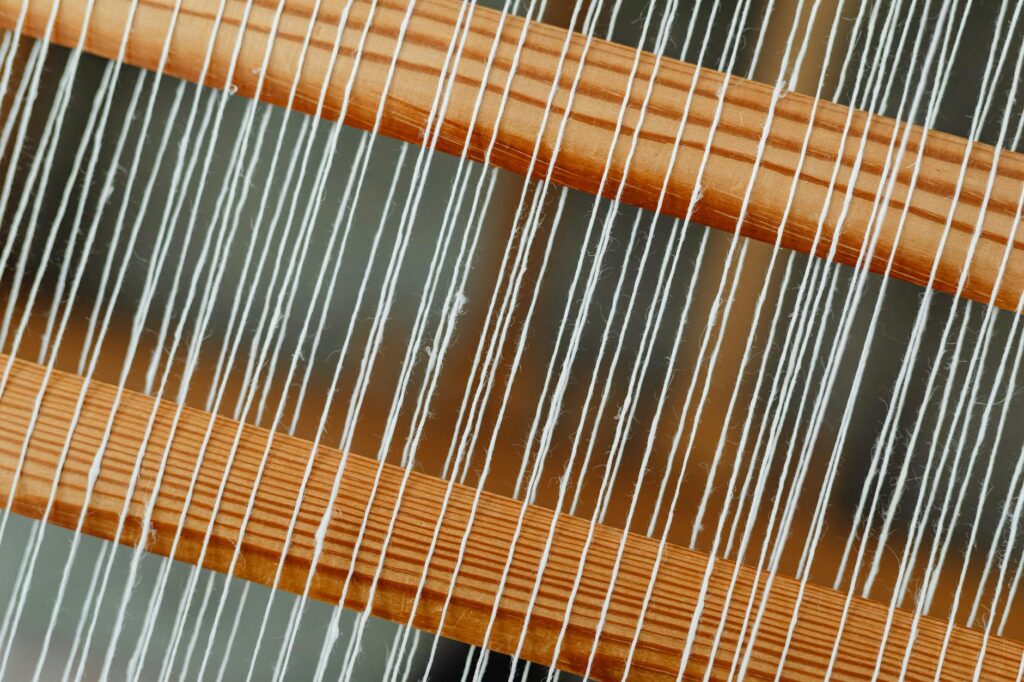
The convergence matrix therefore aligns three vectors: (1) Digital design engines that translate pattern libraries into production‑ready files; (2) Smart material platforms that embed bio‑based fibers with sensor‑enabled traceability; and (3) Localized guild networks that retain manual skill while leveraging data‑driven demand forecasts. This matrix reconfigures the industry’s structural equilibrium, moving power from centralized megafactories to distributed craft clusters.
Algorithmic Embroidery: The Core Mechanism
At the heart of the matrix lies generative AI‑assisted design. Platforms such as ThreadAI (launched 2023) ingest 10 million historic textile motifs—spanning Ottoman brocade to Japanese shibori—and output parametric patterns that can be rendered on digital jacquard looms with 0.2 % material waste, compared with 7 % typical for manual drafting [4].
Algorithmic Embroidery: The Core Mechanism At the heart of the matrix lies generative AI‑assisted design.
A concrete illustration is the 2025 collaboration between London‑based label Bower and the Indian hand‑loom cooperative Kashmir Weave Guild. Bower fed the AI a curated archive of Kashmiri paisley, receiving 1,200 algorithmically varied motifs. The guild then produced limited‑edition scarves using low‑energy laser‑cutting to pre‑shape yarn bundles, cutting labor hours by 38 % while preserving hand‑loom operation [1].
You may also like
 Government & Policy
HDFC Bank’s CEO Choice Reflects Regulatory Shift
Anup Bagchi, a veteran from ICICI Bank, has been appointed as the new managing director and chief executive officer of HDFC Bank, effective October 1,…
Read More →
Beyond pattern generation, AI optimizes yarn blends. Researchers at MIT’s Materials Research Lab demonstrated that a reinforcement‑learning model could predict the tensile performance of hemp‑silk composites within a 5 % error margin, enabling designers to replace polyester with 30 % lower‑carbon alternatives without sacrificing durability [5].
These mechanisms do not merely augment creativity; they institutionalize data‑centric craftsmanship, embedding performance metrics into the cultural knowledge base of artisans. The result is a feedback loop where heritage technique informs algorithmic parameters, and AI‑derived efficiencies expand the economic viability of those very techniques.
Supply‑Chain Reconfiguration and Institutional Realignment
The diffusion of heritage‑tech reshapes the supply chain’s topology. Traditional tier‑1 manufacturers—often located in low‑cost regions—are being bypassed in favor of micro‑cluster hubs that couple a handful of master weavers with a shared digital production platform. The World Trade Organization’s 2025 “Craft‑Cluster Initiative” estimates that such hubs have reduced average lead times from 120 days to 45 days for premium artisanal lines, while cutting carbon emissions per garment by 27 % [3].
Institutional power follows the material flow. Venture capital (VC) allocations to “craft‑tech” startups surged from $210 million in 2022 to $1.2 billion in 2024, reflecting an asymmetric risk‑reward calculus that values provenance as a differentiator [2]. Notable entrants include LoomLedger, which uses blockchain to certify each stitch’s origin, and EcoYarn Labs, whose bio‑fabric patents have attracted a $300 million Series B led by Impact Capital Partners.
Simultaneously, labor institutions are evolving. The International Labour Organization’s 2025 “Artisan Futures” report documents a 14 % rise in formal apprenticeship contracts within heritage clusters, driven by tax incentives for firms that integrate certified digital tools. This institutional shift mitigates the historical precarity of craft work, converting cultural capital into measurable career capital.
This institutional shift mitigates the historical precarity of craft work, converting cultural capital into measurable career capital.
Artisan Capital, Venture Flow, and New Business Models
The structural realignment creates a triad of career pathways: (1) Digital Artisans who blend manual skill with AI‑tool proficiency; (2) Data‑Curators who manage heritage pattern repositories and train generative models; and (3) Platform Operators who orchestrate micro‑cluster logistics. Salary benchmarks illustrate the premium attached to hybrid expertise: the median annual compensation for a “AI‑enabled textile designer” in Europe reached €92,000 in 2025, a 38 % uplift from the €67,000 baseline for traditional designers [4].
You may also like
 Government & Policy
BT accused of ‘bullying’ customers
BT's decision to pause broadband services for some customers has sparked accusations of bullying, raising concerns about the impact on vulnerable populations during the transition…
Read More →Investment vehicles have adapted accordingly. “Impact‑Craft Funds” now allocate 45 % of capital to equity stakes in heritage‑tech platforms, with the remaining 55 % earmarked for growth‑stage manufacturers that meet UN Sustainable Development Goal 12 criteria. This financing model incentivizes product‑as‑a‑service (PaaS) arrangements, where brands lease curated capsule collections to retailers, ensuring circularity and recurring revenue streams.
Case in point: the Swedish brand Nordic Thread launched a “Wear‑Again” subscription in 2024, pairing AI‑designed, locally woven garments with a take‑back program powered by RFID tracking. Within two years, the model generated a 22 % reduction in net material throughput and secured a €75 million Series A led by GreenTech Ventures.
Trajectory to 2030: Institutional and Market Forecast
Projecting forward, three systemic trajectories emerge.
- Scale‑Enabled Heritage Networks – By 2028, the WTO predicts 3,200 certified micro‑clusters operating in 27 countries, collectively accounting for 18 % of premium apparel volume. This diffusion will compress the market share of traditional megafactories from 62 % to 48 %, redistributing bargaining power toward localized guilds.
- Regulatory‑Driven Transparency – The EU Circular Textiles directive will enforce full material traceability by 2027. Blockchain‑based provenance solutions are expected to capture 84 % of high‑end garment transactions, creating a de‑facto standard that could be exported to Asian markets via trade agreements.
- Human‑Capital Re‑skilling Pipelines – Public‑private partnerships, such as the “Digital Craft Academy” launched jointly by the German Ministry for Economic Affairs and the Berlin Institute of Technology, will certify 12,000 hybrid artisans annually by 2029. This pipeline will sustain the talent pool required for AI‑driven design cycles, anchoring the sector’s growth in a skilled workforce rather than speculative automation.
Collectively, these trajectories suggest that the heritage‑tech paradigm will transition from a niche differentiator to a structural backbone of sustainable fashion, aligning economic mobility with cultural preservation and institutional accountability.
This pipeline will sustain the talent pool required for AI‑driven design cycles, anchoring the sector’s growth in a skilled workforce rather than speculative automation.
Key Structural Insights
Algorithmic Heritage Integration: AI‑generated patterns anchored in historic motifs are converting cultural capital into scalable design assets, reducing waste by up to 7 % per collection.
Micro‑Cluster Power Shift: Distributed craft hubs, enabled by digital platforms, are compressing lead times and reallocating supply‑chain control from global megafactories to localized guilds.
- Hybrid Career Capital: The convergence of manual craftsmanship and data science is spawning high‑value career tracks, attracting $1.2 billion in VC funding and redefining talent pipelines for the fashion industry.
Sources
You may also like
 Industry & Global Trends
US Employers Cut Hiring, Wage Growth Stalls
The current labor market reflects a cautious stance from employers, with many opting to freeze hiring and reassess their workforce needs.
Read More →The Revival of Ancient Techniques in a Digital Age: Craft Meets Code — LinkedIn
Emerging Designers and Heritage Craft Reshape 2026 Fashion — MSN
The New Craft Revolution: How Heritage Techniques Are Shaping Tomorrow’s Materials — Fibre2Fashion
Generative AI for Sustainable Fashion Innovation: Revitalizing Traditional Culture — SPIE Digital Library
Craft Revival, Artisanal Techniques Reshape Global Fashion — Indian Apparel