No products in the cart.

AI Fuels Breakthroughs in Scientific Teamwork
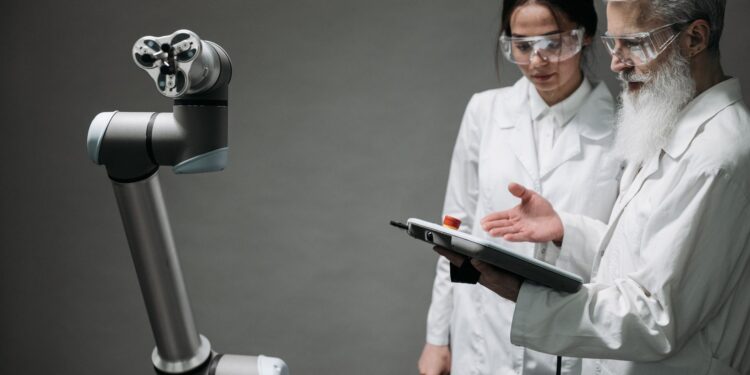
A postdoc’s AI‑co‑authored paper illustrates how machine intelligence is reshaping collaboration, authorship, and career pathways in science.

When Dr. Maya Patel, a postdoctoral fellow in computational chemistry, submitted the first draft of her manuscript, the title page listed three co‑authors and a foot
The Shift from Solo Authorship to AI‑Augmented Collaboration
The scenario above is a microcosm of a broader transformation. Historically, scientific discovery has been celebrated as the triumph of the lone genius or the tight‑knit research group. Today, the integration of large language models, generative design tools, and predictive analytics is redefining what counts as expertise. AI‑assisted research tools now process the vast number of research papers across the natural sciences, extracting patterns that would take a human team years to uncover. The result is a workflow where human intuition guides the question, while AI accelerates the search for answers.
This shift is not merely about speed. It reshapes the economics of authorship. In fields where AI‑oriented Nobel prizes have already been awarded—eight to date—credit is increasingly distributed across human and machine contributors. The presence of an AI model in the author list signals both methodological rigor and a new form of intellectual property. It also lowers the barrier for early‑career researchers to enter high‑impact projects, as the AI handles much of the “technical heavy lifting” that previously required extensive lab resources.
—
It also lowers the barrier for early‑career researchers to enter high‑impact projects, as the AI handles much of the “technical heavy lifting” that previously required extensive lab resources.
Why the Trend Is Structural, Not a Fad
You may also like
 AI & Technology
Beam Unveils Affordable AI Model to Disrupt Competitors
Reflection AI's Beam model, launched on October 5, 2026, is set to disrupt the AI market by offering a cost-efficient alternative to leading Chinese models.…
Read More →The acceleration is underpinned by three interlocking forces.
- Scale of Data and Model Performance Modern pretrained language models achieve a high level of precision on benchmark tasks that involve extracting experimental details from papers. This level of performance makes them reliable partners for drafting methods sections, curating datasets, and even suggesting experimental designs. The performance is not a one‑off spike; it reflects a steady improvement in model architecture, training data, and compute availability.
- Economic Incentives for Institutions Universities and research labs face mounting pressure to publish more frequently and secure larger grants. AI tools reduce the time‑to‑publication curve, allowing institutions to showcase a higher output without proportionally increasing staff. The cost of licensing an AI platform is often dwarfed by the savings in researcher hours, creating a strong financial motive to adopt these systems.
- Cultural Evolution Toward Interdisciplinarity Complex problems—climate modeling, drug discovery, quantum materials—require expertise that spans traditional departmental boundaries. AI serves as a lingua franca, translating jargon, aligning data standards, and suggesting cross‑disciplinary connections. The “Human–AI–Human” cycle, as described by scholars exploring AI integration, emphasizes that humans set the problem, AI processes the data, and humans interpret the outcomes. This cycle normalizes collaborative loops that would have been logistically prohibitive a few years ago.
“What does the future hold for researchers and publishers as AI use continues to increase?” — R Hoch, J Clarke
Our view is that the structural nature of this shift will persist because the incentives align across the entire research ecosystem. When an AI model can reliably draft a methods section, the marginal benefit of human‑only drafting becomes negligible. Moreover, the competitive advantage conferred by rapid, AI‑enhanced discovery creates a feedback loop: institutions that invest in AI attract top talent, which in turn produces more high‑impact work, justifying further AI investment.
—
Edge Cases and Emerging Tensions
While the overall trajectory points toward deeper integration, several edge cases illustrate the limits of the current paradigm.
- Loss of Intuition in Exploratory Science In fields such as theoretical physics, where breakthroughs often arise from unexpected conjectures, over‑reliance on AI‑generated hypotheses may constrain the creative space. An AI trained on existing literature can only extrapolate within known paradigms, potentially sidelining radical ideas that lack precedent.
- Authorship and Accountability The inclusion of AI as a co‑author raises thorny questions about responsibility. If an AI‑generated error leads to a retraction, who is liable? Current guidelines are vague, and institutions are still drafting policies that balance credit with accountability.
- Equity of Access High‑performance AI platforms require substantial compute resources. Researchers at well‑funded institutions can harness these tools, while those at smaller colleges may be left behind, exacerbating existing disparities in scientific influence.
These tensions suggest that a blanket adoption of AI tools is neither feasible nor desirable. Instead, a calibrated approach—where AI augments but does not replace human judgment—will be essential for maintaining the integrity of scientific inquiry.
You may also like
 AI & Technology
A.I. Boom Defies High Interest Rates, Challenges Fed
In the last quarter, AI startups attracted over $10 billion in venture capital, a figure that highlights the ongoing investor interest despite economic headwinds.
Read More →Moreover, the competitive advantage conferred by rapid, AI‑enhanced discovery creates a feedback loop: institutions that invest in AI attract top talent, which in turn produces more high‑impact work, justifying further AI investment.
—
The pattern is clear: AI‑assisted research is not a temporary boost but a reconfiguration of how expertise is mobilized. As we navigate this new terrain, the most successful scientists will be those who treat AI as a collaborative partner, preserving the human spark that fuels curiosity while leveraging the computational horsepower that expands what is discoverable.
If you are shaping a research agenda, start by mapping where AI can take over routine analysis and where human insight remains irreplaceable. That balance will define the next generation of scientific breakthroughs.