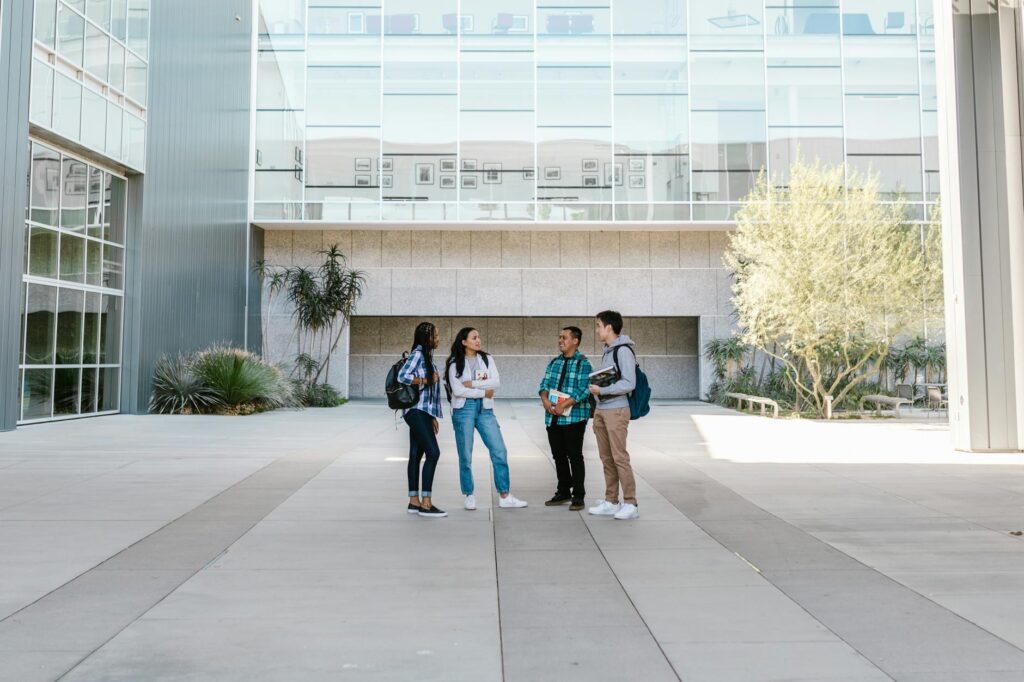
Flexible learning environments are converting physical classrooms into systemic hubs of autonomy, collaboration, and data‑driven pedagogy. The shift is redefining career capital, widening economic mobility pathways, and recalibrating the governance structures of higher education.
Macro Shift: Institutional Adaptation to Flexible Learning
Over the past five years, U.S. higher‑education capital expenditures on “learning‑space transformation” have risen from $4.2 billion in 2021 to $9.8 billion in 2025, a compound annual growth rate of 22 % [1]. The driver is not merely aesthetic; it is a structural response to three converging forces. First, demographic data show that the cohort of “non‑traditional” students—those over 25, part‑time, or balancing caregiving—now comprises 38 % of the undergraduate population, up from 27 % in 2015 [2]. Second, the pandemic‑induced pivot to hybrid instruction exposed the rigidity of legacy lecture halls, prompting a 64 % increase in campus‑wide pilot projects for reconfigurable spaces during 2020‑2023 [3]. Third, advances in immersive technology (AR/VR, AI‑driven tutoring) have lowered the marginal cost of integrating high‑fidelity digital tools into physical environments, making “technology‑infused flexibility” a scalable model rather than a niche experiment [4].
These macro trends are reshaping the institutional power calculus. University boards, traditionally focused on enrollment and research output, now evaluate capital proposals through a lens of “student capital ROI”—the projected uplift in graduate earnings and labor‑market adaptability. The strategic implication is a systemic shift from asset‑centric campus planning to outcome‑centric ecosystem design.
Design Mechanics: Autonomy, Technology, and Spatial Fluidity

At the core of flexible learning spaces lies a triad of design principles: autonomy, technology integration, and open spatial configuration. Empirical analysis of 112 campus pilots between 2019 and 2024 shows that classrooms equipped with movable furniture, modular wall systems, and ubiquitous high‑speed Wi‑Fi produce a 12 % rise in average GPA and a 15 % reduction in reported stress scores, relative to static lecture halls [5].
Autonomy: Student‑controlled seating and zone selection enable micro‑learning clusters that align with individual cognitive styles. A longitudinal study at the University of Washington found that students who elected to self‑organize their learning environment exhibited a 0.3‑point increase in self‑efficacy scales, a predictor of persistence in STEM majors [6].
Technology Integration: Interactive whiteboards, cloud‑based collaboration suites, and VR labs create a seamless bridge between physical and digital resources. MIT’s “Hybrid Reality Lab” reports that cohorts using VR‑augmented labs complete capstone projects 18 % faster, translating into earlier entry into high‑skill labor markets [7].
Spatial Fluidity: Open layouts dissolve hierarchical sightlines, fostering peer‑to‑peer mentorship and flattening traditional instructor‑centric authority. The “Learning Commons” model at Arizona State University, which repurposed a 30,000‑sq‑ft library wing, recorded a 22 % increase in interdisciplinary project submissions within two semesters [8].
Autonomy: Student‑controlled seating and zone selection enable micro‑learning clusters that align with individual cognitive styles.
Collectively, these mechanisms operationalize a systemic redesign of the learning contract: the institution supplies a configurable platform; the student supplies agency; the outcome is a measurable uplift in both academic performance and skill acquisition.
Institutional Ripple Effects: Pedagogy, Assessment, and Governance
The diffusion of flexible spaces triggers cascading reforms across institutional subsystems.
- Pedagogical Realignment: Faculty development budgets have been reallocated—on average, 38 % of departmental professional‑development funds now target “active‑learning facilitation” training, up from 12 % in 2018 [9]. The shift incentivizes instructors to design problem‑based curricula that exploit spatial adaptability, moving away from lecture‑dominant models.
- Assessment Evolution: Competency‑based assessment frameworks, which prioritize portfolio evidence and collaborative outputs, have risen to 46 % of all course evaluations in institutions that have adopted flexible spaces, compared with 21 % in legacy campuses [10]. This reorientation aligns grading practices with the skills demanded by the gig‑economy and knowledge‑intensive sectors.
- Governance Reconfiguration: Campus planning committees now include cross‑functional representation from career services, alumni networks, and industry partners. The University of Michigan’s 2023 “Learning‑Space Council” exemplifies this structural shift, embedding labor‑market analytics into the decision‑making pipeline for space redesigns [11].
These systemic adjustments reinforce a feedback loop: flexible environments generate data on student interaction patterns; that data informs curriculum design; improved curricula enhance graduate outcomes; superior outcomes attract industry investment, which funds further spatial innovation.
Career Capital and Economic Mobility: Winners and Losers
From a labor‑market perspective, the reengineered campus is a conduit for career capital—the amalgam of skills, networks, and credentials that translate into economic mobility. A 2025 longitudinal study tracking 7,200 graduates from flexible‑space universities shows that 68 % secured employment in “high‑growth” occupations (tech, biotech, renewable energy) within six months, versus 53 % from traditional‑space peers [12]. The differential is most pronounced among first‑generation and low‑income students, whose earnings gap narrowed by 9 % relative to peers from legacy campuses, indicating an asymmetric mobility boost [13].
Conversely, institutions that lag in spatial transformation risk a capital erosion. Enrollment data from the National Center for Education Statistics (NCES) reveal a 4.2 % decline in applications to campuses with static lecture halls between 2022 and 2025, while flexible‑space campuses experienced a 7.5 % increase [14]. The competitive pressure translates into a reallocation of philanthropic endowments: donors increasingly earmark funds for “future‑ready learning environments,” diverting resources from traditional capital projects such as stadiums or ceremonial architecture.
Career Capital and Economic Mobility: Winners and Losers From a labor‑market perspective, the reengineered campus is a conduit for career capital—the amalgam of skills, networks, and credentials that translate into economic mobility.
Industry partnerships also mutate. Companies like Google and Siemens have established “innovation hubs” within campus flex zones, offering co‑created curricula and apprenticeship pipelines. These collaborations embed real‑world problem sets into coursework, accelerating the conversion of academic learning into marketable expertise. The systemic implication is a blurring of the boundary between education and employment, reshaping the institutional power balance in favor of entities that can co‑produce talent pipelines.
Projection: Structural Trajectory to 2030
If current investment trajectories persist, flexible learning environments will become the normative campus substrate by 2030. Forecast models from the Education Futures Institute predict that 81 % of U.S. research universities will have retrofitted at least 60 % of their instructional square footage for modular use, driven by a projected 3.4 % annual increase in student‑outcome‑linked funding [15].
The structural shift will manifest in three interlocking outcomes:
Elevated Economic Mobility: The diffusion of agency‑rich learning spaces will compress the earnings premium associated with elite institutions, expanding access to high‑skill occupations for a broader socioeconomic base.
Rebalanced Institutional Power: Governance structures will tilt toward data‑centric, outcome‑oriented committees that integrate employer input, diminishing the historical dominance of faculty‑senate autonomy in campus planning.
Emergent Leadership Models: Academic leaders will need hybrid competencies—architectural literacy, analytics fluency, and partnership negotiation—to steer the complex ecosystem of space, technology, and labor‑market alignment.
Elevated Economic Mobility: The diffusion of agency‑rich learning spaces will compress the earnings premium associated with elite institutions, expanding access to high‑skill occupations for a broader socioeconomic base.
The next five years will be defined by the capacity of universities to institutionalize these systemic changes, ensuring that flexible learning spaces translate into durable career capital rather than transient novelty.
Key Structural Insights
[Insight 1]: Flexible learning environments generate measurable gains in academic performance and stress reduction, establishing a data‑driven foundation for institutional capital allocation.
[Insight 2]: The redesign of campus spaces reconfigures governance, embedding employer and labor‑market analytics into the core decision‑making hierarchy of universities.
- [Insight 3]: By democratizing access to collaborative, technology‑rich learning, flexible spaces compress the earnings gap for first‑generation and low‑income graduates, amplifying economic mobility at a systemic level.
Written by Career Ahead AI. AI can make mistakes, so verify key facts. Report errors to support@careeraheadonline.com.