No products in the cart.

Government School Enrollment Drops Sharply While Private School Enrollment Rises in India and the United States
Government school enrollment fell by 86 lakh in India and 1.4 million in the U.S. while private schools added 88 lakh students in India, reflecting a shift in family choice and fiscal pressures.

Government school enrollment fell by 86 lakh students in India over two years and by 1.4 million students in the U.S. between 2019 and 2024. Private school enrollment grew by 88 lakh in India and continued to increase in several U.S. states during the same periods.
Enrollment data released for the 2024-25 academic year show a net loss of students from public schools in both countries, accompanied by gains in private-sector institutions. The trend reflects a shift in family choice and fiscal pressures on public systems.
The U.S. figures come from the National Center for Education Statistics, which recorded a decline from 50.8 million to 49.4 million K-12 public-school students between fall 2019 and fall 2024 [2]. In India, the Unified District Information System for Education (UDISE) 2025-26 report documented a net loss of 86 lakh students from government schools over the previous two years, while private unaided recognized schools added 88 lakh enrollments in the same period [1].
Enrollment Shifts in India
India’s UDISE 2025-26 dataset indicates that government school enrollment fell by 86 lakh students across the 2023-24 and 2024-25 academic years [1]. The decline represents a reduction of roughly 5 percent of the total public-school population, bringing the share of students in government schools to 49.24 percent in 2024-25, down from 71 percent in 2005 [3].
Private unaided recognized schools recorded an increase of 88 lakh enrollments over the same two-year span [1]. The net gain in private schools was driven by enrollment growth in both urban and semi-urban districts, according to the UDISE analysis.
NITI Aayog’s May 2026 report highlights that the shrinking public-school share poses challenges for the implementation of the National Education Policy (NEP 2020), which relies on a robust government system to achieve universal access [3]. The report notes that reduced enrollment may affect funding formulas that are tied to student counts.
The net gain in private schools was driven by enrollment growth in both urban and semi-urban districts, according to the UDISE analysis.
Enrollment Declines in the United States

U.S. public-school enrollment dropped from 50.8 million to 49.4 million students between fall 2019 and fall 2024, a loss of 1.4 million pupils, or 2.8 percent, over six years [2]. The decline accelerated after the COVID-19 pandemic, which disrupted school attendance and prompted families to reassess schooling options [2].
You may also like
 News
NewsProtect Your Bank Account from Cyber Fraud
Cyber fraud is on the rise, with many individuals unknowingly becoming part of schemes that use their bank accounts as mule accounts. Understanding the implications…
Read More →State-level data show that Florida, California, and North Carolina experienced notable public-school enrollment reductions during the 2024-25 academic year [4]. In Florida and California, budget pressures led to school closures and staff reductions, while North Carolina reported a rise in private-school enrollment that offset some of the public-sector loss [4].
The National Center for Education Statistics attributes part of the enrollment decline to demographic shifts, including lower birth rates in the early 2010s, but emphasizes that pandemic-related disruptions amplified the trend [2].
Factors Contributing to the Decline
In both countries, the COVID-19 pandemic is identified as a catalyst for enrollment shifts. In the United States, school closures, remote-learning challenges, and parental concerns about health safety contributed to families moving children to private institutions or homeschooling [2].
India’s private-school growth aligns with rising household incomes in certain regions and perceptions of higher educational quality in private settings [1]. The UDISE report notes that families in middle-income brackets increasingly opted for private unaided schools, citing better infrastructure and English-medium instruction as motivators [1].
India’s private-school growth aligns with rising household incomes in certain regions and perceptions of higher educational quality in private settings [1].
Fiscal constraints also played a role. State budget shortfalls in Florida and California resulted in reduced public-school staffing and the consolidation of school districts, prompting some families to seek alternatives [4]. In India, reduced per-pupil funding linked to lower enrollment numbers may limit resources available to government schools, further influencing parental choice [3].
Immediate Impact on Stakeholders
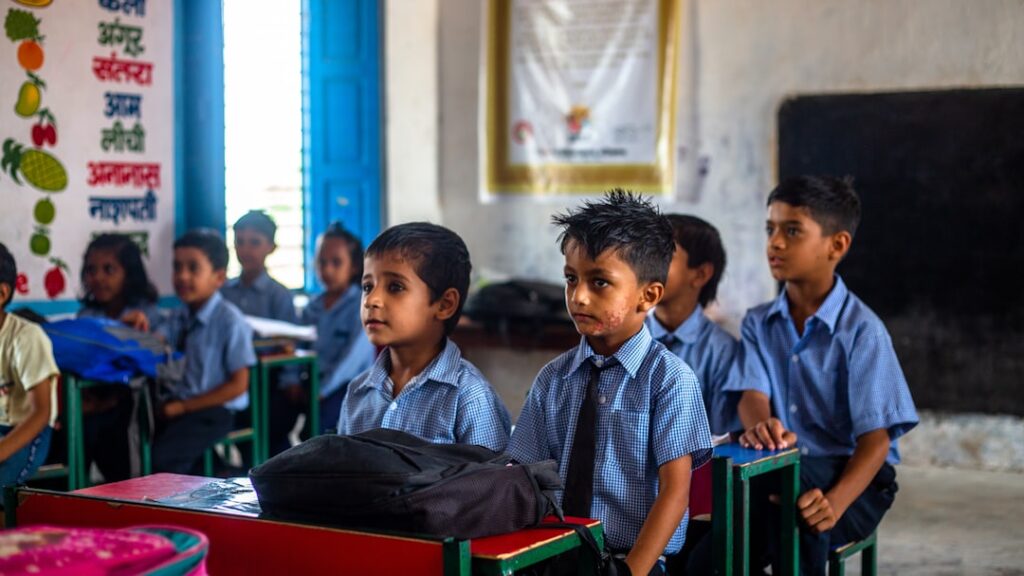
Students in public schools may face larger class sizes or longer travel distances if nearby schools close due to enrollment shortfalls [4]. Teachers and support staff in affected districts risk layoffs or contract reductions, as observed in California’s 2024-25 budget adjustments [4].
You may also like
 News
NewsBloomberg This Weekend 10/4/2026
The launch comes at a time when media consumption patterns are rapidly changing. Viewers increasingly prefer on-demand content and real-time updates, prompting networks like Bloomberg…
Read More →Families opting for private schools encounter higher tuition costs, potentially increasing financial strain for middle-class households [1]. Private-school capacity constraints in high-growth areas could also limit access for families unable to afford fees, raising concerns about educational equity.
Policymakers in India are reviewing the NEP 2020 implementation timeline to accommodate the declining public-school share, with proposals to strengthen funding mechanisms and improve school quality [3]. In the United States, state education departments are monitoring enrollment trends to adjust funding allocations and consider policy interventions aimed at retaining students in the public system [2].
Key Facts
What: Government school enrollment fell sharply while private school enrollment rose in India and the United States.
In the United States, state education departments are monitoring enrollment trends to adjust funding allocations and consider policy interventions aimed at retaining students in the public system [2].
When: Data cover the 2019-2024 period in the U.S. and the 2023-2025 academic years in India.
Impact: Declines may lead to school closures, staff reductions, and increased tuition costs for families choosing private education.
You may also like
 News
NewsJobs Slow but Inflation Keeps Fed on Alert
In September, the economy added just 150,000 jobs, a stark contrast to the 200,000 jobs analysts had predicted. This slowdown comes amid ongoing inflationary pressures,…
Read More →Sources
- Government School Enrollment Drops, Private Schools See Surge: UDISE Report – Career Ahead Online
- K-12 Public School Enrollment Declines, Explained – FutureEd
- NITI Aayog 2026 Report on School Education System: Declining Government Enrolment to 49.24% and Serious Implications for NEP 2020 – Education for All in India
- Government School Enrollment Declines Amid Private School Rise – Career Ahead Online