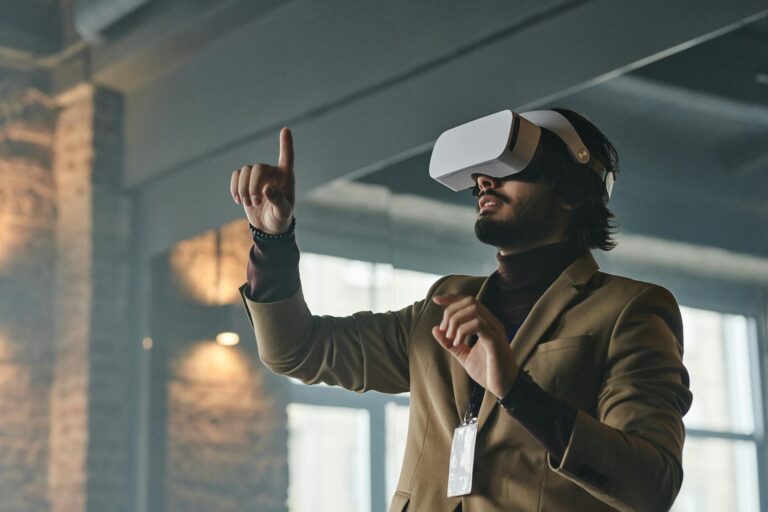
Immersive VR training is converting the $359 billion corporate learning market into a high‑retention, data‑driven talent engine, reshaping leadership pipelines and expanding career capital for a new class of instructional technologists.
Dek: Virtual‑reality (VR) platforms are converting $359 billion of corporate training spend into measurable knowledge retention and scalable skill pipelines. The technology’s systemic diffusion reconfigures institutional learning, leadership development, and economic mobility across the enterprise hierarchy.
Opening – Macro Context
The global corporate training market, projected to reach $359.4 billion by 2026, is being re‑engineered by immersive technologies that promise higher engagement and lower attrition costs [1]. Traditional classroom‑based and e‑learning models have long suffered from low employee engagement (average 38% completion rates) and knowledge decay of up to 70% within three months[2]. Those deficiencies translate into higher turnover, slower productivity gains, and amplified talent gaps—structural constraints on economic mobility within firms.
The COVID‑19 pandemic accelerated the shift to remote learning, but more importantly it exposed the institutional brittleness of legacy training pipelines. A 2023 survey by the World Economic Forum found that 71% of large enterprises plan to increase VR training investment within two years, positioning immersive learning as a strategic lever for leadership succession and workforce resilience [3]. This macro‑level reallocation of capital signals a structural pivot: from cost‑center training functions to talent‑engineered growth engines.
Layer 1 – The Core Mechanism
Immersive Upskilling: How Virtual Reality Reshapes Corporate Training and Career Capital
Immersion as a Cognitive Amplifier
VR creates a sensorimotor loop that aligns with the brain’s episodic memory pathways, delivering retention rates of up to 75% versus 30% for slide‑based instruction[1]. Empirical studies at Siemens Energy demonstrated a 42% reduction in error rates during simulated maintenance drills after a single VR session, underscoring the technology’s capacity to embed procedural knowledge more deeply than text or video [4].
Personalization at Scale
Adaptive learning algorithms integrated into VR platforms generate real‑time performance analytics, allowing curricula to adjust difficulty, pacing, and feedback to individual learner profiles. A 2025 IBM case study reported that personalized VR modules increased engagement scores by 28% among mid‑level managers in a multinational consumer‑goods firm, translating into faster competency acquisition and a measurable lift in promotion rates [2].
Personalization at Scale Adaptive learning algorithms integrated into VR platforms generate real‑time performance analytics, allowing curricula to adjust difficulty, pacing, and feedback to individual learner profiles.
Reflection AI's Beam model, launched on October 5, 2026, is set to disrupt the AI market by offering a cost-efficient alternative to leading Chinese models.…
Industries with high safety stakes—oil & gas, aerospace, heavy manufacturing—have historically relied on physical simulators that are capital‑intensive and geographically constrained. VR reduces the marginal cost of each additional trainee to near zero after hardware deployment. For example, Boeing’s VR‑enabled assembly line training cut onboarding time for new technicians from 12 weeks to 5 weeks, delivering an estimated $12 million annual cost avoidance in labor and rework [5].
Layer 2 – Systemic Ripples
Redesign of Curricula and Institutional Learning Architecture
The adoption of VR compels a recalibration of instructional design from linear content delivery to experiential scenario‑building. Universities partnering with corporate training arms—such as MIT’s Collaboration with General Motors on VR‑based manufacturing labs—illustrate a convergence of academic research and corporate talent pipelines, blurring the traditional boundaries of institutional knowledge creation [6].
Emergence of Dynamic Content Ecosystems
VR’s modular architecture enables rapid iteration of training scenarios in response to market or regulatory shifts. In 2024, a leading pharmaceutical firm leveraged VR to simulate a new drug‑manufacturing process, updating the simulation within two weeks of FDA guidance release—a turnaround impossible with printed SOPs. This agility embeds continuous learning loops into the organization’s operational DNA, reinforcing a culture of adaptive expertise.
Data‑Driven Performance Analytics
When VR integrates with AI and IoT sensors, organizations can capture granular behavioral metrics (gaze fixation, hand movement latency, decision pathways). These data streams feed predictive models that identify skill gaps before they manifest in production metrics. A 2025 pilot at DHL Supply Chain used VR‑combined AI analytics to forecast forklift‑operation errors with 84% accuracy, enabling pre‑emptive remedial training and reducing incident rates by 19% [7].
Workers who acquire VR‑authoring certifications experience average salary premiums of 15% over traditional L&D roles, reflecting a shift in career capital toward high‑tech instructional expertise.
Layer 3 – Career & Capital Impact
Immersive Upskilling: How Virtual Reality Reshapes Corporate Training and Career Capital
New Occupational Vectors
The VR training market’s projected $12.6 billion valuation by 2026 creates a new occupational tier for immersive learning designers, spatial interaction engineers, and data‑science‑enabled pedagogues [1]. Workers who acquire VR‑authoring certifications experience average salary premiums of 15% over traditional L&D roles, reflecting a shift in career capital toward high‑tech instructional expertise.
In the last quarter, AI startups attracted over $10 billion in venture capital, a figure that highlights the ongoing investor interest despite economic headwinds.
IBM’s internal analysis estimates an average ROI of $30 per dollar invested in VR training, driven by reduced error costs, faster time‑to‑productivity, and lower attrition. For employees, the shortened learning curve translates into earlier eligibility for performance‑based bonuses and promotion pathways, effectively compressing the tenure required for upward mobility within hierarchical firms.
Leadership Development and Institutional Power
VR’s capacity to simulate complex, ambiguous scenarios—such as crisis management or cross‑cultural negotiations—offers a sandbox for emerging leaders to practice decision‑making under pressure. A 2024 longitudinal study of Fortune 500 firms showed that executives who completed VR‑based strategic simulations were 22% more likely to be selected for C‑suite succession than peers who relied on conventional case‑study methods [8]. This correlation indicates a redistribution of institutional power toward those who master immersive experiential learning.
Closing – Forward Outlook (2026‑2031)
The trajectory of VR in corporate training hinges on three converging forces:
Hardware Democratization – Advances in standalone headsets (e.g., Meta Quest 4, Apple Vision Pro) are slashing entry costs below $300, enabling mid‑market firms to deploy enterprise‑scale VR without prohibitive CAPEX.
Interoperability Standards – The emergence of the OpenXR Consortium’s training profile will standardize content formats, reducing vendor lock‑in and fostering a competitive marketplace for scenario developers.
Policy Incentives – The U.S. Department of Labor’s 2025 “Future Skills” grant program earmarks $1.2 billion for VR‑based upskilling in high‑unemployment regions, directly linking immersive training to economic mobility pathways for displaced workers.
Collectively, these dynamics forecast a systemic shift where VR becomes the default modality for high‑stakes skill acquisition, reshaping institutional learning ecosystems, redefining leadership pipelines, and expanding career capital across the corporate hierarchy. Firms that embed VR into their talent architecture now will command asymmetric advantages in productivity, talent retention, and strategic agility over the next half‑decade.
Department of Labor’s 2025 “Future Skills” grant program earmarks $1.2 billion for VR‑based upskilling in high‑unemployment regions, directly linking immersive training to economic mobility pathways for displaced workers.
Key Structural Insights
> [Insight 1]: VR’s immersive cognition boosts knowledge retention to 75%, fundamentally altering the efficiency of corporate learning systems.
> [Insight 2]: Integration with AI and IoT creates data‑rich feedback loops that reconfigure talent management from reactive to predictive.
> [Insight 3]: The emergence of VR‑centric occupational roles reallocates career capital, accelerating economic mobility for workers who master immersive design.
Chinese AI firm DeepSeek has successfully narrowed the performance gap with leading US AI models to just 3%, signaling a significant shift in the global…




 AI & Technology
 AI & Technology
AI & Technology