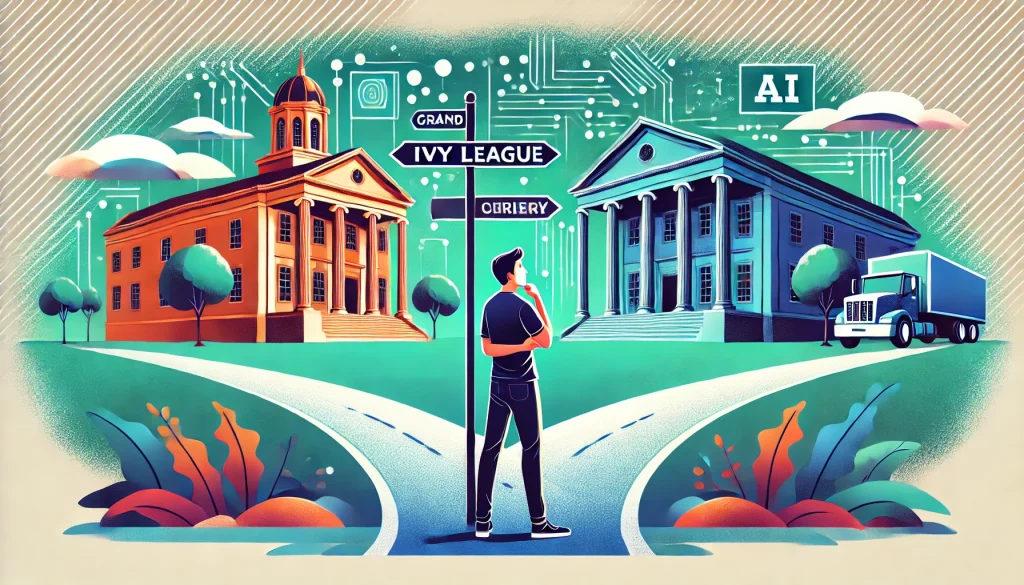
Last spring, Yvette Anguiano walked across the Harvard business School stage, her $225,000 MBA in hand, expecting a seamless leap into a top-tier career. Instead, she’s waiting—her start date at EY-Parthenon pushed to June 2025, her student loans a pressing burden. “You assume Harvard is a golden ticket,” she told the Wall Street Journal, “but the market doesn’t care about your pedigree anymore.” Her story is no outlier. Across America’s elite business schools, a once-unshakable promise is cracking: the Ivy League MBA, long a passport to prosperity, is facing its toughest test yet.
The Numbers Don’t Lie
The statistics paint a stark picture. According to The Wall Street Journal, 23% of Harvard’s 2024 MBA graduates were jobless three months after graduation—up from 20% in 2023 and 10% in 2022. Stanford’s Graduate School of Business hit 22%, Wharton 20%. Even as 2025 unfolds, Bloomberg data suggests only slight improvement—Harvard at 15%, Stanford at 12%, Wharton at 6.9%—still far from the pre-2022 norm of 4% or less.
Beyond the Ivy League, MIT Sloan’s unemployment rose to 15%, Chicago Booth to 13.2%, and Northwestern Kellogg to 10.2%. For a degree synonymous with success, this is a seismic shift.
Why the Decline?
The downturn isn’t just cyclical; it reflects structural changes in hiring. Once-reliable recruiters like Google and Amazon, which previously absorbed over 30% of Harvard MBAs, have slashed hiring—down nearly 30% since 2022, as post-pandemic overexpansion gives way to AI-driven efficiency. Consulting firms like McKinsey and finance powerhouses like Goldman Sachs cut MBA intake by 15-20% since 2023, favoring leaner teams amid economic caution.
For a degree synonymous with success, this is a seismic shift.
Even for those with offers, delays are rampant—10-15% of 2024 hires face start dates deferred by six months or more, the WSJ reports, leaving grads like Anguiano in limbo. Employers now prioritize specialized skills, such as data analytics and AI, over traditional MBA competencies. A Forbes report found that in 2024, 40% of tech hiring managers preferred coding bootcamp grads—cheaper and faster to train—over MBAs.
Compounding the issue, some graduates are holding out for elite roles—think $350,000 private equity gigs—rejecting solid offers from firms like McKinsey. Yet, for those who pivot, opportunities emerge: MBAs entering sectors like renewables or healthcare tech are finding jobs, with Columbia Business School reporting a 90% placement rate by fall 2024.
India’s Unwavering Bet on the Ivy League
Despite a tightening job market, Indian students see a different calculus. Applications to Ivy League MBAs remain strong. The Economic Times reports a sustained interest in Harvard, Stanford, and Wharton, while India Today notes a “growing interest” among Indian applicants in top U.S. business schools.
Why the optimism? India’s youth job market is bleak—44.49% of 20-24-year-olds were unemployed in early 2024, pushing students abroad. The wage gap is striking: the median starting salary for an Ivy League MBA is $175,000, compared to $30,000 for a domestic Indian MBA. With 65% of India’s population under 35, the U.S. remains a beacon, even if the first job isn’t guaranteed.
Reinvention or Reckoning?
Elite schools are scrambling to respond. Harvard is testing AI-driven job-matching tools, while Stanford and Wharton have expanded technical coursework by 25% since 2023. Yet, for most students, the $225,000 price tag feels riskier than ever. Median salaries for employed grads still hit $175,000, but jobless rates rival global youth unemployment (13%, per the international Labour Organisation).
Yet, for those who pivot, opportunities emerge: MBAs entering sectors like renewables or healthcare tech are finding jobs, with Columbia Business School reporting a 90% placement rate by fall 2024.
For Indian applicants and U.S. graduates alike, the message is clear: prestige alone won’t cut it. Skills—data, tech, adaptability—now rule the game. As the class of 2025 applies and the class of 2024 waits, the Ivy League’s golden era is fading, replaced by a harder truth: in 2025, even Harvard can’t promise you a job.