
The world has changed, and so has the leadership environment.
For decades, business planning followed predictable rhythms: annual cycles, growth paths built on extrapolation, change initiatives carefully scoped and managed. Change Management was a curriculum staple, a skill set applied to sporadic, well-defined projects with a clear start and end. That world is gone.
Today’s environment is best described as VUCA – volatile, uncertain, complex, ambiguous – or even BANI: brittle, anxious, non-linear, incomprehensible. Compounding risks across geopolitical, environmental, technological, and economic dimensions create a state of perpetual poly-crisis. And disruptions no longer come one at a time.
Constant Disruption Has Flipped the Traditional Management Script
Research by Nadya Zhexembayeva repeatedly shows that reinvention cycles get shorter and the average company needs to reinvent itself every three years just to survive. There is rarely time to complete one change before the next begins. Yet only 6% of leaders say they feel “very prepared” for the pace of change (IBM Institute for Business Value, 2023).
Change has become perpetual – and the old recipes aren’t working. According to Harvard Business Review, transformation efforts have had an 80% failure rate for decades. Why?
Most change programs focus on fixing processes, structures, and systems while ignoring the human side: behavior, mindset, and culture. A communication plan and a linear project timeline simply cannot carry the weight of real transformation.
The result is widespread employee disengagement and change fatigue – a creeping organizational exhaustion that makes every new initiative harder to launch and harder to land.
The result is widespread employee disengagement and change fatigue – a creeping organizational exhaustion that makes every new initiative harder to launch and harder to land.
The Real Transformation Starts Here
Most transformation efforts focus on changing systems, structures, and processes.
 Future Skills & Work
Quiet Quitting Is Reshaping Corporate Psychology
Quiet quitting costs U.S. employers $300 billion annually—not in lost hours, but in trust and innovation.
Read More →The real challenge is different: changing how leaders think and how people respond to uncertainty.
Technology can accelerate change. Strategy can point the direction. But lasting transformation happens only when leaders build trust, encourage learning, and model the behaviors they expect from others.
Mindset Is the New Competitive Advantage
We’re moving from a performance to a transformation world. The old era rewarded problem-solving, results-driven leaders who delivered efficiency and predictability. The new era calls for something different: Impact Leaders with an adaptable mindset, who inspire people to co-create sustainable transformation.

When knowledge is available at a fingertip and task execution is increasingly outsourced to AI, the differentiating human qualities become paramount: self-leadership, personal responsibility, the courage to experiment, and the ability to create meaning amid ambiguity. The long-admired strong, tough leader who pulls through is an outdated identity that puts even more stress on the organization. Leaders able to inspire and engage people are transformation creators with impact despite uncertainty.
This requires a fundamental identity shift across six dimensions:
- From people management to people leadership: Trust, judgment and meaning-making can’t be managed by dashboards. Lead yourself first – hone self-awareness, self-regulation, self-motivation – before leading others.
- From horizontal to vertical development: Tools and methods, growing competence, matter less than growing your intra- and interpersonal capabilities: empathy, emotional intelligence, inclusive communication, co-creative facilitation, and the art of inspiring through storytelling are adaptive future skills that set apart and expand capacity.
- From talking the talk to walking it: Change can no longer be delegated to a change team. Leaders must visibly demonstrate the behaviors they ask of others – the conscious letting go of outdated practices.
- From managing operations to shaping the future: To actively shape what comes next, fixing yesterday’s processes, achieving short-term results is not enough. The disrupted environment demands leaders who shift perspective from the past to the future.
- From sporadic change to continuous reinvention: Ongoing horizon-scanning and rapid course-correction must become standard practice – not a once-a-year strategy exercise.
- From knowing the answers to collaborative innovation: Complexity exceeds any individual’s grasp. Trusting the collective capabilities of your organization creates safety, autonomy, and momentum – exactly what breaks the freeze response that disruption triggers.
Are You Ready to Become an Impact Leader?
Every organizational transformation begins with the transformation of the leaders who are asking for it. If honest reflection suggests your current approaches may not be future-proof, it’s time to invest in your vertical growth.
From people management to people leadership: Trust, judgment and meaning-making can’t be managed by dashboards.
This journey takes courage, time, and a safe container for development – and it is rarely traveled alone. Working with a transformation coach who creates the space for deep reflection, pattern recognition, and behavioral renewal can dramatically accelerate the process.
Today, coaching is neither a remedial measure nor an executive luxury. It is a strategic investment with exponential return in a hyper-volatile environment – a way to build the human, relational capabilities that no algorithm can replicate.
 Future Skills & Work
Logitech Gives Its Employees a Paid Day to Play Games
The initiative includes interns, while a San Jose streaming event and two Logitech studies add detail to the company’s gaming programme.
Read More →
Why Change Feels Harder Today
Change used to be an event. Now it is the environment.
Before one transformation is complete, another disruption arrives.
The new challenge isn’t managing occasional change. It’s building organizations that can continuously adapt without losing purpose or momentum.
Are You Prepared for the Future of Leadership?
Take a moment to honestly consider these five questions:
- When facing unexpected disruption, do you lean into collaborative problem-solving – or do you default to control and top-down direction?
- How actively are you investing in your own vertical development – growing your inner capacity, not just adding tools and methods?
- Are you genuinely modeling the behaviors you expect from your team, including letting go of what no longer serves?
- Does your organization treat failure as data for learning – or as a flaw to be avoided and hidden?
- How confident are you that your leadership approach will remain effective in a world that reinvents itself every three years or even less?
If these questions reveal gaps, that’s not a weakness – it’s a starting point. The leaders who will shape the future are those willing to transform themselves first.
How confident are you that your leadership approach will remain effective in a world that reinvents itself every three years or even less?
In times of constant change, the strongest leaders aren’t those with all the answers – they’re the ones who keep growing.
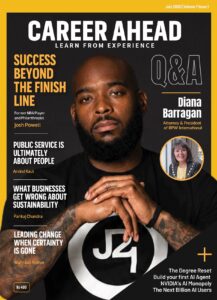
Read this in the magazine
 Future Skills & Work
Nadella Says AI Agents Need Identity and Governance Controls
Nadella’s workplace example pairs thousands of employees with millions of agents, putting oversight and the cognitive load of managing AI in focus.
Read More →This article first appeared in the July 2026 issue of Career Ahead Magazine (pages 2–4).
Read this article in the July 2026 issue · See everything in the July 2026 issue