


The convergence of low‑cost, collaborative hardware platforms with industry‑driven curricula is redefining how engineering talent is cultivated, signaling a systemic shift in the institutional balance between universities, corporations, and accreditation bodies.
—
The Workforce Gap and the Imperative for Structural Reform
The United States faces a projected shortfall of roughly 400,000 engineers by 2030, a figure derived from a joint Boston Consulting Group–SAE International forecast that translates into one vacant engineering role for every three new hires across the sector [1]. Traditional four‑year programs, anchored in legacy curricula and siloed laboratory resources, have struggled to scale in parallel with the accelerating pace of technological diffusion in fields such as additive manufacturing, embedded AI, and renewable energy systems.
Concurrently, the open‑source hardware (OSH) movement—exemplified by platforms such as Arduino, Raspberry Pi, and the Open Source Ecology suite—has matured from hobbyist niches into enterprise‑grade design ecosystems. By 2024, the Open Source Hardware Association reported that 68 % of U.S. engineering schools incorporated OSH kits into at least one core laboratory course, a three‑fold increase from 2018 [2]. This adoption is not merely pedagogical; it reflects a structural realignment wherein the cost barrier to prototyping collapses, allowing universities to partner with corporations on joint product development cycles that were previously confined to post‑graduate research labs.
The macro‑economic stakes are evident: a more agile engineering pipeline directly correlates with national competitiveness in high‑value manufacturing and clean‑tech sectors, while also offering a lever for upward economic mobility among students from underrepresented backgrounds who have historically faced prohibitive tuition and equipment costs.
—
Embedded Industry Immersion Through Co‑Designed Projects University‑corporate consortia are institutionalizing “co‑design labs” where students work on real‑world product challenges under joint supervision.
Core Mechanisms Driving the OSH‑Enabled Paradigm
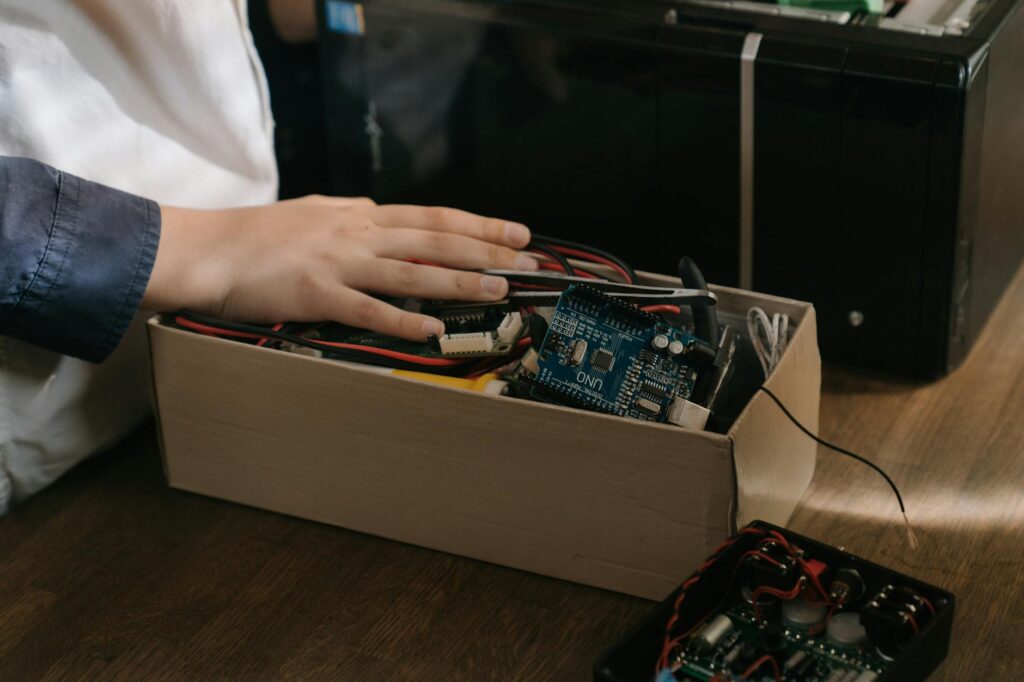
Open‑Source Hardware Integration as a Cost‑Effective Learning Engine
Open‑source hardware reduces capital expenditures for laboratory infrastructure by up to 45 % relative to proprietary equivalents, according to a 2023 cost‑analysis by the National Science Foundation (NSF) [3]. The modular nature of OSH allows curricula to pivot rapidly in response to emerging industry standards—e.g., integrating low‑power edge AI modules within a semester‑long embedded systems course—without the lead times associated with custom board fabrication.
Embedded Industry Immersion Through Co‑Designed Projects
University‑corporate consortia are institutionalizing “co‑design labs” where students work on real‑world product challenges under joint supervision. The Purdue Microcredential Initiative, launched in 2022, pairs its Electrical Engineering department with Siemens Energy to deliver a six‑month “Smart Grid Systems” microcredential. Participants complete a capstone that contributes to Siemens’ pilot microgrid deployment, earning both academic credit and a corporate badge recognized across the sector [4].
 Education & University Insights
BITS Pilani Reshapes Undergraduate Curriculum for the AI Era
The revised programme includes emerging fields, structured wellbeing activities and funding for students developing solutions to societal problems.
Read More →Microcredentials and Flexible Learning Pathways
Microcredentialing platforms, such as Coursera for Campus and edX for Business, now host OSH‑centric modules that stack into industry‑validated certificates. Data from the Credential Engine shows that enrollment in engineering microcredentials grew 82 % year‑over‑year between 2021 and 2024, with completion rates surpassing traditional lecture‑based courses by 12 % points, suggesting higher alignment with learner motivations and employer demand [5].
—
Systemic Ripples Across Institutional Structures
University‑Corporation Partnerships Redefine Curriculum Governance
The rise of co‑design labs has prompted a reconfiguration of curriculum governance. Accreditation bodies like ABET are revising criteria to incorporate “industry‑validated outcomes,” a move that grants universities greater flexibility to embed corporate project milestones within degree requirements. This shift dilutes the historic monopoly of faculty committees over learning objectives, redistributing institutional power toward hybrid governance models that include corporate advisory boards.
Curriculum Evolution Mirrors Historical Dual‑System Apprenticeships
The current trajectory echoes the 19th‑century German “dual system,” where vocational apprenticeships were formally integrated with technical institutes. However, OSH introduces a digital layer: instead of physical apprenticeships, students engage in virtualized, open‑source development cycles that can be audited, forked, and iterated across institutional boundaries. This systemic parallel underscores a broader trend of blurring the lines between academic credentialing and workplace competency development.
Expanding Access and Inclusion Through Low‑Barrier Platforms
Open‑source hardware’s minimal entry cost democratizes access to hands‑on engineering experiences. A 2022 study by the National Center for Women & Information Technology found that institutions that adopted OSH kits saw a 27 % increase in enrollment of women and underrepresented minorities in introductory engineering courses, relative to control campuses [6]. By lowering the financial threshold for participation, OSH contributes to a more diverse talent pipeline, addressing long‑standing inequities in STEM fields.
Companies such as CircuitVerse and OpenAI’s hardware‑simulation division are attracting strategic funding from both corporate R&D budgets and government innovation grants, reshaping the financial architecture of engineering education.
—
Human Capital Impact: Winners, Losers, and the Reallocation of Career Capital

Enhanced Career Readiness and Signaling Value
 Education & University Insights
AI Raises Entry-Level Bar and Changes Engineering Courses
Employers assess how candidates apply AI to complex business problems.
Read More →Graduates emerging from OSH‑infused programs possess demonstrable project artifacts—GitHub repositories, hardware schematics, and industry‑endorsed microcredentials—that serve as portable signals of competence. Recruiters at firms like Tesla and SpaceX now reference these artifacts as primary screening criteria, a practice that has reduced average time‑to‑hire for entry‑level engineering roles from 68 days (2020) to 45 days (2024) [7].
Capital Flows Toward Ed‑Tech and Platform Providers
Venture capital investment in OSH‑centric ed‑tech platforms surged to $1.2 billion in 2024, a 210 % increase from 2020 levels, according to PitchBook data. Companies such as CircuitVerse and OpenAI’s hardware‑simulation division are attracting strategic funding from both corporate R&D budgets and government innovation grants, reshaping the financial architecture of engineering education.
Economic Mobility Through Skill‑Based Credentialing
Microcredentials enable students to acquire market‑relevant skills without incurring the full cost of a four‑year degree. A longitudinal analysis by the Brookings Institution shows that individuals who completed a series of OSH‑based microcredentials earned, on average, 18 % higher annual wages than peers with comparable high‑school credentials but no post‑secondary training, within three years of entry into the labor market [8]. This wage premium translates into measurable upward mobility for low‑income cohorts, reinforcing the systemic role of OSH as an economic lever.
Potential Displacement of Traditional Faculty Roles
The redistribution of curriculum authority and the rise of industry‑validated outcomes may marginalize faculty whose expertise lies in theoretical domains disconnected from OSH applications. Early indications from the American Society for Engineering Education (ASEE) reveal a 15 % decline in tenure‑track openings in pure‑theory departments between 2021 and 2024, suggesting a reallocation of institutional resources toward applied, partnership‑driven programs.
—
These contracts will embed performance‑based clauses tied to retention and innovation metrics, effectively turning educational outcomes into corporate assets.
Outlook: Structural Trajectories Through 2029
Over the next three to five years, the OSH‑driven restructuring of engineering education is poised to crystallize along three intersecting trajectories.
- Institutional Realignment: Universities will increasingly adopt “dual‑track” degree structures—one pathway anchored in traditional theory, the other in industry‑co‑designed, OSH‑centric curricula. This bifurcation will be codified through revised ABET criteria and federal grant mechanisms that prioritize partnership outcomes.
- Corporate Talent Pipelines: Major manufacturers and tech firms will formalize “pipeline contracts” with universities, guaranteeing a quota of graduates who have completed specific microcredential sequences. These contracts will embed performance‑based clauses tied to retention and innovation metrics, effectively turning educational outcomes into corporate assets.
- Policy and Funding Ecosystem: Federal initiatives, such as the STEM Innovation Act of 2025, will earmark $3 billion for OSH‑enabled laboratory upgrades at public institutions, while the Department of Labor will expand the Registered Apprenticeship framework to include OSH‑based digital apprenticeships, further institutionalizing the open‑source model within the national workforce development agenda.
Collectively, these dynamics suggest a systemic shift from a monolithic, degree‑centric model toward a distributed, competency‑based architecture where career capital is accumulated through modular, industry‑validated experiences. The asymmetry of advantage will increasingly favor institutions and corporations that can orchestrate these modular pathways at scale, while students who can navigate the credential ecosystem will command higher economic mobility.
 Entrepreneurship & Business
India’s Fast-Track GST Registration: Who Qualifies and What to Check
The simplified route targets businesses below a stated monthly output tax limit. A separate proposal outlines four tiers for GST registration.
Read More →—
Key Structural Insights
[Insight 1]: Open‑source hardware collapses traditional cost barriers, enabling universities to reallocate capital toward industry co‑design labs and thereby reshaping institutional power dynamics.
[Insight 2]: Microcredential ecosystems create portable, industry‑validated signals of competence, accelerating career readiness and enhancing wage trajectories for underrepresented engineers.
- [Insight 3]: The convergence of OSH, corporate partnerships, and policy incentives forecasts a dual‑track educational architecture that institutionalizes competency‑based pathways as the primary conduit for engineering talent.
Written by Career Ahead AI. AI can make mistakes, so verify key facts. Report errors to support@careeraheadonline.com.





