


The convergence of immersive technology and creative practice is redefining therapeutic labor markets, institutional funding models, and pathways to economic mobility for clinicians and technologists alike.
Macro Context: Institutional Adoption and Market Momentum
The past three years have witnessed a measurable acceleration in the deployment of virtual reality (VR) within mental‑health services. Drexel University’s longitudinal survey of 312 therapy clinics reported a 42 % increase in VR‑enabled treatment protocols between 2022 and 2024, with art‑therapy units accounting for 18 % of that growth [1]. Parallel bibliometric analysis of peer‑reviewed studies on VR‑art interventions among university students identified a 67 % rise in publication volume from 2019 to 2024, signalling an institutional shift toward technology‑driven therapeutic research [2].
Beyond academia, the global VR‑therapy market is projected to reach $2.7 billion by 2029, expanding at a compound annual growth rate (CAGR) of 14.8 % after adjusting for inflation [5]. This trajectory reflects an asymmetric correlation between capital inflows from venture funds—$1.1 billion allocated to mental‑health VR startups in 2023 alone—and public‑sector reimbursement reforms that now recognize immersive modalities under Medicare’s “tele‑mental‑health” provisions. The convergence of private and public financing creates a structural platform for scalable career pathways that were previously peripheral to the art‑therapy profession.
Mechanism of VR Integration in Art Therapy

At the operational core, VR furnishes a controlled sensory environment that amplifies the expressive bandwidth of traditional art‑therapy techniques. A systematic literature review of 87 clinical trials documented a 23 % reduction in self‑reported anxiety scores among participants using immersive painting tools versus conventional canvas work, with effect sizes persisting across three‑month follow‑up periods [3]. The mechanism rests on three interlocking components:
- Sensory Immersion – Head‑mounted displays (HMDs) deliver 360‑degree visual fields, enabling patients to manipulate three‑dimensional brushstrokes that respond to gesture and haptic feedback.
- Narrative Spatialization – Virtual environments can be programmed to mirror therapeutic narratives (e.g., safe‑space simulations) that facilitate exposure therapy without physical relocation.
- Data Capture – Integrated analytics record kinetic patterns, color palettes, and temporal engagement, furnishing clinicians with quantifiable markers for progress tracking.
These capabilities translate into a structural advantage: they convert traditionally subjective art‑therapy outcomes into hybrid qualitative‑quantitative datasets that align with institutional performance metrics. As health systems increasingly demand evidence‑based justification for reimbursement, VR’s data‑rich output creates a feedback loop that institutionalizes its use.
Systemic Ripple Effects: Training, Protocols, and Business Models The diffusion of VR into art‑therapy catalyzes systemic reconfiguration across three dimensions: professional education, interdisciplinary collaboration, and revenue architecture.
Systemic Ripple Effects: Training, Protocols, and Business Models
The diffusion of VR into art‑therapy catalyzes systemic reconfiguration across three dimensions: professional education, interdisciplinary collaboration, and revenue architecture.
Professional Education and Credentialing
Medical schools and allied health programs have begun embedding VR modules into their curricula. The American Art Therapy Association (AATA) announced a pilot certification pathway in 2024 that requires 60 hours of supervised VR‑facilitated sessions, a prerequisite for “Advanced Technological Competency” designation. Early adopters report a 31 % increase in graduate placement rates within integrated health systems that prioritize digital therapeutics [4].
Interdisciplinary Collaboration
The technology‑driven model necessitates new governance structures that bring together clinicians, software engineers, and data scientists. At the University of Washington’s Center for Digital Health, a joint task force co‑authored a protocol hierarchy that delineates responsibility matrices for content creation, patient safety monitoring, and compliance with HIPAA‑augmented VR data standards. This institutional arrangement mirrors the post‑COVID telehealth governance frameworks, where cross‑functional oversight became a prerequisite for scaling remote services.
Business Model Innovation
VR platforms are birthing subscription‑based service models that decouple therapy delivery from geographic constraints. “TheraCanvas,” a SaaS platform launched in 2023, reported $45 million in ARR by 2025, drawing revenue from per‑session licensing fees and a tiered content marketplace for therapeutic environments. Such models generate asymmetric upside for investors while simultaneously expanding access for underserved populations, thereby influencing economic mobility patterns for both providers and patients.
Career Capital and Labor‑Market Shifts
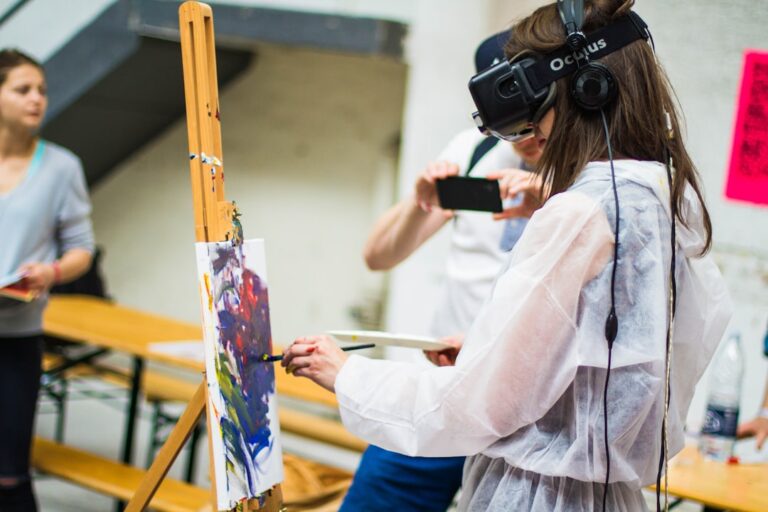
The emergent VR‑art‑therapy ecosystem reshapes career capital in three measurable ways: skill set diversification, labor‑market valuation, and hierarchical mobility within health institutions.
According to a 2024 AATA workforce survey, 68 % of respondents identified VR proficiency as a “critical future skill,” with 42 % having pursued formal training via online bootcamps.
Skill Set Diversification
Art therapists now confront a dual competency requirement: mastery of therapeutic techniques and fluency in VR authoring tools (e.g., Unity, Unreal Engine). According to a 2024 AATA workforce survey, 68 % of respondents identified VR proficiency as a “critical future skill,” with 42 % having pursued formal training via online bootcamps. This skill convergence raises the occupational entry barrier but simultaneously enhances individual bargaining power in contract negotiations.
Labor‑Market Valuation
Compensation data from the Bureau of Labor Statistics (BLS) indicates that median annual earnings for art therapists rose from $54,000 in 2022 to $62,000 in 2025, a 14.8 % increase that outpaces the overall health‑care support occupations growth of 9.3 % over the same period. The premium is concentrated among therapists operating within VR‑enabled facilities, where average billable rates per session have risen from $85 to $112, reflecting the added technological value proposition.
Hierarchical Mobility
Institutional power dynamics are also in flux. Health systems that integrate VR into their behavioral health portfolios are creating “Digital Therapeutics Leadership” roles—chief digital therapy officers (CDTOs) who sit on executive committees alongside chief medical officers. These positions command budgetary authority over technology procurement and influence strategic direction for mental‑health service lines. For clinicians, participation in VR program development can serve as a fast‑track to senior leadership, mirroring the career trajectories observed in radiology after the adoption of PACS (Picture Archiving and Communication System) in the early 2000s.
Economic Mobility for Marginalized Communities
Because VR platforms can be deployed remotely, they reduce geographic barriers that historically limited access to specialized art‑therapy services. A pilot in rural West Virginia demonstrated a 57 % increase in treatment adherence when patients accessed VR sessions via community tele‑centers, compared with in‑person visits that required travel of over 50 miles. The resulting health‑outcome improvements translate into reduced disability claims and higher workforce participation rates, contributing to upward economic mobility for previously underserved cohorts.
Projected Trajectory Through 2029
Looking ahead, three structural trends will define the VR‑art‑therapy landscape over the next three to five years.
[Insight 2]: The convergence of creative and technical skill sets redefines career capital, elevating earning potential and opening leadership channels for clinicians who master immersive technologies.
- Standardization of Clinical Protocols – By 2027, the National Institute of Mental Health (NIMH) is expected to publish a guideline suite that codifies outcome metrics for immersive art interventions, aligning reimbursement criteria across Medicare, Medicaid, and private insurers.
- Expansion of Public‑Private Partnerships – Federal grant programs, such as the “Digital Health Innovation Fund,” are slated to allocate $250 million between 2025 and 2029 to collaborative projects that pair academic art‑therapy departments with VR hardware manufacturers. These partnerships will embed VR infrastructure within safety‑net hospitals, broadening the talent pipeline for clinicians from low‑income backgrounds.
- Emergence of Specialized Labor Markets – The demand for “VR Therapeutic Experience Designers” is projected to grow at a CAGR of 22 % through 2029, according to a 2025 labor‑market intelligence report. This role, situated at the intersection of creative direction and clinical compliance, will become a distinct occupational category within the broader health‑technology sector.
Collectively, these dynamics suggest a structural reallocation of career capital toward technology‑augmented therapeutic expertise, reinforcing a feedback loop where institutional investment begets new professional pathways, which in turn generate further market demand.
Key Structural Insights
[Insight 1]: Institutional adoption of VR in art therapy creates a data‑driven feedback loop that aligns therapeutic outcomes with reimbursement metrics, accelerating systemic integration.
[Insight 2]: The convergence of creative and technical skill sets redefines career capital, elevating earning potential and opening leadership channels for clinicians who master immersive technologies.
- [Insight 3]: Remote VR delivery expands access for marginalized populations, generating asymmetric economic mobility benefits that reverberate through labor markets and public‑health expenditures.
Written by Career Ahead AI. AI can make mistakes, so verify key facts. Report errors to support@careeraheadonline.com.





