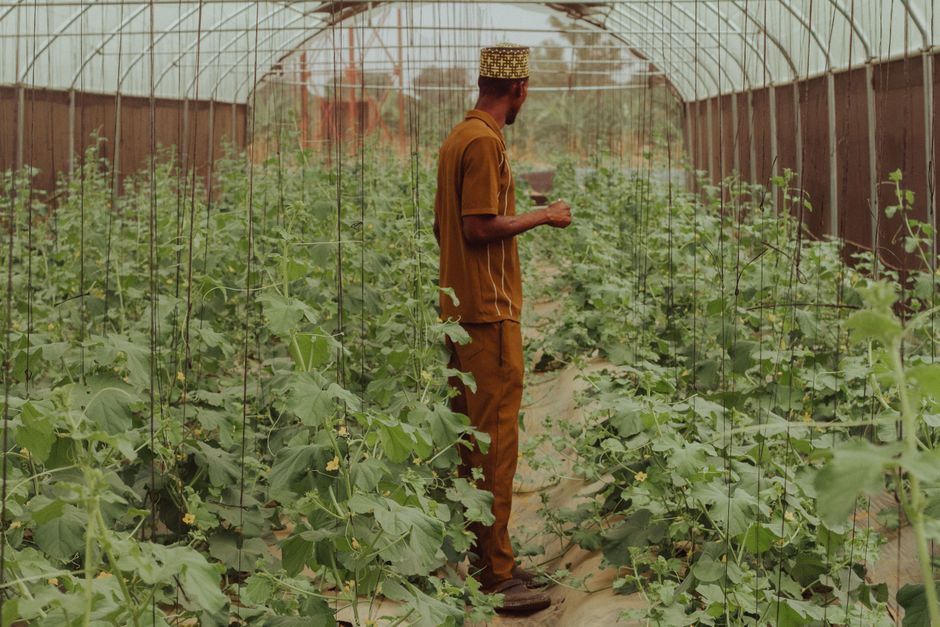
Runsewe started Freee Recycle in 2020, building a Nigerian tyre-recycling business that employs about 62 people.
Nigerian women own businesses but face a sharp loan gap
Women own about 40% of small businesses in Nigeria, but access to credit remains uneven. Fifty-six per cent of female entrepreneurs’ last loan applications were denied, compared with 17% for men. The gap sits alongside businesses such as Freee Recycle, which Runsewe started in 2020. Its factory employs about 62 people, making the company an example of a women-owned business operating at a scale that requires staff and production.¹
Freee Recycle collects tyres from Oyo, Lagos, Osun and Kwara, four states in Nigeria. The company has secured partnerships with Michelin, Save the Children and the International Committee of the Red Cross. It also launched the Freee art residency programme in 2025. Oladele Ogunseitan, a presidential chair at the University of California, Irvine, is another named figure connected to the wider discussion of the business.¹
Those installations show the business’s reach across the country and its work with women farmers, rather than limiting its customers to a single group.¹
A Ugandan company links water systems with farmer loans
Kyokushaba started her business in February 2025. Winta Engineering Solutions has installed 30 water systems across Uganda, including more than 10 for female farmers. Those installations show the business’s reach across the country and its work with women farmers, rather than limiting its customers to a single group.¹
Winta’s collaboration with microfinance providers also connects farmers to loans of about 5m Ugandan shillings, or about £1,000. The loan offer adds financing to the company’s water-system work: farmers can access credit through the partnership while using systems installed by Winta. The arrangement combines equipment and borrowing in one business model, with female farmers accounting for more than 10 of the systems installed so far.¹
Carnival pairs fuel savings with higher fuel spending
 Entrepreneurship & Business
AI Output Costs More When Verification Is Expensive
Before automating a deliverable, decide who checks it, how long the check takes and what happens if it fails.
Read More →Brent crude oil settled at $116.72 per barrel on Friday. Carnival CEO Josh Weinstein said cutting fuel consumption is the best way to avert the effects of expensive fuel. The company reported an all-time high net income of $1.9 billion in its third quarter, while also spending $615 million on fuel, about 7.3% of revenue. That fuel bill was higher than the $425 million, or about 6.7% of revenue, Carnival spent in the fourth quarter of 2025.²
Carnival has cut its unit fuel consumption rate by 26% since 2019. Based on consumption savings since then, the company estimates it has saved about $700 million in 2026. Its projected fuel costs reach $640 million in the fourth quarter. The figures put the company’s efficiency gains alongside a rising fuel bill: lower consumption has produced estimated savings, but fuel remains a substantial operating expense.²
Cruise operators report fuel exposure and bookings
Royal Caribbean is over 60% hedged for 2026, a measure that limits its exposure to fuel-price changes. It spent about $347 million on fuel in the third quarter, equal to about 6.2% of revenue. In the fourth quarter of 2025, it spent $293 million, or about 6.8% of revenue. The company projects fuel costs at $379 million in the fourth quarter, while saying reservations for 2027 are already up by a high-teens percentage.²
Norwegian Cruise Line Holdings reported adjusted earnings per share of $1.12 for the third quarter. It has hedged approximately 48% of its fuel consumption for 2026. Norwegian spent about $196 million on fuel in the third quarter, or about 6.6% of revenue. Its fourth-quarter 2025 fuel spending was $167 million, equal to 7.4% of revenue. The company projects fuel consumption at 255,000 metric tons in the fourth quarter, up from 239,000 metric tons.²
Carnival has cut its unit fuel consumption rate by 26% since 2019.
Check your loan rejection odds before scaling
If you are a woman building a business in Nigeria, the 56% denial rate for female entrepreneurs' last loan applications versus 17% for men is a number to plan around. Before you expand staff or production, as Freee Recycle did with 62 employees, treat credit access as a constraint, not an afterthought. Build a case that shows revenue and contracts, like partnerships with Michelin or Save the Children, to counter lender bias. Your goal is to reduce the chance you fall into that 56% bucket when you seek capital.¹
For founders in Uganda, the Winta model shows a way to bundle equipment with financing. Farmers received loans of about 5m Ugandan shillings through microfinance providers, tied to the 30 water systems installed. If you sell a product that lowers costs or raises income, consider partnering with a lender to offer credit alongside your service. That approach turns a single sale into a recurring relationship and helps customers afford your offering, as Winta did with more than 10 female farmers.¹
Sources
 Entrepreneurship & Business
Fractional C‑Suite Model Slashes Startup Burnout and Costs
Fractional C-suite models cut executive costs by 30 percent. Gen Z founders hire on demand to slash burnout and preserve cash.
Read More →Written by Career Ahead AI. AI can make mistakes, so verify key facts. Report errors to support@careeraheadonline.com