
In 17 months as Reliance’s Executive Director, Anant Ambani has moved from describing a New Energy vision to attaching capacity targets, operating assets, customer contracts and major investment commitments to it. The next phase is commercial execution.
At Madanapalle in Andhra Pradesh on October 2, 2026, the subject was energy, but the starting point was agriculture.
Speaking at the foundation stone laying ceremony for the Rayalaseema Horticulture Hub and the proposed Indian School of Agriculture, Anant Ambani described an opportunity for India’s farmers to become participants in the country’s energy economy, not only its food economy.
He called the idea a transition from “Anna Daatas” to “Urja Daatas”, or from providers of food to participants in energy production. He said Reliance planned to invest ₹1 lakh crore in compressed biogas projects in Andhra Pradesh, with the company expecting more than 3 lakh jobs and nearly ₹60,000 crore in state revenue over the coming decades. Those figures are company projections attached to a proposed programme, not realised outcomes.
The announcement arrived in a particularly significant policy moment. The Union government’s GOBARdhan programme has been designed to accelerate India’s compressed-biogas economy, with a proposed outlay of ₹23,731 crore over ten years and a target of around 5 million standard cubic metres a day of CBG production. The scheme includes measures around offtake, pricing, capital assistance, pipeline connectivity and credit support.
The numbers are large.
But the more interesting story is what connects them.
Seventeen months, from vision to execution
Anant M. Ambani became an Executive Director of Reliance Industries for a five-year term beginning May 1, 2025. Reliance describes his role as spanning corporate strategy and large-scale transformation, with a key role in the group’s transition towards renewable energy, green hydrogen, circular materials, carbon capture, clean fuels and related technologies.
The progression since then can be viewed in three phases.
The first was capacity and capability.
At Reliance’s 48th Annual General Meeting in August 2025, the company laid out a New Energy platform spanning an integrated solar manufacturing chain, batteries, electrolysers and green-hydrogen-based products. Reliance said it was targeting 3 million metric tonnes per annum of green hydrogen equivalent production capacity by 2032.
The second was commercial commitment.
On March 16, 2026, Reliance announced a binding 15-year green-ammonia supply agreement with South Korea’s Samsung C&T worth more than US$3 billion. The agreement is scheduled to commence in the second half of FY2029. Samsung C&T independently confirmed the transaction.
The third phase arrived at the 49th AGM in June 2026.
The language was no longer primarily about what would eventually be built.
Reliance said solar-module commercial revenues would begin during FY2026-27, its first 40 GWh battery-manufacturing phase was on track for commissioning in 2026, and New Energy would begin contributing meaningfully to financial performance from FY2026-27.
That distinction matters.
The first stage is building capacity.
The second is connecting capacity to customers.
The third is turning capacity into sustained revenue and scale.
Why India needs the capacity
The business case does not depend on Reliance alone.
India’s electricity system is entering a period of structurally higher demand.
The International Energy Agency expects India’s electricity demand to grow by around 6.4% annually through 2030, with solar expected to account for roughly half of the increase in electricity generation over that period.
That creates demand for much more than solar panels.
It means generation capacity.
Transmission.
Energy storage.
Manufacturing.
Grid flexibility.
Industrial fuels.
And new technologies capable of supplying energy to sectors that cannot easily be electrified directly.
Green hydrogen is one such market.
India’s National Green Hydrogen Mission aims for at least 5 million tonnes of annual green-hydrogen production capacity by 2030, supported by an initial government outlay of ₹19,744 crore, including ₹17,490 crore for the SIGHT programme covering electrolyser manufacturing and green-hydrogen production.
That creates a substantial domestic policy framework around a potentially global market.
The strategic opportunity is therefore not simply to generate renewable electricity.
It is to manufacture the equipment, generate the electricity and then convert it into products that can be stored, transported and sold.
Jamnagar: building the industrial base
The Dhirubhai Ambani Green Energy Giga Complex in Jamnagar is central to that strategy.
Reliance is developing an integrated manufacturing ecosystem spanning solar, batteries, electrolysers and other clean-energy technologies. The company says its solar manufacturing lines are operational and that it is progressing towards 20 GWp of annual integrated solar manufacturing capacity, including polysilicon, ingots, wafers, cells, modules and glass.
Reliance’s FY2025-26 annual report recorded production of the first 200 MWp of HJT modules during the year. By the June 2026 AGM, the company said nearly 1 GW had subsequently been produced.
Those products can then reach domestic and international customers.
Reliance also said its HJT technology had received Approved List of Models and Manufacturers, or ALMM, listing and described itself as the first in India to achieve the listing for HJT solar and modules. That “first” is a Reliance characterization and should be treated as such.
The battery programme is being built alongside solar.
The first phase is designed around 40 GWh of annual manufacturing capacity, with the company’s longer-term roadmap reaching 100 GWh in its FY2025-26 reporting and later presentations discussing a scale-up towards 120 GWh.
The electrolyser business adds another layer.
Reliance has secured exclusive technology licensing from Norway’s Nel ASA for alkaline electrolysers in India and is developing an electrolyser manufacturing giga-factory, with an initial planned capacity of around 3 GW per year.
The logic is vertical integration.
Renewable power can feed electrolysers.
Electrolysers produce hydrogen.
Hydrogen can become ammonia and other green chemicals.
Those products can then reach domestic and international customers.
The objective is to build more of that chain within one ecosystem.
Kutch: the electricity underneath the system
Jamnagar is the manufacturing engine.
Kutch is intended to provide a substantial part of the renewable electricity underneath it.
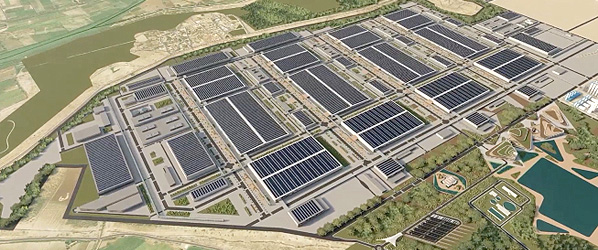
Reliance is developing a renewable-energy hub across approximately 5,50,000 acres in Kutch, combining large-scale solar generation with battery storage. The company says the integrated system, once fully operational, could generate more than 40 billion units of green electricity annually, equivalent to around 3% of India’s annual electricity requirement.
Reliance’s stated peak installation rate is 55 MWp of solar modules and 150 MWh of battery containers per day.
The significance is not simply the headline electricity number.
Renewable electricity becomes the starting material for several downstream businesses.
It can charge batteries.
It can produce hydrogen.
Hydrogen can become ammonia.
Ammonia can move into industrial and export markets.
And a large captive supply of renewable power can potentially improve the economics of the integrated platform.
Reliance describes the Kutch-to-Jamnagar system as a foundation for round-the-clock green power. The company has also said the transmission corridor connecting the renewable hub to Jamnagar is under construction.
Green ammonia gives the strategy a customer
This is where the business story becomes tangible.
Capacity is one thing.
A customer is another.
The Samsung C&T agreement is therefore important because it creates a long-term commercial destination for green ammonia produced through Reliance’s future New Energy platform.
Samsung C&T says the agreement covers 15 years and is worth approximately US$3 billion. Reliance describes it as one of the largest binding long-term green-ammonia offtake agreements globally.
It does not establish the profitability of the whole New Energy business.
What it establishes is more specific: a major international customer has committed to purchase a future green product from the platform.
That is a meaningful step in the transition from investment to commercialisation.
Reliance says it is also in discussions concerning further long-term export opportunities in Japan, Korea and Europe. Those remain discussions until contracts are signed.
Then there is CBG
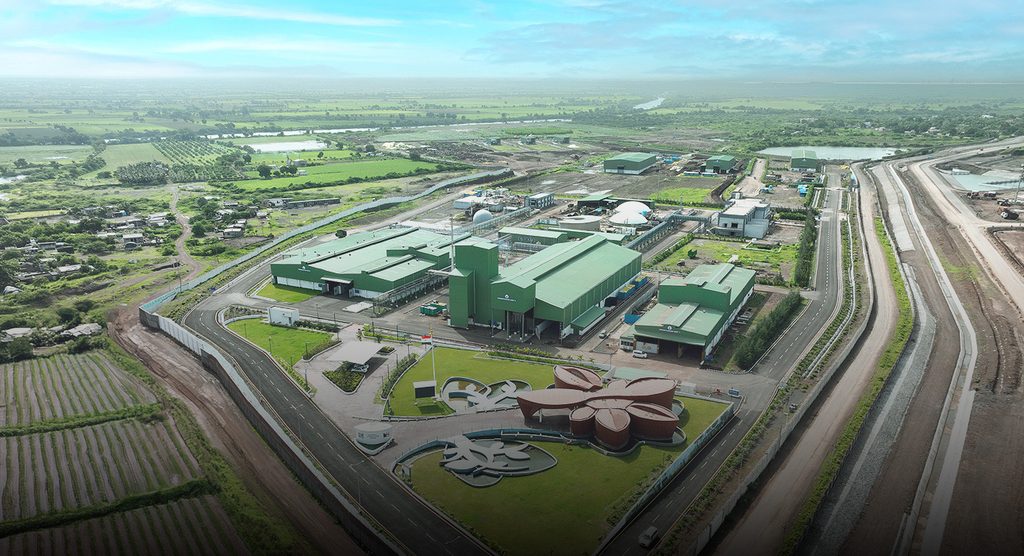
If Jamnagar and Kutch represent the industrial side, compressed biogas represents another part of the strategy, one that reaches directly into India’s agricultural economy.
CBG can be produced from agricultural residues, energy crops, cattle dung, sugarcane press mud and organic waste. The resulting biogas can be upgraded for use as fuel, while the process can also produce organic fertiliser.
Reliance’s FY2025-26 reporting says it had 35 operating CBG plants, production above 270 tonnes per day, approximately 700 tonnes per day of installed capacity, more than 80,000 farmers engaged and more than 10,000 jobs supported. The company says it is on track for 55 operating plants producing approximately 1,100 tonnes per day by the end of FY2026-27 and is targeting integrated hubs capable of producing 1 million tonnes of CBG annually over the following five years.
The national market is also expanding.
The IEA’s India Bioenergy Market Report forecasts that liquid and gaseous biofuel use will rise by more than 50%, from 293 petajoules in 2025 to 429 petajoules in 2030 in its main case, with ethanol and CBG accounting for much of the growth. The IEA says India had around 170 functional CBG plants in 2025, with almost 300 additional plants under construction.
That is a market moving from policy ambition towards industrial scale.
Andhra Pradesh: agriculture becomes part of the energy strategy
The Andhra Pradesh story has been developing for more than a year.
In April 2025, Reliance announced plans to invest ₹65,000 crore in developing integrated CBG hubs in Andhra Pradesh and broke ground at Kanigiri in Prakasam district on the first of a proposed 500 plants. The first project had a stated capital investment of ₹139 crore. Reliance said the programme would use Napier grass and other biomass resources and develop activity across approximately 5 lakh acres.
The October 2026 announcement raises the proposed investment figure to ₹1 lakh crore, with Reliance projecting more than 3 lakh jobs and nearly ₹60,000 crore in state revenue over the coming decades. Public disclosures do not yet provide enough detail to reconcile every rupee between the earlier and newer commitments, so the two figures should not simply be added together.
What makes the latest announcement more interesting is the ecosystem around the plants.
At Madanapalle, Reliance said Jio would work with the proposed Indian School of Agriculture on digital training, including village virtual classrooms and digitally enabled agricultural extension. The programme also points to artificial intelligence, Jio Krishi, drones, robotics, cloud computing and market intelligence.
The proposition becomes broader than CBG.
GOBARdhan is creating a larger policy framework for CBG.
A farmer can remain a food producer while also becoming part of a biomass and energy supply chain.
Agriculture can become linked to energy.
Energy can become linked to technology.
And technology can become linked to rural employment and productivity.
That is the model behind the phrase “Urja Daata.”
The policy window is opening
The timing of all this is important.
India is simultaneously trying to improve energy security, expand renewable generation, build domestic clean-energy manufacturing, develop green hydrogen, increase bioenergy and reduce dependence on imported fossil fuels.
Government policy is increasingly attempting to connect those objectives.
The National Green Hydrogen Mission is supporting domestic manufacturing and production.
GOBARdhan is creating a larger policy framework for CBG.
India’s electricity demand is rising.
And international markets are beginning to develop for green molecules.
That creates the possibility of a new industrial cycle.
The opportunity is not limited to the companies constructing the largest factories.
It extends to the ecosystem around them.
The financial base makes the bet possible
Reliance has something that most companies entering emerging energy businesses do not have: an enormous existing industrial and financial base.
For FY2025-26, Reliance reported consolidated revenue of ₹11,75,919 crore, EBITDA of ₹2,07,911 crore and net profit of ₹95,754 crore.
Capital expenditure was ₹1,44,271 crore, with Reliance saying it was principally directed towards growth projects in Oil-to-Chemicals and New Energy, along with continuing investments in Digital Services and Retail.
That matters because New Energy is capital intensive.
Factories need to be built before they generate revenue.
Supply chains have to be established before they become efficient.
Transmission infrastructure has to be connected.
Customers have to be secured.
Technology has to move from development into high-volume production.
A company with substantial internal cash generation has more capacity to fund that transition over several years.
It is one of the central strategic advantages of the model.
The numbers that matter now
The next chapter will be less about announcements and more about operating data.
Solar module production.
Capacity utilisation.
Battery commissioning and output.
Electrolyser production.
Renewable electricity generated at Kutch.
Green-ammonia deliveries.
CBG production and offtake.
Farmer participation.
Revenue.
Margins.
Capital efficiency.
Those are the numbers that will gradually determine whether the New Energy strategy becomes a major earnings engine.
Reliance has already said it expects New Energy to begin contributing meaningfully to financial performance from FY2026-27.
That makes FY2026-27 a particularly important transition year.
The opportunity beyond Reliance
Perhaps the most interesting lesson for entrepreneurs is that an industrial transition of this scale creates opportunities far beyond the headline companies.
A clean-energy ecosystem needs equipment suppliers.
It needs maintenance specialists.
It needs testing laboratories.
The Reliance model suggests one possible answer.
It needs logistics.
It needs biomass aggregation.
It needs quality and safety systems.
It needs software.
It needs drones and sensors.
It needs agricultural data.
It needs training.
It needs certification.
It needs recycling.
It needs energy-management systems.
The larger the underlying infrastructure becomes, the larger the ecosystem around it becomes.
For a young entrepreneur, that can be more relevant than trying to build a mega-project.
The opportunity may be to build the company that makes the mega-project work better.
Sustainability becomes strategy
That brings the story back to the original question.
Can sustainability become a business strategy?
The Reliance model suggests one possible answer.
Do not treat the energy transition only as a problem to be managed.
Treat it as an industrial market.
Do not look at agricultural residue only as waste.
Look at it as a feedstock.
Do not look at renewable electricity only as power.
Look at it as the input for batteries, hydrogen and green chemicals.
Do not look at technology only as a productivity tool.
Use it to connect entire ecosystems.
And do not measure the strategy only through investment announcements.
Measure it through factories, customers, output, revenue and economic value.
That is what makes the current moment different.
The experiment is entering its measurable phase
The numbers now form a connected industrial proposition.
20 GWp of planned integrated solar manufacturing capacity.
40 GWh of initial battery manufacturing capacity, with a longer-term roadmap beyond that.
Around 3 GW a year of planned initial electrolyser manufacturing capacity.
3 million tonnes a year of green hydrogen equivalent green-chemicals capacity targeted by 2032.
A US$3 billion, 15-year green-ammonia supply agreement with Samsung C&T.
Approximately 5,50,000 acres in the Kutch renewable-energy development.
More than 40 billion units of potential annual renewable electricity generation at full development.
500+ CBG plants targeted by 2030.
And now a proposed ₹1 lakh crore CBG investment programme in Andhra Pradesh.
These are not all the same kind of number.
Some describe current operating capacity.
Some describe investments already committed.
Some describe signed commercial contracts.
Some are targets.
Some are projections.
Keeping those categories separate is essential.
Keeping those categories separate is essential.
But together they reveal the scale of the proposition.
This is no longer a collection of isolated sustainability initiatives.
It is an attempt to construct an integrated New Energy business around manufacturing, renewable power, storage, hydrogen, green molecules, bioenergy and technology.
The commercial test is beginning.
For India, the outcome could matter well beyond one company.
A successful transition would mean more than cleaner energy.
It could mean new manufacturing capacity, new export products, new rural supply chains, new technologies and a new generation of businesses built around the energy system of tomorrow.
That may ultimately be the most important part of the story.
The world’s energy system is changing.
India has the sunlight, agricultural resources, engineering talent, technology ecosystem and domestic market to play a major role in that change.
The question now is whether those ingredients can be assembled into businesses that operate at global scale and compete on economics.
Reliance is making one of the largest attempts to do exactly that.
And with Anant Ambani increasingly at the public centre of the New Energy strategy, the coming years will provide something increasingly valuable in business:
the opportunity to watch a very large industrial thesis move from ambition to evidence, quarter by quarter.
Written by Career Ahead AI. AI can make mistakes, so verify key facts. Report errors to support@careeraheadonline.com.