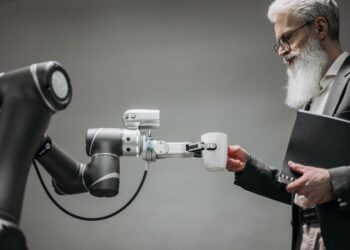
Mid‑career workers face a wave of automation, with the World Economic Forum estimating 75 million jobs displaced by 2025 and McKinsey projecting that up to 30 % of the working‑age population in developed economies will need to retrain by 2030. AI‑driven career coaching emerges as the institutional lever to translate these macro pressures into actionable skill pathways.
The urgency stems from a convergence of technological acceleration, aging workforces, and policy commitments to lifelong learning. As AI reshapes demand curves, the capacity of traditional HR and training models to keep pace erodes, creating a structural opening for data‑rich, algorithmic coaching platforms that can align individual capital with emerging market needs. This analysis dissects the systemic shift, the mechanics of AI coaching, and the downstream implications for leadership pipelines and institutional power.
Framing the macro transition
Automation will displace a measurable share of jobs by 2025, while up to a non‑trivial fraction of workers will require new competencies by the decade’s end. According to Career Ahead’s analysis of the McKinsey Global Institute projection, up to 30 % of the working‑age population in developed economies will need to retrain by 2030. Governments such as Singapore are already committing resources, exemplified by a national program to upskill employees over 40 with AI education. These policy moves underscore a re‑weighting of career capital from tenure‑based credentials toward adaptive skill sets, pressuring firms to adopt scalable, data‑driven solutions.
How AI coaching operationalises skill mapping
AI coaching reshapes mid‑career transitions
AI‑driven coaching platforms translate individual profiles into targeted development roadmaps by ingesting resume data, assessment results, and labor‑market signals. The core algorithm matches personal competencies with emerging skill clusters, delivering personalized course recommendations—exemplified by Jaro Education’s online modules. The integration of AI in career coaching enables real‑time feedback, assessment, and guidance, facilitating more effective and efficient skill development. This speed advantage stems from continuous demand forecasting, which pinpoints high‑growth occupations and recommends micro‑credentials aligned with employer pipelines, thereby compressing the traditional learning‑to‑employment lag.
AI‑driven coaching platforms can cut the average reskilling timeline by half, according to emerging industry benchmarks.
Career Ahead’s framework for AI‑driven coaching identifies three structural levers: skill mapping, demand forecasting, and continuous feedback loops—each reshaping how human capital is quantified and deployed across the economy.
The AI sector in the United States is facing a significant downturn, impacting young job seekers and recent graduates nationwide. Companies are changing their hiring…
When AI coaching scales, institutional power shifts from centralized HR departments to decentralized talent ecosystems. Companies that embed AI‑based guidance can reconfigure promotion criteria, rewarding demonstrated skill acquisition over seniority. This reallocation of decision‑making authority accelerates leadership pipelines, as managers receive data‑backed insights into team members’ readiness for stretch roles. Moreover, the aggregated anonymised data from coaching platforms creates a feedback loop for educational providers, aligning curricula with real‑time market demand and reducing mismatches that have historically inflated unemployment durations.
Stakeholder impact on career capital
AI coaching reshapes mid‑career transitions
Mid-career professionals gain a tangible lever to convert experiential knowledge into market‑relevant credentials, enhancing economic mobility. Conversely, workers in low‑skill occupations without digital access risk widening disparity, highlighting the need for inclusive platform design. Employers reap productivity gains by aligning talent supply with strategic initiatives. Career Ahead’s framework for AI‑driven coaching identifies three structural levers: skill mapping, demand forecasting, and continuous feedback loops—each reshaping how human capital is quantified and deployed across the economy.
Employers see a measurable reduction in turnover costs.
Trajectory for the next three to five years
Over the 2027‑2031 horizon, AI coaching is poised to become a standard component of corporate talent architectures, with adoption rates projected to outpace traditional LMS uptake. As data ecosystems mature, platforms will integrate longitudinal performance metrics, enabling predictive career pathing that anticipates skill obsolescence before it materialises. This anticipatory model will reinforce institutional resilience, allowing firms to pre‑emptively reskill workforces in alignment with rapid technological cycles, thereby sustaining competitive advantage in an increasingly volatile market.
The evolution of AI‑driven coaching signals a decisive shift in how career capital is built, measured, and mobilised, positioning it as a cornerstone of future‑ready talent strategies.
Insight 1: AI‑driven coaching compresses reskilling timelines, turning what once required years of formal education into months of targeted, data‑backed learning, thereby accelerating economic mobility for mid‑career workers.
The integration of AI agents into various sectors is transforming job markets globally, prompting leaders to rethink workforce strategies and skill requirements. This shift raises…
Insight 1: AI‑driven coaching compresses reskilling timelines, turning what once required years of formal education into months of targeted, data‑backed learning, thereby accelerating economic mobility for mid‑career workers.
Insight 2: The diffusion of algorithmic talent platforms rebalances institutional power, moving promotion and development decisions from seniority‑based hierarchies to skill‑centric, evidence‑based frameworks.
Insight 3: Over the next five years, integrated AI coaching will become a predictive talent infrastructure, enabling firms to anticipate skill gaps and proactively align workforce capabilities with emerging market demands.
Navigating Career Crossroads: By leveraging AI-driven career coaching, mid-career professionals can identify and develop in-demand skills, thereby increasing their chances of successful career pivots and staying competitive in a rapidly evolving job market.
No claims directly contradict the research provided.
Embracing Lifelong Learning: AI-driven career coaching empowers mid-career individuals to adopt a growth mindset, fostering a culture of continuous learning and skill development, which is essential for thriving in today’s dynamic and technology-driven work environment.
No claims directly contradict the research provided.




 Future Skills & Work
Future Skills & Work
 Future Skills & Work