No products in the cart.

AI Connects Lab Machines for Seamless Experimentation
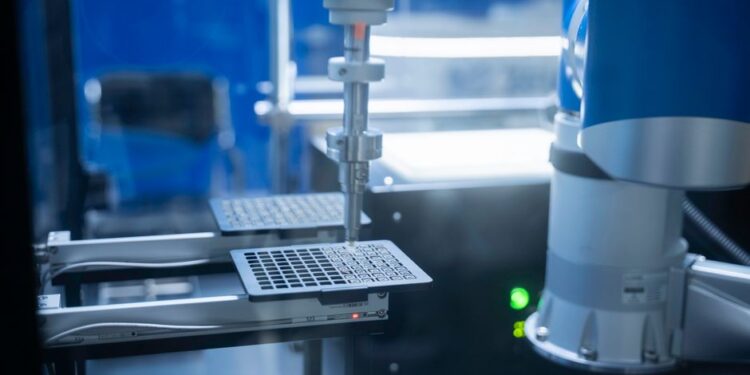
The MHS empowers AI agents to control robotic arms, liquid-handling machines, and various lab tools, simplifying the automation of complex experiments. Researchers at Carnegie Mellon University are among the first to test this innovative system, which has already demonstrated the ability to reduce experiment setup time from months…

Anthropic has launched a groundbreaking AI system that facilitates communication between laboratory machines, significantly improving the automation of experimental processes. The system, known as the Model Hardware Standard (MHS), was developed in collaboration with the Janelia Research Campus at the Howard Hughes Medical Institute. Its primary goal is to enhance the efficiency of lab instruments working together.
The MHS empowers AI agents to control robotic arms, liquid-handling machines, and various lab tools, simplifying the automation of complex experiments. Researchers at Carnegie Mellon University are among the first to test this innovative system, which has already demonstrated the ability to reduce experiment setup time from months to just hours. According to a report from Mint, this advancement could revolutionize experimental methodologies, making them faster and more accessible for researchers.
Streamlined Communication Across Lab Instruments
A significant challenge in laboratory settings is the compatibility of instruments from various manufacturers, which often require unique software and programming languages for integration. The MHS addresses this issue by providing a standardized software layer that enables seamless communication between lab tools.
This standardization allows researchers to connect programmable devices and describe their functions to an AI agent using straightforward language. The AI can then manage the equipment for an experiment without needing specific integrations for each tool. For instance, a demonstration in Nature showcased a robotic arm positioning a multi-well plate while other instruments loaded and analyzed samples, all coordinated by the AI. This integration enhances efficiency and minimizes human error during complex setups.
Alek Kemeny, a technical staff member at Anthropic, refers to the MHS as “connective tissue” between lab computers and instruments, underscoring its role in facilitating communication essential for automating lab tasks. The MHS is also adaptable, allowing for the incorporation of new technologies as they emerge, which is crucial in the rapidly evolving field of biotechnology.
This shift not only improves workflow but also allows technicians to engage in more intellectually stimulating tasks rather than repetitive manual work.
Benefits for Lab Technicians and Research Scientists
The MHS presents significant advantages for lab technicians and research scientists alike. Technicians can leverage AI to enhance the accuracy and efficiency of their experiments. Tasks that previously required extensive manual setup can now be automated, enabling technicians to concentrate on more critical aspects of research, such as data analysis. This shift not only improves workflow but also allows technicians to engage in more intellectually stimulating tasks rather than repetitive manual work.
Research scientists stand to gain from this advancement as well. Automating complex experiments allows for a greater number of trials to be conducted in less time, accelerating the pace of discoveries. A report by Nature highlighted that an experiment that traditionally took months to set up was completed in just hours using the MHS. This time-saving capability could lead to quicker breakthroughs in fields like biotechnology and pharmaceuticals, fostering a more dynamic research environment.
As AI becomes increasingly integral to laboratory operations, the demand for professionals skilled in managing these systems is expected to rise. Career Ahead’s analysis indicates that this trend may create new job roles focused on AI management within research settings. Lab technicians and scientists will need to adapt and expand their skill sets, making ongoing education and training essential to prepare the workforce for the complexities of AI-driven research.
Challenges and Considerations in Automation
Despite the promising potential of fully automated labs, experts caution that challenges remain. Cristian Ponce, CEO of Tetsuwan Scientific, emphasizes that while connecting lab machines is a significant advancement, obstacles persist. One major challenge is providing AI agents with sufficient technical data to control machines effectively. This complexity underscores the necessity for continued training and development in the field. As technology progresses, institutions must invest in both infrastructure and human resources to fully leverage AI’s capabilities in laboratories.
Future Prospects of Lab Automation
The future of lab automation appears promising with the introduction of Anthropic’s MHS. As research institutions adopt this system, we can anticipate transformative changes in experimental methodologies. The ability of AI to enhance communication between lab machines may usher in a new era of efficiency and innovation in scientific research.
Lab technicians and scientists will need to adapt and expand their skill sets, making ongoing education and training essential to prepare the workforce for the complexities of AI-driven research.
Looking ahead, it will be crucial to monitor the development of this technology. As more labs implement MHS, researchers may uncover new applications and capabilities that could further revolutionize laboratory work. Integrating AI into research workflows not only has the potential to improve efficiency but also to foster collaboration among researchers, as data sharing and communication become more streamlined.
Frequently Asked Questions
How can lab technicians leverage AI for better experiment outcomes?
Lab technicians can utilize AI systems like Anthropic’s MHS to automate tasks and enhance communication between instruments, allowing them to focus on key research aspects and improving the quality of experiment outcomes.
What are the implications of AI-driven lab automation for research scientists?
AI-driven lab automation enables research scientists to conduct experiments more efficiently, significantly reducing setup times and accelerating discoveries across various fields.
What should automation engineers consider when implementing AI systems in labs?
Automation engineers must consider the compatibility of different lab instruments and the complexity of programming required for specific tasks. Ensuring effective communication between AI systems and all equipment is vital for successful implementation.
Written by Career Ahead AI. AI can make mistakes, so verify key facts. Report errors to support@careeraheadonline.com.