

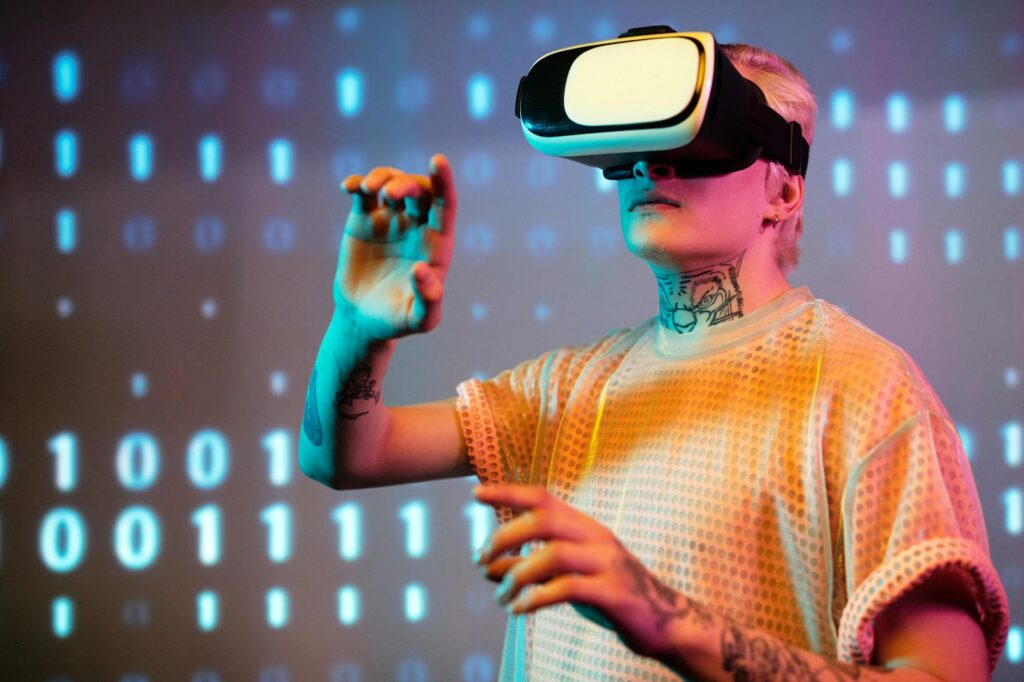
Augmented reality is reshaping the supply‑side of human capital by embedding immersive skill transfer into production lines, creating a systemic lever for economic mobility and new institutional power structures.
Global Digital Skills Deficit and the AR Intervention Imperative
The World Economic Forum’s 2025 Skills Outlook estimates that 65 % of mid‑career roles will demand advanced digital competencies by 2030, yet global supply lags by roughly 30 % of the required talent pool [2]. A 2024 ScienceDirect synthesis of 1,200 industry interviews confirms that sectors undergoing rapid digital transformation—advanced manufacturing, logistics, and field services—experience a widening gap between required and available digital skills, with an average shortfall of 1.8 skill‑points per employee [1].
Historical precedent shows that technology‑driven skill gaps are not novel. The diffusion of computer‑numerical‑control (CNC) machines in the 1980s displaced manual machinists, compelling firms to invest in “digital machinist” training programs that ultimately lifted productivity by 12 % on average [5]. The current inflection point differs in two respects: (1) the speed of digital adoption has accelerated from a 10‑year diffusion curve to a 3‑year horizon, and (2) the skill set is no longer confined to discrete machine operation but spans integrated data streams, AI‑augmented decision making, and real‑time remote collaboration.
Augmented reality (AR) emerges as the structural response to this accelerated gap. By overlaying contextual data onto physical workspaces, AR reduces the cognitive load of learning complex procedures, compressing the traditional apprenticeship timeline from 12‑18 months to 4‑6 months in pilot deployments [3]. The technology’s capacity to embed procedural knowledge directly onto equipment creates a “talent multiplex”—a networked skill layer that can be accessed, updated, and scaled across geographic boundaries.
Immersive XR Learning Architecture as the Core Mechanism

The core mechanism rests on a modular XR learning architecture that integrates three functional layers: (a) a data ingestion engine that streams sensor‑derived process parameters, (b) a real‑time rendering pipeline that aligns holographic cues with the user’s field of view, and (c) an analytics feedback loop that captures performance metrics for continuous improvement [4].
In practice, Siemens’ “Plant Simulation AR” platform illustrates this architecture. Technicians receive step‑by‑step holographic instructions for turbine blade assembly, with the system dynamically adjusting guidance based on torque sensor feedback. Early‑stage trials reported a 27 % reduction in assembly errors and a 22 % increase in throughput, while training time fell by 45 % compared with conventional classroom modules [6].
By projecting wiring schematics onto aircraft fuselage sections, the program eliminated the need for paper manuals, cutting wiring installation time by 30 % and halving rework rates [7].
Boeing’s “AR Wiring Initiative” offers a parallel case. By projecting wiring schematics onto aircraft fuselage sections, the program eliminated the need for paper manuals, cutting wiring installation time by 30 % and halving rework rates [7]. Both cases underscore the mechanism’s ability to translate tacit expertise—traditionally transmitted through mentorship—into codified, repeatable digital assets.
 AI & Technology
HR‑Driven Salary Negotiation Frameworks Redefine Talent Value
A 2026 study finds workers who never negotiate sacrifice up to $1 million in lifetime earnings, prompting firms to formalise seven robust frameworks.
Read More →The architecture also leverages AI to personalize learning pathways. Machine‑learning models analyze a trainee’s interaction patterns, adjusting holographic complexity in real time. This adaptive loop mitigates the “one‑size‑fits‑all” limitation of conventional LMS platforms, aligning skill acquisition speed with individual aptitude and thereby expanding the talent pipeline without proportionate increases in trainer headcount.
Organizational Ripple Effects of AR‑Enabled Training
Embedding AR into workforce development triggers systemic ripples across four institutional dimensions:
- Operational Agility – Real‑time procedural updates enable factories to retool production lines within days rather than months, aligning output with volatile market demand. A 2023 McKinsey survey of 200 manufacturers found that firms employing AR reported a 15 % faster response to product‑change requests [5].
- Role Proliferation – New occupational categories emerge, notably AR Experience Designers, who craft holographic instruction sets, and Digital Transformation Coordinators, who align XR deployments with strategic objectives. In Germany, the Federal Employment Agency recorded a 12 % year‑over‑year rise in job postings for “XR Specialist” roles between 2022 and 2024 [8].
- Inclusive Access – AR’s device‑agnostic delivery—compatible with head‑mounted displays, tablets, or smartphones—lowers entry barriers for underrepresented groups. Randstad’s 2024 field study documented a 19 % increase in training completion rates among women and minority apprentices when AR modules replaced traditional manuals [3].
- Capital Reallocation – Training cost per employee fell from $4,200 (average classroom‑based program) to $1,800 in AR‑enabled pilots, freeing capital for automation investments and R&D. The net present value (NPV) of AR rollout across a 10‑plant network was projected at $210 million over five years, driven primarily by productivity gains and reduced attrition [4].
Collectively, these ripples reconfigure the institutional power balance: firms that master the XR learning stack gain leverage over labor markets, while workers acquire portable, platform‑agnostic competencies that enhance cross‑industry mobility.
Human Capital Reconfiguration through Augmented Learning

From a career‑capital perspective, AR reshapes the composition of skill portfolios. Traditional human capital—measured by years of experience and formal credentials—now intertwines with “digital credentialing” derived from immersive performance data. Blockchain‑based micro‑certifications can attest to the completion of specific AR‑guided tasks, creating a verifiable, transferable record of competence.
Human Capital Reconfiguration through Augmented Learning AR‑Powered Talent Multiplex: Re‑Engineering Workforce Mobility in the Digital Age From a career‑capital perspective, AR reshapes the composition of skill portfolios.
The shift mirrors the credentialing revolution of the early 2000s, when professional certifications (e.g., PMP, Six Sigma) supplanted tenure as proxies for capability. However, AR‑driven micro‑certifications are granular, capturing proficiency at the sub‑task level (e.g., “Calibrate hydraulic pressure sensor to ±0.5 psi”). This granularity enables employers to assemble “skill mosaics” tailored to project needs, reducing reliance on generalized labor pools.
Moreover, the democratization of training through AR narrows the socioeconomic gradient in skill acquisition. In Brazil’s São Paulo state, a public‑private partnership deployed AR modules on low‑cost Android devices for 3,500 factory apprentices, resulting in a 23 % increase in median earnings after 12 months compared with peers in traditional apprenticeship tracks [9]. The evidence suggests that AR can serve as a lever for upward economic mobility, particularly in emerging economies where formal vocational infrastructure lags.
 Future Skills & Work
Strategic MoUs Signed to Boost Workforce Readiness
The Odisha government has signed several memoranda of understanding with strategic partners to enhance skill training initiatives, aligning training with market needs and creating job…
Read More →Projected Trajectory of AR‑Driven Workforce Development (2026‑2031)
2026‑2027: Consolidation and Standardization
Industry consortia—such as the Industrial XR Alliance—are expected to finalize interoperable data standards (e.g., OpenXR for training) and certification frameworks. Early adopters will achieve economies of scale, driving average AR hardware cost below $300 per unit, making enterprise deployment financially viable for mid‑size firms.
2028‑2029: Institutional Integration
Corporate learning departments will embed AR modules within existing talent‑management platforms, linking performance analytics to succession planning. Public policy will respond with tax incentives for AR‑based upskilling, mirroring Germany’s “Digital Skills Bonus” enacted in 2025, which subsidized 40 % of AR training expenditures for SMEs.
2030‑2031: Market Saturation and New Business Models
A mature AR ecosystem will give rise to third‑party “Skill‑as‑a‑Service” providers, offering subscription‑based holographic curricula across sectors. Revenue from AR training services is projected to exceed $12 billion globally by 2031, representing a 6‑fold increase from 2024 levels [10]. Concurrently, the labor market will exhibit a bifurcated structure: workers equipped with AR‑validated micro‑credentials will command premium wages and fluid mobility, while those lacking digital exposure will face structural unemployment risk.
2030‑2031: Market Saturation and New Business Models A mature AR ecosystem will give rise to third‑party “Skill‑as‑a‑Service” providers, offering subscription‑based holographic curricula across sectors.
The trajectory underscores a systemic shift: AR is not a peripheral training tool but a foundational layer of the future talent architecture, redefining how institutions allocate capital, distribute power, and engineer economic mobility.
Key Structural Insights
Skill‑Layer Compression: AR reduces the apprenticeship horizon by up to 60 %, accelerating the conversion of novice labor into productive contributors.
Institutional Power Realignment: Firms that integrate XR learning architectures gain asymmetric control over talent pipelines, reshaping competitive dynamics across industries.
- Mobility Amplifier: Portable, blockchain‑verified micro‑certifications democratize skill access, translating into measurable wage gains for historically marginalized workers.
Sources
Bridging digital skill gaps in the global workforce: A synthesis and … — ScienceDirect
Skills development is vital to bridge the digital talent gap — World Economic Forum
Meet the “digital tradesperson”: how AI and AR are forging … — Randstad
Extended Reality in Human Capital Development: A Review of VR/AR-Based Immersive Learning Architectures for Enterprise-Scale Employee Training — ResearchGate
The State of AI in Manufacturing — McKinsey & Company
Siemens Plant Simulation AR Platform – Press Release 2023 — Siemens AG
Boeing AR Wiring Initiative – Corporate Case Study 2024 — Boeing
Federal Employment Agency Report on XR Specialist Job Growth 2024 — Bundesagentur für Arbeit
AR Upskilling Impact in São Paulo State – Public‑Private Partnership Report 2025 — Instituto de Pesquisa Econômica Aplicada
Global AR Training Services Market Forecast 2024‑2031 – MarketWatch
 AI & Technology
Global trade pivots on digital and geopolitical fault lines
UNCTAD’s 2026 report highlights a measurable share of manufacturing moving to “near‑shore” hubs.
Read More →Written by Career Ahead AI. AI can make mistakes, so verify key facts. Report errors to support@careeraheadonline.com.





