

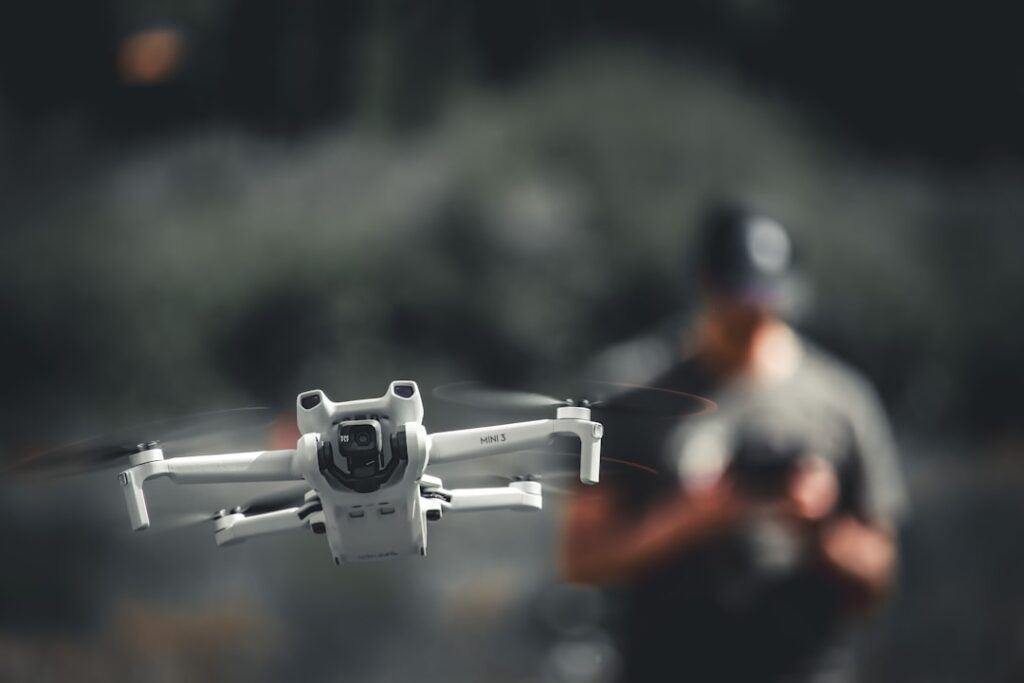
The Game-Changing Drone: Brinc’s Guardian
Blake Resnick, a former Thiel Fellow, has launched a drone called Guardian. It’s designed to replace police helicopters.
Resnick’s startup, Brinc, has been working on unmanned-air systems for police and municipal agencies across the United States for nine years. The company’s latest offering, Guardian, is a quad-rotor drone that Resnick describes as “the closest thing to a police helicopter replacement that the drone industry has ever produced.”
Replacing Police Helicopters: A Safer, More Efficient Option?
Police helicopters have been a staple of urban law-enforcement for decades, but they come with a high price tag. Guardian sidesteps many of these expenses. It runs on swappable lithium-ion packs that are recharged automatically in a “charging nest,” eliminating on-site fuel handling and the need for a crew-rest schedule.
The system can be deployed from a modest ground station, meaning municipalities can field aerial assets without the overhead of a dedicated hangar or runway. Beyond the balance sheet, the drone’s smaller footprint reduces risk to bystanders. Helicopter rotors generate dangerous down-wash, and low-altitude flight over crowds can be hazardous.
Cost considerations
Brinc has not disclosed a unit price, but the company emphasizes that the total cost of ownership is dramatically lower than that of a traditional rotorcraft. No fuel contracts, no pilot salaries, and no mandatory annual overhauls translate into a fraction of the expense per flight hour.
It can cruise at up to 60 mph and sustain a 62-minute flight, giving it enough endurance to patrol a city’s perimeter or circle a disaster zone without needing a mid-mission battery change.
The Capabilities of Guardian: A Closer Look
Guardian’s specifications are built around the demands of emergency response. It can cruise at up to 60 mph and sustain a 62-minute flight, giving it enough endurance to patrol a city’s perimeter or circle a disaster zone without needing a mid-mission battery change.
The payload includes a thermal imaging camera and two 4K visual cameras, each equipped with optical zoom. Resnick claims the system can read license plates from “significant altitude,” a capability that could streamline traffic enforcement and suspect identification.
Operational flexibility
 AI & Technology
How Google and Unity Are Transforming Game Development
The new platform by Google and Unity enables game developers to create video games from prompts, streamlining the development process and making game design more…
Read More →Because Guardian is autonomous, it can be programmed to follow predefined flight paths or respond to real-time commands from a ground control station. Its software suite integrates with existing dispatch systems, allowing a single operator to launch, monitor, and retrieve the drone while maintaining situational awareness through live video feeds.

Industry Reaction: Will Brinc’s Drone Revolutionize Public Safety?
The launch has sparked a mixture of enthusiasm and caution among municipal leaders and industry observers. On the one hand, the promise of a “most capable 9-11 response drone” resonates with agencies that have struggled to justify helicopter budgets while still needing rapid aerial insight.
Early adopters are reportedly testing Guardian in live scenarios, focusing on high-visibility events and emergency medical dispatch. The ability to carry life-saving supplies directly to a scene has been highlighted as a differentiator, especially in rural jurisdictions where ambulance response times can exceed 15 minutes.
Investor confidence
The involvement of Sam Altman as an early seed investor adds a layer of credibility that extends beyond the drone market. Altman’s track record of backing transformative technology signals to other venture firms that Brinc’s growth trajectory is worth watching.

On the one hand, the promise of a “most capable 9-11 response drone” resonates with agencies that have struggled to justify helicopter budgets while still needing rapid aerial insight.
The Future of Public Safety: Strategic Perspective
Guardian arrives at a moment when municipalities are re-evaluating every line item in their budgets. If the drone can deliver reliable aerial intelligence at a fraction of the cost of a helicopter, it could reshape procurement strategies across the country.
Challenges remain. Regulatory pathways for beyond-visual-line-of-sight operations, data-privacy safeguards, and community acceptance of persistent aerial surveillance will all influence adoption rates. Brinc’s next steps—expanding the charging-nest network, integrating third-party analytics, and possibly developing a fixed-wing VTOL variant—will determine whether Guardian becomes a niche tool or a new standard for public-safety aviation.
 AI & Technology
Google Launches AI Game Development Tool for Creators
Google's new AI tool, Playground, allows game creators to build games using simple prompts without coding. This innovation significantly lowers barriers for indie developers, fostering…
Read More →
One thing is clear: the conversation about how cities watch, protect, and respond to emergencies is no longer limited to the roar of rotor blades. Guardian’s debut forces policymakers to weigh the economics of altitude against the realities of risk, and it may well be the catalyst that grounds the traditional police helicopter in favor of a quieter, more versatile sky.
Written by Career Ahead AI. AI can make mistakes, so verify key facts. Report errors to support@careeraheadonline.com.





