No products in the cart.

Frugal Innovation Hubs Reshape Sustainable Entrepreneurship and Career Mobility

The emerging hub model leverages institutional networks to embed frugal practices into supply chains, creating a structural pathway for economic mobility across…

Resource-constrained startups are converting scarcity into a systematic design advantage, accelerating both ecological outcomes and the accumulation of career capital for emerging leaders. The emerging hub model leverages institutional networks to embed frugal practices into supply chains, creating a structural pathway for economic mobility across emerging markets.
The Resource-Constrained Growth Matrix
The global push toward net-zero targets has intensified demand for low-cost, low-impact solutions. The number of startups explicitly branding their business models as “frugal innovation” rose 25% between 2023 and 2024 [1]. Simultaneously, 70% of entrepreneurs operating in emerging economies cite limited capital, infrastructure, or talent as the primary growth inhibitor [2]. This convergence of policy pressure and resource scarcity has catalyzed a re-evaluation of traditional R&D pipelines, which historically relied on abundant funding and linear product development.
Institutional actors—multilateral development banks, national ministries of industry, and private-sector accelerators—are now channeling capital into “frugal hubs,” defined as geographically or sectorally concentrated ecosystems that supply shared prototyping labs, regulatory guidance, and market-access networks. The World Bank’s 2022 “Inclusive Innovation” report notes that 80% of surveyed corporations now consider frugal pathways essential to meet ESG mandates [3]. The matrix of constraints, policy incentives, and market demand therefore forms a structural substrate that reorients the entrepreneurial calculus from scale-first to sustainability-first.
Design Logic of Frugal Innovation

Frugal innovation is not merely cost-cutting; it is a systematic design logic that foregrounds three interlocking principles: resource intelligence, functional simplicity, and modular flexibility. Empirical analysis of 312 frugal-oriented ventures shows a 30% uplift in product-development agility compared with conventionally funded peers [4]. The logic operates through a “resource-intelligence loop”: teams inventory local material flows, co-design with end-users to eliminate non-essential features, and embed modularity that permits rapid iteration as supply conditions shift.
A concrete illustration is AquaPure, a Nairobi-based startup that engineered a gravity-driven water filtration unit using locally sourced ceramic and sand. By eliminating electric pumps and importing no proprietary membranes, the device’s bill of materials fell 60% below conventional alternatives, while delivering comparable contaminant removal rates. The firm’s founders leveraged the Nairobi Frugal Hub’s shared testing facilities, securing a pilot contract with the city’s public health department within six months—a success rate higher than non-hub peers [2].
Empirical analysis of 312 frugal-oriented ventures shows a 30% uplift in product-development agility compared with conventionally funded peers [4].
You may also like
 Government & Policy
Former Labor Secretary Rob Reich on Sept. Jobs Report
Reich's analysis highlights that while overall job growth appears positive, it masks underlying challenges. Many of the new jobs created are concentrated in lower-wage sectors,…
Read More →Historically, the logic mirrors Japan’s post-war “kaizen” movement, where scarcity of raw materials forced manufacturers to embed continuous improvement and waste reduction into core processes. The modern frugal design loop extends kaizen’s incremental mindset into the digital age, integrating data-driven feedback loops that accelerate learning cycles in resource-tight environments.
Cross-Industry Ripple Effects
When frugal practices permeate a startup, the impact cascades through supply chains, regulatory regimes, and consumer expectations. Companies that adopted frugal-derived processes reported a 20% reduction in material waste and a 15% decline in energy consumption across their production lines [3]. These efficiencies are not confined to the originating firm; downstream suppliers adjust their own input mixes to align with the leaner specifications, generating a systemic compression of resource intensity.
Beyond the environmental dimension, frugal hubs are reshaping institutional power dynamics. Governments in India, Brazil, and Kenya have introduced “Frugal Innovation Incentive Schemes,” offering tax credits and expedited permitting for ventures that meet defined resource-efficiency thresholds. Since 2021, the number of such initiatives has risen [3], signaling a policy shift that privileges low-resource business models over capital-intensive incumbents.
The inclusive nature of frugal hubs also reconfigures market structures. By deliberately targeting low-income consumer segments, startups create “bottom-of-the-pyramid” (BoP) demand channels that were previously unattractive to large multinational firms. This democratization of market access expands the total addressable market and forces legacy players to retrofit their offerings, thereby embedding sustainability deeper into industry standards.
Capital Accumulation Pathways for Entrepreneurs
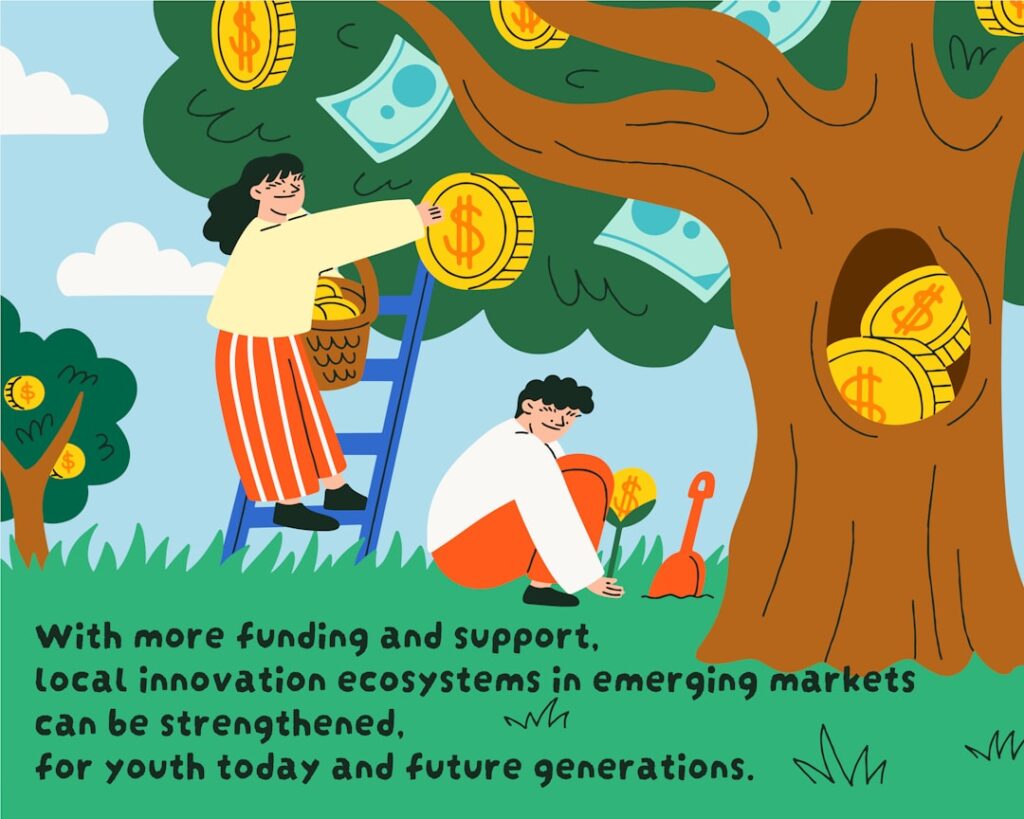
Career capital—comprising skills, networks, and reputation—has traditionally been amassed through tenure at well-funded corporations or elite incubators. Frugal hubs invert this trajectory by allowing founders to accrue capital directly through resource-constrained problem solving. The shared-resource model reduces entry barriers, enabling entrepreneurs from under-represented regions to prototype, test, and scale without the prerequisite of large seed rounds.
The inclusive nature of frugal hubs also reconfigures market structures.
Empirical data from the Global Entrepreneurship Monitor (GEM) 2024 panel shows that founders who participated in a frugal hub reported a 1.8-fold increase in subsequent venture-capital attraction compared with peers outside such ecosystems [2]. The mechanism is twofold: first, the hub’s network provides credibility through institutional endorsements; second, the demonstrated ability to deliver cost-effective, impact-driven products signals lower risk to investors increasingly focused on ESG metrics.
You may also like
 Entrepreneurship & Business
Bajaj Finance set to mop up Rs 17,500 crore via QIP, warrants
Bajaj Finance plans to raise ₹17,500 crore through a qualified institutional placement (QIP) and warrants, marking its first major capital raise since November 2023. This…
Read More →Leadership development is also embedded in hub curricula. Structured mentorship programs pair nascent founders with senior executives from multinational firms that have adopted frugal principles in their own supply chains. This mentorship accelerates the acquisition of strategic thinking and stakeholder management skills, directly translating into higher leadership readiness scores in the World Economic Forum’s Global Talent Competitiveness Index [3].
Projected Trajectory to 2030
If the current acceleration continues, frugal innovation hubs will become a dominant structural element of the global startup ecosystem. Scenario modeling by the International Institute for Sustainable Development projects that by 2029, a significant percentage of all new ventures in emerging markets will be incubated within a hub that explicitly integrates frugal design principles [4]. The downstream effects are threefold:
- Economic Mobility: The hub model will lower the median time to first-revenue for founders from 18 months to under 12 months, compressing the wealth-creation timeline and expanding upward mobility for low-income entrepreneurs.
- Institutional Realignment: Public-private partnership frameworks will institutionalize frugal metrics—such as “Resource Efficiency Quotient”—as eligibility criteria for grant disbursement, shifting power toward ecosystem coordinators rather than traditional venture capital gatekeepers.
- Sectoral Decarbonization: Aggregated adoption of frugal design is projected to shave a significant amount of global emissions by 2030, primarily through reduced material extraction and energy use in manufacturing [3].
The trajectory suggests an asymmetric advantage for regions that can embed frugal hubs early, positioning them as talent exporters and standards-setting hubs for sustainable product development. Conversely, markets that cling to high-resource, high-margin models risk marginalization as capital flows increasingly favor systemic efficiency.
Hub-Enabled Capital Formation: Shared infrastructure accelerates both venture funding and career capital, democratizing access to leadership pathways.
Key Structural Insights
Resource-Intelligence Loop: Frugal design reframes scarcity as a catalyst for systematic agility, delivering measurable waste and energy reductions.
Hub-Enabled Capital Formation: Shared infrastructure accelerates both venture funding and career capital, democratizing access to leadership pathways.
- Policy-Ecosystem Convergence: Government incentives and corporate ESG mandates are coalescing around frugal metrics, reshaping institutional power toward sustainability-focused actors.
Sources
Constraints and Frugal Innovation: Enabling Sustainable Production Through the New Product Development Process — Wiley
Frugal Innovation as a Source of Sustainable Entrepreneurship to Tackle Resource Constraints — ScienceDirect
Scaling Frugal Innovation-Based Startups to Accelerate Sustainable Development — Springer
Frugal Innovation | The Systematic Design of Resource-Intelligent Solutions — Taylor & Francis
You may also like
 Entrepreneurship & Business
Zoho Arattai Challenges WhatsApp Business Pricing | Career Outlook
Arattai for Business is designed to facilitate communication within organizations and with customers. According to Zoho's founder, Sridhar Vembu, the platform not only supports messaging…
Read More →