No products in the cart.

AI and Mental Health What Science Really Says About AI Psychosis
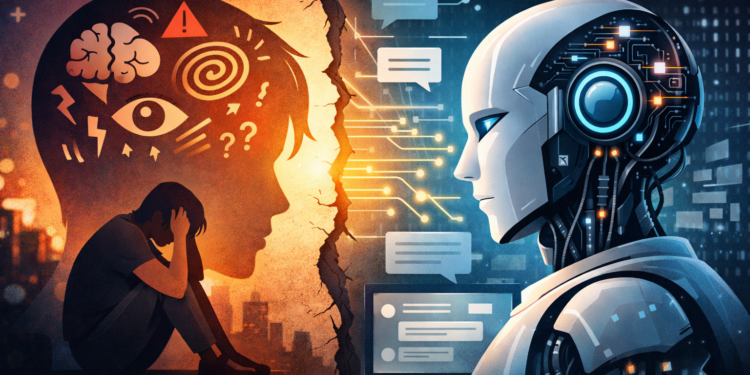
As AI tools become part of daily life, fears around mental health impacts are growing. This evidence based explainer examines what science actually says about so called AI psychosis, separating viral myths from verified research and expert insight.

Why the term “AI psychosis” is misleading and what science really says
Artificial intelligence has moved faster than almost any technology in recent memory. In just a few years, conversational AI tools have gone from research demos to everyday companions for writing, studying, problem solving, and conversation. Millions of people now interact with AI systems daily.
Alongside this rapid adoption, a new phrase has begun circulating online “AI psychosis”.
It sounds alarming. It spreads quickly on social media. And it raises a serious question can interacting with AI harm mental health
The short answer, based on current scientific evidence, is no AI does not cause psychosis. But the longer answer is more nuanced and more important.
What people mean when they say “AI psychosis”
“AI psychosis” is not a medical term. It does not appear in psychiatric manuals, and it is not recognized by clinicians or researchers.
Instead, the phrase is being used informally to describe situations where people experience psychological distress after prolonged or emotionally intense interaction with AI systems. These experiences may include
Believing AI responses carry hidden or personal meaning
Attributing intention or agency to an automated system
Strong emotional reliance on AI conversations
Difficulty separating AI generated output from real world authority
Increased anxiety withdrawal or rumination
In clinical language, some of these patterns can resemble delusion like thinking obsessive cognition or dissociation. But resemblance does not equal diagnosis.
In clinical language, some of these patterns can resemble delusion like thinking obsessive cognition or dissociation.
There is currently no evidence that AI systems independently cause psychotic disorders in people who were previously healthy.
Why AI can feel psychologically powerful
AI systems are not conscious. They do not possess beliefs awareness or intent. But they are extremely good at producing fluent confident language and that matters psychologically.
You may also like
 AI & Technology
AI and sustainability redefine entrepreneurship landscape in 2026
A 2025 OECD report estimates that AI‑augmented startups achieve market‑fit three quarters faster than pre‑AI cohorts.
Read More →Several characteristics make AI interactions unusually immersive
AI responses sound authoritative even when speculative or incorrect
Language models mirror tone and emotion which can feel validating
AI is available constantly without social boundaries or fatigue
Conversations feel personalized because systems retain context
For most users, this poses little risk. But for people who are already emotionally distressed socially isolated sleep deprived or experiencing anxiety or depression these features can unintentionally reinforce unhelpful thinking patterns.
This is not because the AI is influencing the mind in a mysterious way. It is because humans are wired to respond socially to language even when it comes from nonhuman sources.
What research actually shows
Despite viral headlines, research so far paints a measured picture.
A large cross lagged study involving nearly four thousand adolescents examined whether AI dependence leads to mental health decline or whether existing distress predicts AI reliance. The findings were clear anxiety and depressive symptoms predicted later dependence on AI tools. AI use did not independently predict worsening mental health outcomes.
In other words, people who are already struggling are more likely to turn to AI. The AI itself was not shown to create new mental health disorders.
Clinical professionals have echoed this caution.
Other experimental research has found that repeated exposure to conversational AI optimized for social interaction can increase feelings of attachment. Participants were more likely to describe the AI as companion like over time. However this attachment did not translate into improved wellbeing or reduced loneliness.
Clinical professionals have echoed this caution. Mental health organizations warn that AI systems are not substitutes for therapy. They lack contextual judgment ethical responsibility and the ability to detect crisis in the way trained clinicians do. In some cases they may reinforce cognitive distortions simply by reflecting user input back to them.
What the evidence does not support
There is no recognized condition called “AI psychosis”.
There is no peer reviewed evidence that AI causes psychotic illness.
There is no data showing AI induces hallucinations in healthy users.
You may also like
 AI & Technology
Google Gemini, OpenAI Dots: Select Your AI Powerhouse
Explore the distinct functionalities of Google Gemini Tasks and OpenAI Dots to determine which AI productivity tool best suits your needs. This article delves into…
Read More →Many stories circulating online rely on anecdotal accounts without clinical verification. While these experiences should not be dismissed they cannot be generalized into scientific conclusions.
Where the real risks are
The most consistent risk factors identified by researchers and clinicians are not technological but human
Pre existing anxiety depression or trauma
Severe stress or sleep deprivation
Social isolation or loneliness
Using AI as a replacement for human support
Excessive use focused on identity destiny or hidden meanings
In these contexts, AI can act as an amplifier rather than a cause.
How to use AI responsibly for mental wellbeing
Experts recommend clear boundaries
Treat AI as a tool not a confidant or authority on personal meaning
Avoid relying on AI for emotional validation or mental health diagnosis
Take breaks from AI use during periods of stress or overwhelm
Maintain offline routines social contact and sleep
Seek professional help when thoughts feel intrusive fixed or distressing
AI can assist with productivity learning and creativity. It should not be expected to replace human judgment care or connection.
The bottom line AI is not breaking minds.
The bottom line
AI is not breaking minds. But it reflects what users bring into the interaction.
For most people, AI is simply useful software. For a smaller group of vulnerable users, especially during periods of psychological strain, unbounded interaction can reinforce distress.
Understanding that distinction matters more than viral labels.
You may also like
 AI & Technology
OLED MacBook Pro Design Revolution Under John Ternus
This development is particularly relevant for product designers and hardware engineers in the tech industry. The introduction of touch-screen OLED technology not only enhances the…
Read More →Responsible use grounded in evidence not fear is the way forward.
Reading list and sources
Cross lagged analysis of AI dependence and adolescent mental health
https://www.dovepress.com/ai-technology-panicis-ai-dependence-bad-for-mental-health-a-cross-lagg-peer-reviewed-fulltext-article-PRBM
Experimental study on psychological attachment to conversational AI
https://arxiv.org/abs/2512.01991
British Association for Counselling and Psychotherapy guidance on AI and mental health
https://www.bacp.co.uk/news/news-from-bacp/ai-and-therapy/
Artificial intelligence in healthcare overview
https://en.wikipedia.org/wiki/Artificial_intelligence_in_healthcare