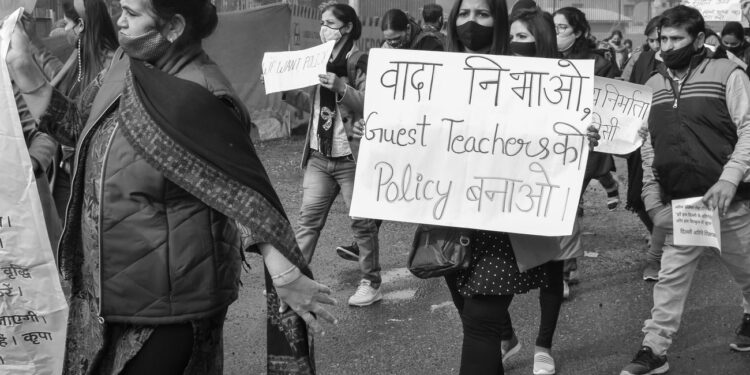
Students in Delhi have maintained large-scale protests demanding education reform despite police attempts to disperse gatherings. The movement, sparked by widespread exam-paper leaks, has drawn participants from multiple universities and colleges across the capital.
The protests began in early March 2026 when leaked examination papers for national entrance exams were reported in several Indian states. Demonstrations intensified in Delhi during the week of March 12-18, when students organized marches, sit-ins, and overnight encampments outside the Ministry of Education and university campuses. Police deployed riot gear and used water cannons to clear streets, but many participants remained, refusing to disperse and continuing to chant demands for systemic change [1].
Student leaders, representatives of the All India Students’ Union (AISU), and members of opposition political parties have coordinated the actions. Police officials from the Delhi Police Commissioner’s office have issued notices ordering the removal of protest structures and have filed charges against several organizers. The protests have been sustained through social-media coordination, with participants using encrypted messaging apps to organize flash-mob tactics and to document police actions [1].
Background and Timeline of the Protests
The initial trigger was the leak of answer keys for the Joint Entrance Examination (JEE) Main and Advanced, as well as the National Eligibility cum Entrance Test (NEET), in late February 2026. Students alleged that the leaks reflected deeper corruption within the examination administration and called for an independent oversight body [3].
Following the leaks, student groups in Delhi organized a “cockroach” movement—a reference to a protest slogan demanding that the government “squash the cockroach of corruption.” On March 5, a small rally outside the Central Board of Secondary Education (CBSE) headquarters attracted roughly 2,000 participants. By March 12, the movement expanded to a citywide march that converged on the Ministry of Education, drawing an estimated 15,000 students and supporters [1].
By March 12, the movement expanded to a citywide march that converged on the Ministry of Education, drawing an estimated 15,000 students and supporters [1].
Between March 13 and March 16, police issued a series of warnings and subsequently moved to disperse the encampments with water cannons and tear-gas canisters. Despite these measures, participants re-established their presence each night, citing constitutional rights to peaceful assembly. On March 18, police announced a temporary halt to the marches after a reported clash resulted in injuries to several officers and protestors alike [1].
Delhi Police employed standard crowd-control protocols, including the deployment of riot shields, batons, and non-lethal munitions. Official statements indicated that the force aimed to prevent obstruction of traffic and to maintain public order [2]. The police also filed criminal complaints against identified student leaders under sections of the Indian Penal Code relating to unlawful assembly and incitement [1].
Student organizers responded by forming “peaceful resistance cells” that emphasized non-violent civil disobedience. They used mobile loudspeakers to broadcast speeches, organized candlelight vigils, and distributed pamphlets outlining specific reform demands: the creation of an autonomous exam-monitoring agency, transparent grading procedures, and increased funding for public higher-education institutions [3].
Human-rights observers from the National Human Rights Commission (NHRC) documented instances of excessive force, noting that water-cannon use occurred at night when many protestors were sleeping in tents. The NHRC called for an independent inquiry into police conduct, while the Ministry of Home Affairs defended the actions as necessary to enforce law and order [1].
Impact on Students and Educational Institutions
The ongoing protests have prompted several universities in Delhi, including the University of Delhi and Jawaharlal Nehru University, to temporarily suspend classes to ensure safety on campus. Examination boards have announced a review of security protocols for upcoming entrance exams scheduled for May 2026, citing the need to restore public confidence [3].
Impact on Students and Educational Institutions The ongoing protests have prompted several universities in Delhi, including the University of Delhi and Jawaharlal Nehru University, to temporarily suspend classes to ensure safety on campus.
Student unions across India have reported a surge in membership, with many institutions forming new committees to address exam integrity and curriculum relevance. The Ministry of Education has scheduled a meeting with student representatives for early April to discuss potential policy revisions, though no formal proposals have been released as of July 23 2026 [2].
Educators have expressed concerns about disruptions to academic calendars and the psychological impact on students involved in the protests. Meanwhile, private tutoring firms reported a short-term increase in enrollment as students seek alternative preparation methods amid uncertainty surrounding official exam schedules [3].
Key Facts
What: Indian students in Delhi continue protests demanding education reform after police crackdowns over exam-paper leaks.
When: Protests intensified between March 5 and March 18 2026 and remain ongoing as of July 23 2026.
What: Indian students in Delhi continue protests demanding education reform after police crackdowns over exam-paper leaks.
Impact: Demonstrations have led to class suspensions, a review of exam security, and pending discussions between the Ministry of Education and student leaders.
Sources
India’s ‘cockroach’ protest movement halts marches after police violence – Al Jazeera
A warning shot for 2029? Why Delhi protests hold key for Opposition too – The Federal
Thousands Protest in India Over Exam Leaks Amid Youth-Led Movement – Global Banking & Finance Review



 News
NewsNews