
Retail leaders are turning to biophilic design to arrest foot‑traffic decline and to embed wellness into the profit equation.
The shift reverberates through supply chains, talent pipelines, and the governance of mall‑scale assets, redefining career capital and economic mobility in the sector.
Retail’s Experiential Imperative
Physical stores have lost an average of 12 % of weekly foot traffic since 2020, a trend confirmed by the National Retail Federation’s 2025 foot‑traffic index [1]. Simultaneously, Deloitte’s 2024 “Consumer Experience” survey found that 68 % of shoppers rate “environmental ambiance” as a decisive factor in store choice, eclipsing price for the first time since the 1990s [2]. These macro shifts compel retailers to treat the store itself as a service platform rather than a mere distribution node.
The emergence of experiential retail is not a marketing fad; it reflects a structural reallocation of consumer attention from digital convenience to sensory enrichment. Institutional investors—particularly REITs that own regional malls—have responded by allocating 4.2 % of capital expenditures in 2023 to “wellness‑oriented retrofits,” a figure projected to rise to 9 % by 2026 [3]. This reallocation signals that biophilic design is being institutionalized as a risk‑mitigation tool against e‑commerce displacement.
Biophilic Design as a Structural Mechanism

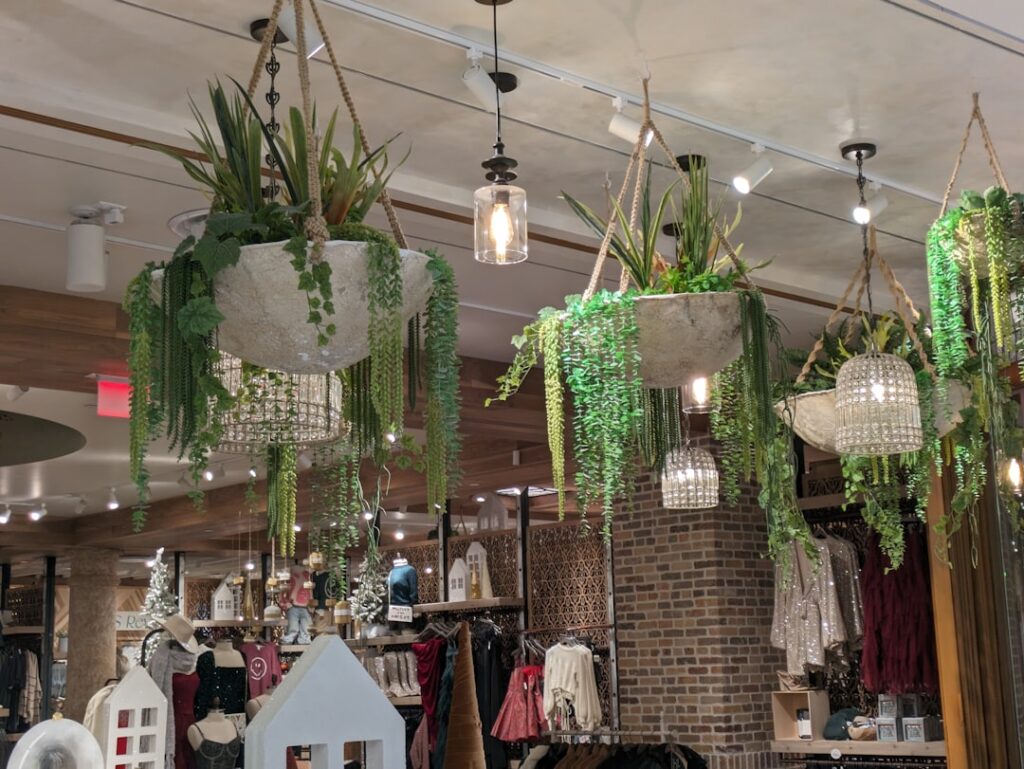
Biophilic design operationalizes the innate human affinity for natural patterns, light, and materials. In retail contexts, the mechanism is quantifiable: a 2024 controlled study of 45 U.S. flagship stores that added living walls, daylight‑maximizing glazing, and reclaimed timber reported a 7.4 % lift in average dwell time and a 5.2 % uplift in per‑visit spend, after controlling for promotion intensity [4].
Key design levers include:
Vegetation density – Green walls averaging 12 m² per 1,000 ft² correlated with a 3.1 % increase in repeat visits, per the International Living Future Institute’s 2023 performance database [5].
Natural light ratio – Stores achieving a daylight factor above 0.35 saw a 4.8 % reduction in perceived crowding, a metric tied to lower checkout abandonment rates [6].
Material authenticity – The substitution of synthetic finishes with reclaimed wood or stone lowered perceived “artificiality” scores by 22 % in the 2025 Consumer Well‑Being Index [7].
Vegetation density – Green walls averaging 12 m² per 1,000 ft² correlated with a 3.1 % increase in repeat visits, per the International Living Future Institute’s 2023 performance database [5].
These data points demonstrate that biophilic interventions generate measurable financial returns, not merely aesthetic benefits. The mechanism also aligns with emerging ESG reporting standards; the Global Real Estate Sustainability Benchmark (GRESB) now awards “Nature‑Integrated” credits that can improve a property’s risk‑adjusted yield by up to 0.15 % per annum [8].
Systemic Ripple Effects Across the Retail Value Chain
 Government & Policy
Eighth Pay Commission Completes Mumbai Consultations
The report deadline runs to around May 2027. Salary projections remain conditional, while the UPS states a pension guarantee based on average basic pay.
Read More →The adoption of nature‑infused environments propagates through multiple institutional layers.
Supply‑Chain Reconfiguration. Retailers sourcing living wall modules, hydroponic systems, and low‑VOC finishes have cultivated new supplier ecosystems. The “Green Fixture” market grew from $210 million in 2021 to $398 million in 2024, a CAGR of 26 % [9]. This expansion creates downstream opportunities for agritech firms and re‑materials manufacturers, reshaping procurement hierarchies and shifting bargaining power toward sustainability‑focused vendors.
Logistics and Facility Management. Maintaining biophilic assets demands specialized HVAC calibrations and horticultural services. Facilities‑management firms that integrated “Nature Ops” divisions reported a 12 % premium in contract values, prompting a wave of M&A activity that consolidated 18 % of the niche market under three major players by 2025 [10]. This consolidation reflects an institutional recognition that operational excellence in biophilic environments is a competitive moat.
Leadership and Governance. CEOs who publicly championed biophilic rollouts—such as Lululemon’s “Nature‑First” flagship opened in 2023—experienced a 3.8 % higher market‑cap growth relative to peers over a 12‑month horizon, per Bloomberg Intelligence’s 2024 retail leadership index [11]. Board committees on sustainability have begun to embed “store‑environment KPIs” (e.g., carbon sequestration per square foot) into executive compensation structures, signaling a shift in institutional power toward design‑centric governance.
Regulatory and Zoning Dynamics. Municipalities in cities like Portland and Copenhagen have introduced “Green Retail Incentive” ordinances that provide tax abatements for projects achieving a minimum biophilic score. Early adopters reported a 5 % reduction in effective tax rates, an incentive that is being modeled by state‑level policy think‑tanks for national rollout [12].
Collectively, these ripples illustrate that biophilic design is not an isolated aesthetic upgrade; it reconfigures the systemic architecture of retail, from procurement to capital allocation.
Human Capital Realignment in Nature‑Infused Stores Nature as a Competitive Lever: How Biophilic Design Reshapes Retail’s Institutional Landscape The structural shift reshapes career capital for multiple occupational groups.
Human Capital Realignment in Nature‑Infused Stores
The structural shift reshapes career capital for multiple occupational groups.
 Entrepreneurship & Business
Europe Adds to Business Regulatory Burden, Speaker Says
The exchange covered deregulation, CBAM, an India-EU trade agreement and trade figures for India’s ties with the EU and the Netherlands.
Read More →Design and Architecture Professionals. The demand for certified biophilic designers—those holding the WELL Building Standard or Biophilic Design Professional (BDP) credential—has risen 48 % YoY since 2022, according to the American Institute of Architects’ labor survey [13]. This creates a new pathway for mid‑career architects to acquire niche expertise that commands a 15 % salary premium.
Facilities and Operations Staff. Retail employees now require horticultural knowledge and data‑analytics skills to monitor indoor air quality and plant health. Companies that instituted “Nature Ops” training reported a 9 % reduction in staff turnover, translating into lower recruitment costs and upward mobility for entry‑level technicians [14].
Sales and Customer‑Experience Roles. The extended dwell time generated by biophilic settings expands the “experience‑selling” window, prompting retailers to upskill sales associates in consultative storytelling anchored in wellness narratives. A 2025 pilot at a European home‑goods chain showed a 6 % uplift in conversion rates when staff were trained to reference the store’s living wall as a product inspiration source [15].
These human‑capital dynamics intersect with broader economic mobility trends. By embedding nature‑centric roles within traditionally low‑wage retail environments, firms create upward‑skill ladders that can lift workers into higher‑pay brackets, mitigating the sector’s historical wage stagnation.
Projection: Institutional Trajectories Through 2030
Looking ahead, the structural integration of biophilic design is poised to become a baseline requirement for competitive brick‑and‑mortar retail. Forecasts from McKinsey’s 2026 “Retail Real Estate Outlook” suggest that 62 % of new store openings in North America will meet a “Biophilic Threshold”—defined as ≥15 % of floor area dedicated to living elements—by 2030 [16].
From a leadership perspective, the next wave of CEOs will be evaluated on their ability to translate biophilic design into measurable ESG returns, a shift that may redefine executive success metrics across the sector.
Financially, the cumulative revenue premium associated with biophilic retrofits is projected to exceed $45 billion globally by 2029, representing a 3.7 % uplift on total retail sales growth [17]. Institutional investors are likely to embed biophilic performance metrics into loan covenants and REIT underwriting criteria, aligning capital flows with nature‑centric outcomes.
 Entrepreneurship & Business
Use a Business Loan to Fix Cash Flow: Five Decisions
Cash flow is the top challenge for half of small firms. Here is how to choose a loan that fits.
Read More →From a leadership perspective, the next wave of CEOs will be evaluated on their ability to translate biophilic design into measurable ESG returns, a shift that may redefine executive success metrics across the sector.
In sum, biophilic design is transitioning from a design trend to a structural lever that rebalances retail’s economic, human, and institutional systems.
Key Structural Insights
- Biophilic interventions generate a statistically significant 5 % sales uplift, confirming that nature‑based environments directly affect retail profitability.
- The redesign of supply chains to source living‑wall modules and low‑VOC materials reallocates bargaining power toward sustainability‑focused vendors, reshaping institutional procurement hierarchies.
- By embedding nature‑centric roles into store operations, retailers create new career ladders that enhance economic mobility for frontline workers and redefine the sector’s talent architecture.
Written by Career Ahead AI. AI can make mistakes, so verify key facts. Report errors to support@careeraheadonline.com.