No products in the cart.

Sustainable Fashion’s Supply‑Chain Reset: From Emissions to Economic Mobility

Sustainable fashion’s circular models are reshaping institutional power and career capital, turning climate risk into a structural source of competitive advantage while driving supply‑chain resilience through policy, technology, and impact‑linked finance.

The shift toward circular, technology‑enabled fashion is redefining institutional power, reallocating career capital, and embedding resilience into a sector responsible for roughly one‑tenth of global greenhouse‑gas emissions.
Climate‑Driven Pressure on Textile Emissions
The textile value chain accounts for an estimated 10 % of global output in greenhouse gas emissions annually—approximately 1.2 billion tonnes of CO₂‑equivalent emissions, and consumes 79 million m³ of water each year, rivaling the total water use of some nations [3]. Climate‑related disruptions—floods in Bangladesh, droughts in the Indian cotton belt, and heatwaves across Southeast Asia—have translated into production delays, price volatility, and heightened regulatory scrutiny [4].
Institutionally, the European Green Deal’s “Circular Economy Action Plan” mandates that 30 % of textile fibers be recycled by 2030, while the U.S. Inflation Reduction Act (IRA) extends tax credits to manufacturers that meet verified carbon‑reduction thresholds [2]. These policy levers convert environmental risk into a structural incentive for firms to embed sustainability at the core of their operations.
Circularity as the Core Mechanism of Supply‑Chain Resilience

Circular business models replace the linear “take‑make‑dispose” paradigm with loops of reuse, refurbishment, and material regeneration. The mechanism operates on three interlocking levers:
- Material Regeneration – Closed‑loop recycling technologies, such as chemical fiber depolymerization, enable the recovery of up to 95 % of polyester content, reducing virgin petroleum demand and stabilizing input costs [1].
- Product‑Life Extension – Rental and resale platforms (e.g., Rent the Runway, Vestiaire Collective) increase garment utilization rates from an industry average of 1.5 years to over 3 years, diluting the environmental intensity per wear [2].
- Digital Traceability – Blockchain ledgers and AI‑driven analytics provide immutable records of fiber provenance, water usage, and labor conditions, allowing brands to certify compliance with ESG standards in real time [2].
Patagonia’s “Worn Wear” program exemplifies this mechanism: since 2013, the initiative has reclaimed 2 million kg of polyester, translating into a 5 % reduction in the company’s carbon footprint while generating a 12 % uplift in repeat customer spend [3]. Similarly, Adidas’ partnership with Parley for the Oceans has integrated 50 million tonnes of ocean‑derived plastic into its shoe line, delivering a 30 % emissions cut per unit compared with conventional nylon [1].
Digital Traceability – Blockchain ledgers and AI‑driven analytics provide immutable records of fiber provenance, water usage, and labor conditions, allowing brands to certify compliance with ESG standards in real time [2].
Institutional Realignment and Systemic Ripple Effects
You may also like
 Entrepreneurship & Business
Marico Boosts Plix Stake to 84.09%; Q2 Revenue Surge Ahead
Marico has increased its stake in Satiya Nutraceuticals to 84.09%, a strategic move expected to enhance revenue growth amid rising consumer demand for health-focused products.…
Read More →The adoption of circularity triggers a cascade of institutional adjustments across the supply chain:
Upstream Material Shifts – Cotton growers in India are transitioning to regenerative agriculture practices, supported by the World Bank’s $200 million Climate‑Smart Agriculture fund, which promises higher soil carbon sequestration and improved farmer income stability [4].
Midstream Manufacturing Reconfiguration – Textile mills in Vietnam are retrofitting with low‑temperature dyeing equipment, cutting water use by 40 % and energy consumption by 25 %—a shift accelerated by the ASEAN Green Manufacturing Initiative, which ties export incentives to sustainability metrics [2].
Downstream Retail Realignment – Retail giants such as H&M have instituted “Closed‑Loop” collection points in 1,200 stores worldwide, feeding reclaimed fibers into their “Renewcell” partnership, thereby embedding circularity into inventory planning and demand forecasting [3].
These systemic ripples reflect a structural shift akin to the post‑World War II retooling of the automotive sector, where lean production standards diffused from Toyota to global manufacturers, redefining labor relations, capital allocation, and competitive dynamics. In fashion, the diffusion of circular standards is reshaping institutional hierarchies: ESG officers now sit alongside CFOs on executive committees, and sustainability KPIs are integrated into board‑level performance dashboards [2].
Career Capital Reallocation in Sustainable Fashion
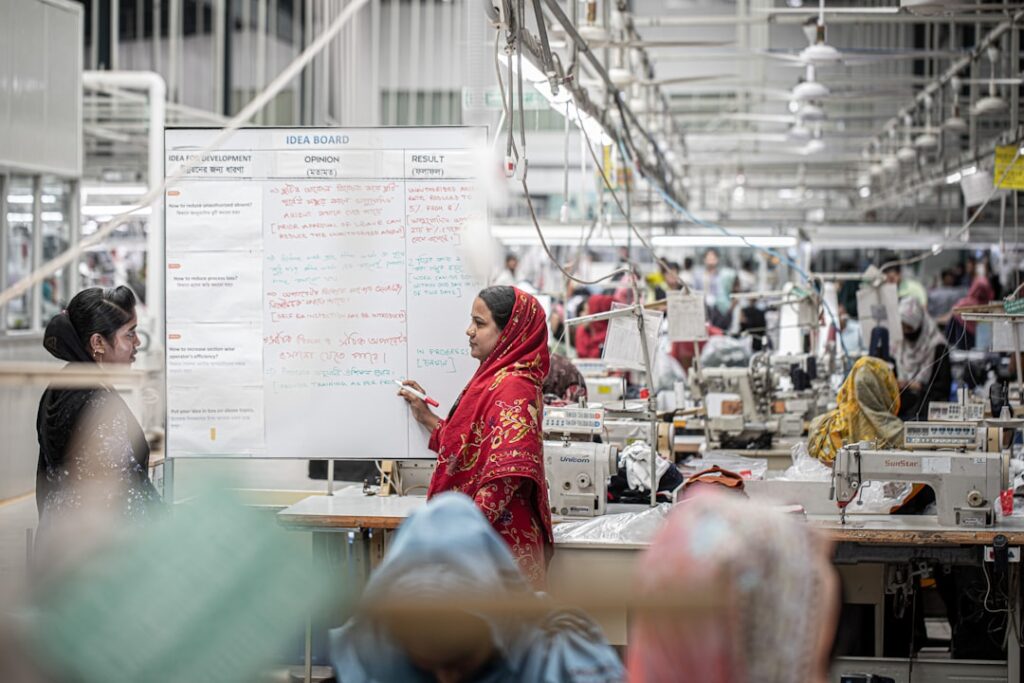
The transformation of the fashion value chain is reconfiguring career capital—knowledge, networks, and credentials—across three dimensions:
- Skill Set Evolution – Demand for expertise in material science (e.g., bio‑based fibers), data analytics (supply‑chain carbon accounting), and regulatory compliance has surged. LinkedIn reports a 68 % YoY increase in job postings for “circular supply chain manager” roles between 2022 and 2025 [1].
- Economic Mobility Pathways – Fair‑wage certifications, such as the Fair Wear Foundation, are being embedded into supplier contracts, creating upward mobility channels for garment workers. In Bangladesh, factories that attained Fair Wear certification saw a 15 % wage premium and a 22 % reduction in turnover, fostering a more stable labor pool for downstream firms [3].
- Leadership Reorientation – CEOs who champion sustainability—Stella McCartney (Stella McCartney Ltd.), François‑Henri Pinault (Kering), and Phebe Bekker (Riot Studios)—are leveraging board influence to allocate capital toward R&D in regenerative fibers, thereby signaling institutional commitment that attracts impact investors.
Venture capital flows illustrate this capital reallocation: sustainable‑fashion startups attracted $5.3 billion in equity financing from 2021‑2025, a 4.2× increase over the prior five‑year period, with notable participation from funds such as Generation Investment and the Rise Fund [2]. These investments are not merely financial; they embed governance structures that prioritize ESG metrics, thereby reshaping the institutional architecture of fashion finance.
Skill Set Evolution – Demand for expertise in material science (e.g., bio‑based fibers), data analytics (supply‑chain carbon accounting), and regulatory compliance has surged.
Projected Trajectory of Supply‑Chain Resilience 2026‑2030
Looking ahead, three converging trends will define the next 3‑5 years:
You may also like
 Industry & Global Trends
BT Expands Reach with TalkTalk Acquisition
The acquisition is seen as a strategic necessity for BT, allowing it to consolidate its position in a market that has seen increasing pressure from…
Read More → Policy Convergence – By 2028, the EU’s “Textile Strategy” and the U.S. “Sustainable Apparel Act” will harmonize labeling standards, creating a unified compliance framework that reduces duplication costs for multinational brands by an estimated $1.2 billion annually [2].
Technology Diffusion – AI‑driven demand forecasting, combined with real‑time carbon accounting platforms (e.g., SAP Climate 21), will enable firms to adjust production runs within a 48‑hour window, cutting overproduction waste by up to 30 % [1].
Capital Reallocation – Impact‑linked bonds tied to circularity targets are projected to reach $12 billion issuance by 2030, channeling debt capital into refurbishing facilities and renewable‑energy retrofits across emerging‑market textile hubs [3].
These dynamics will produce a bifurcated industry landscape. Firms that embed circularity into governance, invest in traceability infrastructure, and align talent pipelines with sustainability competencies will capture a growing share of the $2.5 trillion global apparel market. Conversely, legacy players that cling to linear models risk regulatory penalties, supply disruptions, and eroding brand equity, potentially leading to consolidation or market exit.
In sum, sustainable fashion is not a peripheral trend but a systemic reconfiguration of the global textile supply chain—one that reshapes institutional power, reallocates career capital, and embeds resilience into the sector’s economic core.
[Insight 2]: Institutional realignment—spanning policy, finance, and corporate governance—creates asymmetric incentives that accelerate supply‑chain transformation and expand economic mobility for low‑skill workers.
Key Structural Insights
[Insight 1]: Circular business models convert environmental risk into a durable source of competitive advantage by aligning material regeneration, product‑life extension, and digital traceability.
[Insight 2]: Institutional realignment—spanning policy, finance, and corporate governance—creates asymmetric incentives that accelerate supply‑chain transformation and expand economic mobility for low‑skill workers.
- [Insight 3]: The convergence of ESG‑linked capital, AI‑driven analytics, and harmonized regulation will crystallize a resilient, low‑carbon fashion ecosystem by 2030.
Sources
Assessing the Sustainable Circular Fashion Supply Chain as a Model for Achieving Economic Growth in the Global Market — MDPI
How The Global Textile Sector Can Build A Resilient Value Chain — Forbes
Sustainable Supply Chain Management in the Fast Fashion Industry: A Review — ScienceDirect
The Forces That Will Shape Fashion’s Supply Chains in 2026 — Vogue
You may also like
 Entrepreneurship & Business
College Students Shape the Future of A.I. Investment
College students are increasingly influencing the A.I. investment landscape, with initiatives like Dorm Room Fund raising substantial capital. This shift highlights the growing importance of…
Read More →