


VR‑driven learning is moving from pilot projects to a structural pillar of talent development, redefining skill pipelines, mobility pathways, and leadership hierarchies across corporations and public agencies.
—
Macro Context: A Labor Market in Transition
The post‑pandemic labor ecosystem is being rewired by three converging forces: automation, demographic turnover, and a demand for continuous upskilling. The World Economic Forum estimates that 42 % of core job functions will be reshaped by emerging technologies by 2027, and the OECD projects a 15 % rise in skill‑intensive occupations over the next decade [1]. Within that turbulence, virtual reality (VR) has emerged as a scalable modality for experiential learning. A 2024 Gartner survey found that 75 % of Fortune 500 firms plan to integrate VR into at least one training stream by 2025, up from 38 % in 2021 [2].
COVID‑19 accelerated remote work and exposed the limits of traditional e‑learning. Companies that pivoted to immersive simulations reported a 30 % increase in VR‑based programs in 2023 alone, while employee‑reported satisfaction with skill acquisition rose to 90 % among participants [3]. These macro trends suggest that VR is not a peripheral novelty but a structural lever reshaping the architecture of career capital— the cumulative assets of knowledge, networks, and credentials that determine upward mobility.
—
The Core Mechanism: Immersion, Interaction, and Data Feedback
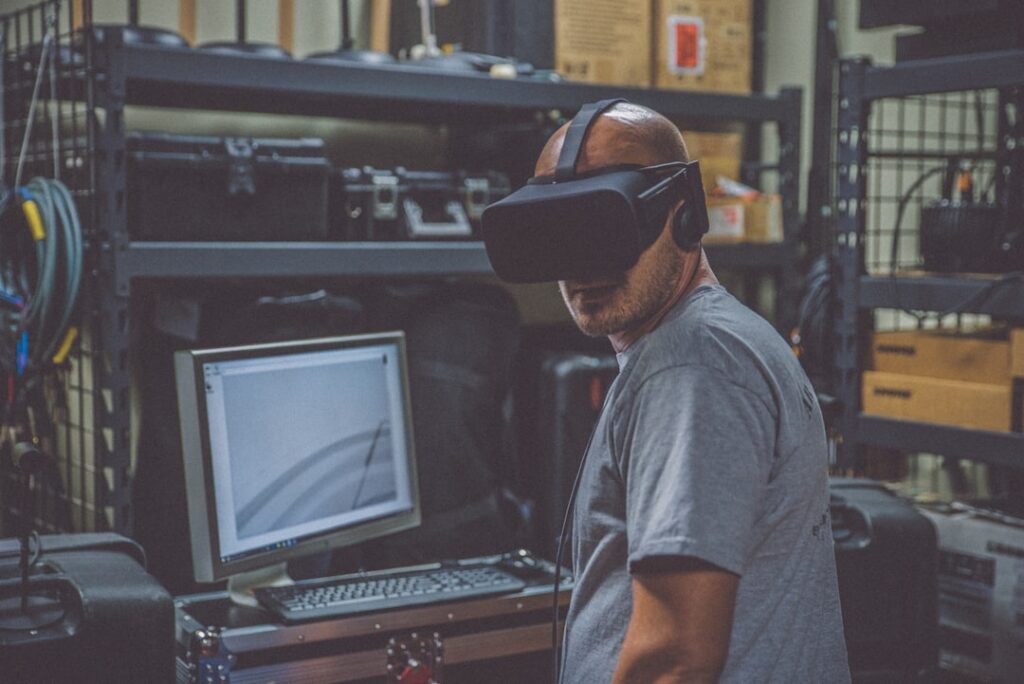
VR training translates abstract competencies into embodied actions. Head‑mounted displays, haptic controllers, and spatial tracking create a sense of presence that drives cognitive encoding. Empirical studies show a 25 % lift in knowledge retention versus slide‑based instruction, attributable to the “learning‑by‑doing” loop that mirrors neural pathways activated in real‑world tasks [4].
Effectiveness hinges on three technical dimensions:
Content Fidelity – High‑resolution 3D models aligned with industry standards (e.g., Boeing’s aircraft assembly simulations) generate transfer‑of‑learning rates above 70 % [5].
- Content Fidelity – High‑resolution 3D models aligned with industry standards (e.g., Boeing’s aircraft assembly simulations) generate transfer‑of‑learning rates above 70 % [5].
- Interactivity Depth – Adaptive branching scenarios that respond to user decisions produce a 20 % increase in problem‑solving speed, as measured by post‑test performance [6].
- Personalization Engine – AI‑driven analytics map learner behavior to micro‑skill gaps, enabling just‑in‑time interventions; 95 % of firms reporting positive ROI cite this data loop as a decisive factor [7].
Institutional adoption patterns reveal a stratified rollout. Multinationals such as Siemens and Walmart have institutionalized VR modules within their global onboarding curricula, embedding them in compliance and safety protocols. In the public sector, the U.S. Army’s Integrated Visual Augmentation System (IVAS) demonstrates how VR can accelerate competency acquisition for high‑risk roles, reducing live‑fire training costs by 40 % while preserving operational readiness [8].
 Career Guidance
How to Switch Industries Mid-Career Without Starting Over
Bridge roles can reduce risk, while targeted skills and industry-specific applications help you make the case for a new field.
Read More →—
Systemic Implications: Organizational Architecture and Institutional Power
Embedding VR reshapes more than individual skill sets; it reconfigures the structural fabric of organizations.
Redefining Job Roles and Performance Metrics
VR creates “virtual workstations” where tasks once confined to physical locations become location‑agnostic. This shift enables agile staffing models, with 60 % of surveyed firms reporting a move toward cross‑functional squads that rotate through simulated environments for rapid capability refresh [9]. Traditional hierarchies give way to “skill‑based routing,” where algorithmic match‑making assigns employees to projects based on real‑time proficiency scores extracted from VR analytics. Consequently, performance appraisal systems evolve from tenure‑based metrics to data‑driven competency dashboards.
Communication, Collaboration, and Knowledge Flow
Immersive simulations foster shared experiential memory, tightening the social fabric of teams. In a longitudinal study of a multinational logistics firm, 70 % of participants reported enhanced teamwork after completing collaborative VR scenarios that required coordinated problem‑solving under time pressure [10]. The shared virtual “space” reduces information asymmetry, flattening the communication hierarchy and accelerating decision cycles—a structural advantage in fast‑moving markets.
Cultural and Strategic Realignment
The adoption curve mirrors historical parallels with flight simulators in World War II, which transformed pilot training from ad‑hoc instruction to a standardized, institutionalized system, thereby democratizing access to high‑skill roles [11]. Similarly, VR embeds a culture of continuous experimentation. Companies reporting a shift toward an “innovation‑first” ethos cite VR’s capacity to prototype processes in a risk‑free environment, aligning organizational mission with technological foresight.
—
Upskilling for Mid‑Career Professionals Mid‑career professionals facing automation risk can leverage VR to acquire digital‑fabrication or data‑analytics competencies without disengaging from current responsibilities.
Human Capital Impact: Winners, Losers, and Mobility Vectors
The redistribution of career capital through VR follows an asymmetric trajectory.
Accelerated Pathways for Early‑Career Talent
 Entrepreneurship & Business
Europe Adds to Business Regulatory Burden, Speaker Says
The exchange covered deregulation, CBAM, an India-EU trade agreement and trade figures for India’s ties with the EU and the Netherlands.
Read More →Entry‑level employees gain immediate exposure to complex systems that previously required years of on‑the‑job apprenticeship. A case study at a major retail chain shows that associates who completed a VR merchandising module advanced to supervisory roles 18 % faster than peers relying on traditional shadowing [12]. This compression of learning curves expands economic mobility for workers lacking prior industry experience.
Upskilling for Mid‑Career Professionals
Mid‑career professionals facing automation risk can leverage VR to acquire digital‑fabrication or data‑analytics competencies without disengaging from current responsibilities. The “learn‑while‑working” model reduces opportunity costs, a structural advantage that preserves labor market attachment and mitigates displacement.
Displacement Risks for Low‑Digital Literacy Cohorts
Conversely, workers with limited digital fluency may encounter barriers to entry. Organizations that fail to provide scaffolded onboarding for VR hardware risk entrenching existing inequities. A 2023 labor survey found that 22 % of blue‑collar workers expressed apprehension toward VR training, citing ergonomic discomfort and perceived surveillance [13]. Without institutional safeguards—such as subsidized equipment, ergonomic design standards, and transparent data governance—VR could amplify stratification within the workforce.
Leadership and Institutional Power Shifts
Data‑rich VR platforms empower leaders who can interpret analytics to steer talent pipelines. Executive dashboards now display skill heat maps, enabling strategic redeployment of high‑potential talent across business units. This analytical visibility consolidates decision‑making authority within a smaller cadre of data‑savvy leaders, reshaping internal power dynamics.
—
Standardized Credentialing – Industry consortia are drafting interoperable VR certification frameworks, allowing skill badges earned in one simulation to be recognized across firms, thereby institutionalizing portable career capital.
Outlook: Structural Trajectory Over the Next Five Years
Projection models from McKinsey anticipate that by 2029, VR‑enabled training will account for 35 % of corporate learning spend, driven by cost efficiencies (average 45 % reduction in instructor hours) and measurable performance gains [14]. Anticipated developments include:
Standardized Credentialing – Industry consortia are drafting interoperable VR certification frameworks, allowing skill badges earned in one simulation to be recognized across firms, thereby institutionalizing portable career capital.
Hybrid Metaverse Workflows – Integration of VR with enterprise collaboration tools (e.g., Microsoft Mesh) will blur the line between training and production, creating “continuous rehearsal” environments that embed learning into daily workflows.
Regulatory Oversight – Data privacy authorities are drafting guidelines for biometric data collected via VR sensors, which will shape how organizations balance personalization with employee rights.
Equity Programs – Public‑private partnerships aim to fund VR labs in community colleges, targeting underrepresented groups to democratize access to high‑tech skill pipelines.
If these structural shifts materialize, VR will become a cornerstone of institutional talent strategy, redefining the calculus of career advancement and reinforcing a feedback loop where data‑driven learning fuels organizational agility, which in turn accelerates further VR investment.
 Entrepreneurship & Business
Use a Business Loan to Fix Cash Flow: Five Decisions
Cash flow is the top challenge for half of small firms. Here is how to choose a loan that fits.
Read More →—
Key Structural Insights
- VR training converts experiential learning into quantifiable career capital, compressing skill acquisition timelines and reshaping mobility ladders across industries.
- The data feedback loop inherent in immersive simulations reallocates institutional power toward analytics‑savvy leadership, redefining performance governance.
- Over the next five years, standardized VR credentials and equitable access initiatives will embed immersive learning into the systemic fabric of workforce development.
Written by Career Ahead AI. AI can make mistakes, so verify key facts. Report errors to support@careeraheadonline.com.





