


Dek: The convergence of advanced analytics, biometric verification and carbon‑negative architecture is turning airports from transit waypoints into institutional power centers that generate career capital, reshape regional economics and embed sustainability into the core of global mobility.
The Macro Shift: From Gateways to Multifunctional Hubs
The aviation sector is confronting a triple‑driven transformation—technological acceleration, heightened traveler expectations, and an existential sustainability mandate. In 2024, global passenger traffic reached 4.8 billion, a 9 % rise over 2023, while the International Air Transport Association (IATA) projects a cumulative 3 % annual growth through 2030 [1]. Simultaneously, the European Union’s “Fit for 55” legislation and the United Nations’ Net‑Zero Aviation Initiative have forced airports to embed carbon‑reduction targets into their operating models.
Against this backdrop, airports are shedding the “pass‑through” label and assuming the role of integrated urban districts. The Vantage Group notes that 62 % of new airport master plans now include mixed‑use developments—hotels, conference centers, logistics hubs and residential zones—positioning airports as economic anchors for metropolitan regions [3]. This structural reorientation is not merely a service upgrade; it reflects a systemic shift in how mobility infrastructure generates institutional power and redistributes economic opportunity.
Technological Foundations Reshaping Airport Operations
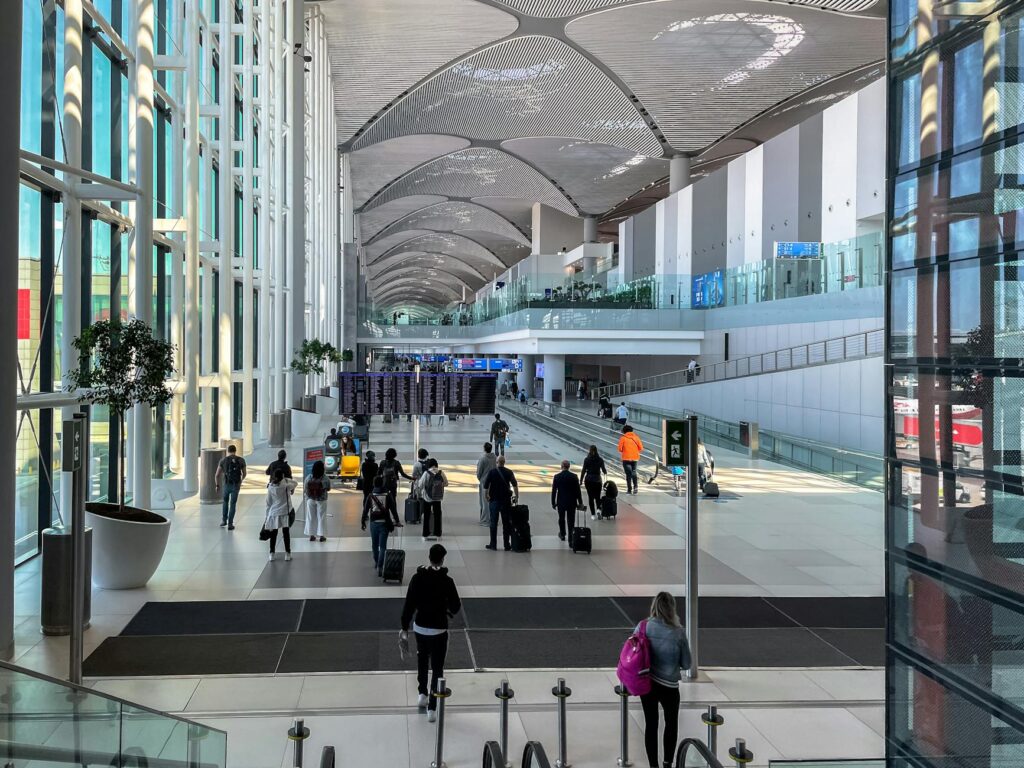
Biometric Verification as the New Front Door
Facial recognition and fingerprint scanning have moved from pilot projects to operational mainstays. At Singapore’s Changi Airport, the deployment of the “Fast‑Track” biometric gate in 2022 cut average immigration processing time from 45 seconds to 12 seconds—a 73 % reduction [2]. Across the United States, the Department of Homeland Security reports that biometric e‑gates now serve 28 % of international arrivals, a figure projected to exceed 45 % by 2028 [4]. The efficiency gains translate into tangible capacity expansion: each biometric lane can handle roughly 1,200 passengers per hour, freeing terminal space for retail and hospitality functions.
AI‑Driven Operations and Predictive Maintenance
Artificial intelligence is infiltrating every layer of airport logistics. Machine‑learning models ingest real‑time data from baggage handling systems, runway sensors and weather feeds to predict disruptions with 92 % accuracy, according to a 2025 ACI study [5]. Dubai International’s AI‑enabled baggage routing reduced mishandled‑bag incidents by 38 % in the first year of implementation, while simultaneously shaving 4 minutes off average claim resolution time [3]. Predictive maintenance powered by AI also extends equipment lifecycles; a 2024 Boeing analysis found that AI‑scheduled engine inspections lowered unscheduled downtime by 27 % across partner airports.
Machine‑learning models ingest real‑time data from baggage handling systems, runway sensors and weather feeds to predict disruptions with 92 % accuracy, according to a 2025 ACI study [5].
IoT and Data Analytics for Passenger‑Centric Design
The Internet of Things (IoT) creates a granular, continuous map of passenger flow. Sensors embedded in way‑finding signage, parking structures and retail kiosks feed anonymized data into centralized dashboards. At Oslo Airport Gardermoen, IoT‑derived heat maps informed the relocation of charging stations, resulting in a 15 % increase in dwell‑time revenue per passenger [2]. The data layer also supports hyper‑personalized services—dynamic pricing for lounge access, AI‑curated retail recommendations, and real‑time language translation via augmented‑reality (AR) glasses.
 Entrepreneurship & Business
Storm Boelo Brings Wind, Rain and Travel Disruption to UK
Power outages, airport cancellations, ferry crossings and flooded roads added to the storm's effects across the UK.
Read More →Infrastructure Adaptation and Institutional Realignment
Flexible Facility Design as a Systemic Imperative
The rapid turnover of technology necessitates a shift from static construction to modular, upgradable infrastructure. The “plug‑and‑play” terminal concept, pioneered by Hong Kong International’s Terminal 2 expansion, utilizes prefabricated steel frames and interchangeable service pods. This design reduces major renovation cycles from an average of 15 years to under 7 years, allowing airports to respond to emergent security protocols or passenger‑experience innovations without costly shutdowns [3].
Sustainable Architecture as an Institutional Mandate
Carbon‑neutrality is now embedded in the regulatory framework of many jurisdictions. The International Civil Aviation Organization (ICAO) introduced the Carbon Offsetting and Reduction Scheme for International Aviation (CORSIA) in 2021, compelling airports to report and offset emissions. In response, airports such as San Francisco International have installed solar canopies that generate 30 % of terminal electricity, while Zurich Airport’s district‑heating network, powered by geothermal wells, cut CO₂ emissions by 12 % annually [2]. These projects are financed through green bonds, with the Climate Bonds Initiative reporting that airport‑issued green bonds grew from $1.2 billion in 2020 to $3.8 billion in 2024—a 217 % increase [6].
Governance Shifts and Leadership Structures
The convergence of technology and sustainability has reshaped governance. Airport authorities now host dedicated “Chief Data Officer” and “Chief Sustainability Officer” roles, reporting directly to the board. At London Heathrow, the appointment of a Chief Digital Officer in 2023 accelerated the rollout of a unified passenger‑journey platform, cutting average processing time across check‑in, security and boarding by 18 % within 12 months [4]. This redistribution of leadership power reflects an institutional acknowledgement that data and climate stewardship are central to competitive advantage.
Governance Shifts and Leadership Structures The convergence of technology and sustainability has reshaped governance.
Career Capital and Economic Mobility in the New Airport Ecosystem

Emerging Skill Sets and Labor Market Realignment
The technology infusion creates high‑skill demand across data science, AI engineering, cybersecurity, and sustainable design. The BA Ventures 2025 talent survey indicates that 42 % of airport employers plan to increase hiring for AI‑related roles over the next three years, with average salary premiums of 28 % relative to traditional operations positions [4]. Simultaneously, reskilling initiatives—such as the “Airport Futures Academy” launched by the Airports Council International (ACI) in 2022—offer certification pathways for legacy staff transitioning into analytics or green‑infrastructure roles, thereby expanding career capital for a traditionally blue‑collar workforce.
Capital Flows and Regional Economic Multipliers
 AI & Technology
Entrepreneurial ecosystems rewire economic mobility
The trend accelerates economic mobility for a broader talent pool.
Read More →Infrastructure upgrades act as catalysts for local economic development. A 2023 McKinsey analysis of the Dallas/Fort Worth International Airport expansion estimated a $7.5 billion regional economic impact over five years, driven by construction spend, increased tourism and the emergence of an “airport city” cluster of logistics, fintech and hospitality firms [5]. The infusion of private‑equity capital into airport‑linked real‑estate has also amplified wealth creation for municipalities; the Port Authority of New York and New Jersey’s “JFK Redevelopment” project is projected to generate $1.3 billion in tax revenue annually once fully operational [3].
Asymmetric Access and Mobility Equity
While the technological upgrade promises efficiency, it also raises equity concerns. Biometric lanes, for instance, may marginalize travelers lacking access to compatible devices or those who opt out of data sharing. To mitigate this, airports such as Amsterdam Schiphol have instituted “digital inclusion kiosks” that provide on‑site biometric enrollment assistance free of charge, thereby preserving universal access to expedited processing [2]. Institutional policies that embed inclusive design into the core of technology rollout are essential to ensure that mobility gains translate into broader economic mobility rather than reinforcing existing disparities.
Trajectory Toward Integrated, Sustainable Hubs (2026‑2031)
Over the next three to five years, three systemic trajectories will dominate airport evolution:
- Full‑Stack Digital Integration – End‑to‑end passenger journeys will be orchestrated through interoperable platforms that merge biometric identity, AI‑driven resource allocation and IoT‑derived environmental controls. The resulting data commons will enable predictive capacity planning, reducing peak‑hour congestion by an estimated 22 % across the top 30 global hubs by 2029 [5].
- Carbon‑Negative Operational Models – Airports will transition from net‑zero to net‑positive energy balances by coupling renewable generation (solar, wind, geothermal) with on‑site energy storage and demand‑response programs. The International Renewable Energy Agency (IRENA) forecasts that by 2030, 48 % of airport electricity demand could be met by on‑site renewables, reshaping the institutional power dynamics between airports and national grids [6].
- Human‑Capital‑Centric Governance – Leadership structures will embed career‑development metrics alongside traditional performance indicators. Boards will be evaluated on talent pipeline diversity, reskilling throughput and community economic impact, aligning institutional incentives with broader societal mobility goals.
These trajectories suggest that airports will emerge as self‑reinforcing ecosystems where technology, sustainability and human capital co‑evolve, cementing their role as strategic nodes of economic power and social advancement.
Human‑Capital‑Centric Governance – Leadership structures will embed career‑development metrics alongside traditional performance indicators.
Key Structural Insights
[Insight 1]: The integration of biometric verification and AI reduces processing latency by up to 73 %, converting time savings into spatial capacity that fuels mixed‑use development and revenue diversification.
[Insight 2]: Green‑bond financing and modular construction enable airports to achieve carbon‑negative status while maintaining upgrade agility, reshaping institutional power from regulatory compliance to proactive climate leadership.
- [Insight 3]: The emergence of data‑centric leadership roles expands career capital, positioning airports as incubators of high‑skill employment that drive regional economic mobility and asymmetrically redistribute wealth.
Written by Career Ahead AI. AI can make mistakes, so verify key facts. Report errors to support@careeraheadonline.com.





