The MHS is designed to facilitate communication between different lab devices, which often have unique programming interfaces. By standardizing these interactions, the protocol allows AI agents to manage multiple instruments simultaneously, from microscopes to liquid handlers. This capability not only accelerates the pace of research but also improves…
Anthropic has unveiled a groundbreaking protocol that allows AI agents to operate microscopes and other laboratory devices, significantly enhancing efficiency in research labs. The Model Hardware Standard (MHS), introduced on August 27, 2026, aims to streamline the integration of various lab instruments, enabling automated experimental processes. This development marks a pivotal moment for research scientists and lab technicians, as it promises to reduce setup times from weeks to mere hours.
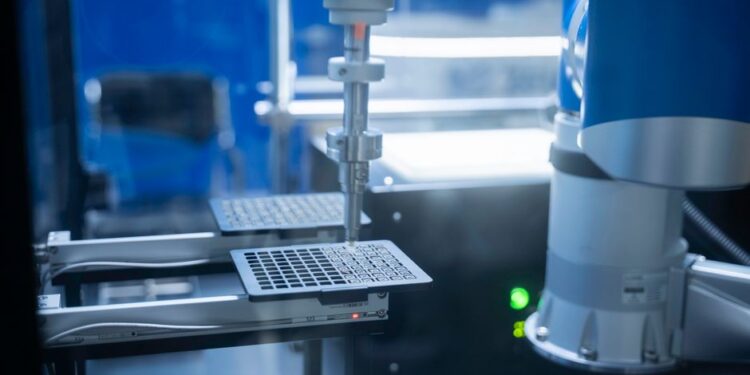
The MHS is designed to facilitate communication between different lab devices, which often have unique programming interfaces. By standardizing these interactions, the protocol allows AI agents to manage multiple instruments simultaneously, from microscopes to liquid handlers. This capability not only accelerates the pace of research but also improves the accuracy of experimental outcomes, making it a significant advancement in laboratory automation. According to a report from Mint, the MHS can operate various lab and manufacturing instruments in parallel, enhancing the overall productivity of research teams.
Enhancing Experimental Efficiency through AI
The integration of AI into laboratory settings is poised to transform the way experiments are conducted. Traditionally, setting up and integrating hardware in labs has been a time-consuming process, often requiring specialized knowledge to connect devices that do not naturally communicate with one another. Anthropic’s MHS addresses this challenge by providing a standardized driver that simplifies these connections, allowing AI to orchestrate complex experiments autonomously.
Career Ahead’s analysis finds that the introduction of MHS can lead to substantial time savings in experimental workflows. For instance, researchers can initiate experiments that previously took days to set up in just a few hours. This rapid turnaround enables scientists to test hypotheses more frequently and iterate on their findings, ultimately accelerating the pace of discovery in fields such as biotechnology and pharmaceuticals. Furthermore, the MHS allows AI agents to reason through each step of an experiment, adjusting parameters in real-time and recovering from errors without human intervention. This capability not only enhances the reliability of experiments but also frees up researchers to focus on more complex analytical tasks, leading to a more productive research environment.
As the protocol becomes more widely adopted, lab technicians will need to adapt to operating AI-driven devices. This shift will require a new set of skills focused on managing AI interactions with laboratory equipment, ensuring that technicians can effectively leverage these advanced tools to maximize research outcomes. The potential for AI to enhance laboratory operations is underscored by the White House’s recent initiatives, including the unveiling of the National AI Legislative Framework, which aims to promote the responsible use of AI technologies across various sectors, including scientific research.
Career Ahead’s analysis finds that the introduction of MHS can lead to substantial time savings in experimental workflows.
Nvidia's strong outlook for AI technology is reshaping the job market for data scientists and software engineers, driving demand for specialized skills globally.
In addition to improving efficiency, the MHS also supports real-time fault detection, allowing researchers to identify and resolve issues as they arise. This proactive approach to troubleshooting can significantly reduce downtime in laboratory operations, further enhancing productivity and research output. As noted in a recent article from The New York Times, the integration of AI into laboratory settings is not just about automation; it also involves creating systems that can learn and adapt, thereby improving their performance over time.
Implications for Research Scientists and Lab Technicians
The introduction of the MHS protocol is particularly relevant for research scientists and lab technicians who rely heavily on microscopes and other automated devices in their work. As these professionals begin to integrate AI protocols into their daily operations, they will experience a shift in how they approach experimental design and execution.
Career Ahead research indicates that the demand for professionals skilled in AI and automation technologies is set to rise. With the MHS enabling more sophisticated interactions between devices, research scientists will need to develop a deeper understanding of how to design experiments that effectively utilize these capabilities. This may include training in data analysis and AI programming, as well as familiarity with new lab protocols. Furthermore, as the scientific community embraces these advancements, there may be a growing expectation for researchers to publish their findings using AI-enhanced methodologies. This trend could lead to a new standard in research publication, where studies incorporating AI-driven experimental designs are viewed as more credible and innovative.
However, this shift also brings challenges. As AI systems take on more responsibilities in the lab, concerns about data security and the ethical use of AI in scientific research will need to be addressed. Ensuring that AI systems are used responsibly and that their outputs are interpretable will be crucial for maintaining trust in scientific findings. Additionally, the integration of AI into laboratory settings may lead to job displacement for some roles traditionally held by lab technicians. As automation takes over routine tasks, there may be a need for a reevaluation of job descriptions and responsibilities within research teams. This evolving landscape emphasizes the importance of continuous education and adaptation for professionals in the field.
Looking ahead, the successful integration of AI protocols like the MHS into laboratory settings will hinge on the willingness of research scientists and technicians to adapt to new technologies. As the capabilities of AI expand, the potential for accelerated scientific discovery will be immense, reshaping the future of research as we know it. The collaboration between AI developers and research institutions will be essential in refining and expanding the capabilities of the MHS, paving the way for even more complex experiments with minimal human oversight.
Career Ahead research indicates that the demand for professionals skilled in AI and automation technologies is set to rise.
Ultimately, as the scientific community continues to explore the potential of AI in research, we may witness a rise in interdisciplinary studies that combine expertise from computer science, engineering, and biological sciences. This trend could foster a new wave of innovation, driving breakthroughs in various fields, including drug discovery, genetic engineering, and environmental science.
Frequently Asked Questions
How can research scientists leverage AI to improve their experiments?
Research scientists can use AI protocols like Anthropic’s MHS to automate and streamline their experimental processes. This allows for quicker setup times, real-time adjustments during experiments, and enhanced data analysis capabilities.
What skills do lab technicians need to operate AI-driven devices?
Lab technicians will need to develop skills in managing AI interactions with laboratory equipment. This includes understanding AI programming, data analysis, and how to effectively design experiments that utilize AI capabilities.
What should research scientists do about the introduction of AI protocols in their labs?
Research scientists should familiarize themselves with AI technologies and consider how these tools can enhance their experimental designs. Staying informed about advancements in AI will be crucial for maximizing research efficiency and effectiveness.



AI & Technology
AI & Technology