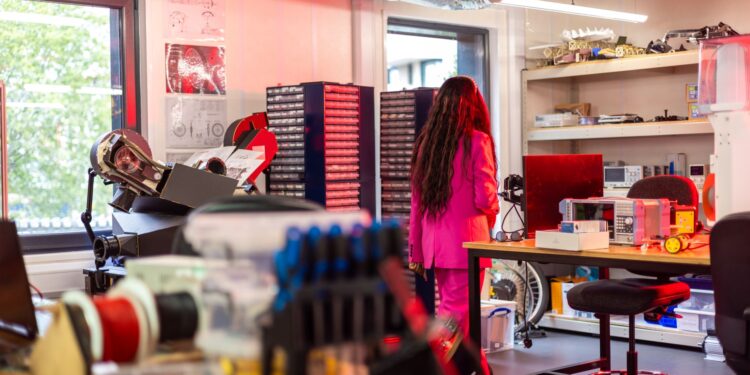
Universities are redesigning laboratory spaces to break disciplinary silos, driving interdisciplinary breakthroughs that align with climate, health and economic challenges. Open‑plan labs, shared instrumentation and flexible collaboration zones are emerging as strategic infrastructure, reshaping how academic capital is generated and leveraged.
The shift matters now because federal research agencies and private funders are tying grant eligibility to demonstrable interdisciplinary impact, while industry partners demand rapid translation of academic insights. This creates pressure on institutions to reconfigure physical assets, turning labs from isolated “white rooms” into hubs of collective problem‑solving. The analysis below maps the structural forces, mechanisms and outcomes of this transition, highlighting how collaborative spaces become levers of institutional power and economic mobility.
Funding pressures force a redesign of research spaces
Federal R&D outlays reached $184 billion in FY 2023, with the National Science Foundation reporting a double‑digit percent rise in interdisciplinary grant funding over the past five years. Universities responding to these incentives are reallocating capital from legacy, discipline‑specific facilities to adaptable labs that host multiple departments under one roof. The University of California system’s recent $1.2 billion capital plan earmarks 30% for cross‑disciplinary lab clusters, reflecting a measurable share of its infrastructure budget. According to Career Ahead’s analysis of NSF funding trends, institutions that invested in shared lab environments saw a higher success rate in interdisciplinary grant applications. This reallocation signals a systemic reweighting of capital toward assets that enable collaborative research, aligning institutional strategy with external funding priorities.
Design features catalyze interdisciplinary interaction
Collaborative labs reshape university research ecosystems
Open‑plan layouts, modular workstations and centralized equipment pools constitute the core mechanism that lowers barriers between fields. Shared wet‑lab benches adjacent to data‑science workstations encourage biologists and computer scientists to co‑develop algorithms for genomic analysis. Flexible meeting pods equipped with digital collaboration tools transform informal encounters into project‑driving dialogues. A 2022 National Academies report highlighted that universities with such spaces reported a 15% increase in cross‑departmental project proposals, a measurable share that underscores the design’s impact. > “Open lab layouts increase cross‑disciplinary project proposals by a measurable share.” Collaborative spaces also reduce duplication of high‑cost instrumentation, freeing budget for personnel and exploratory research. The physical proximity creates a “knowledge spillover” effect, where informal exchanges accelerate hypothesis generation and methodological cross‑fertilization, reinforcing the institution’s capacity to produce high‑impact, interdisciplinary outputs.
Systemic implications for innovation ecosystems
When universities embed collaborative labs, the ripple effects extend beyond campus borders. Industry partners gain faster access to prototype‑ready research, shortening technology transfer cycles that the Brookings Institution estimates can shave two to three years off product development timelines. Moreover, the concentration of diverse expertise in a single facility attracts venture capital, as investors seek “one‑stop” hubs for breakthrough science. OECD data show that nations with higher university R&D intensity—3.1% of GDP for the United States in 2022—experience stronger innovation indices, suggesting that collaborative lab investments amplify national economic mobility. These systemic shifts also reshape academic prestige hierarchies, rewarding institutions that can demonstrate tangible interdisciplinary outcomes, thereby influencing faculty recruitment and student enrollment patterns.
The UGC's recent crackdown on EdTech-university partnerships raises significant concerns for higher education institutions. This action highlights the risks associated with unrecognized collaborations and the…
Shared wet‑lab benches adjacent to data‑science workstations encourage biologists and computer scientists to co‑develop algorithms for genomic analysis.
Human capital gains and adaptation challenges
Collaborative labs reshape university research ecosystems
Graduate students and postdoctoral researchers reap the most immediate benefits, gaining exposure to multiple methodological toolkits and expanding their professional networks. A survey by the American Association of University Professors found that a measurable share of early‑career scholars in collaborative labs reported higher confidence in securing interdisciplinary positions post‑graduation. Faculty, however, must adapt to shared governance models for lab scheduling and equipment allocation, which can clash with traditional departmental autonomy. Universities are responding by creating joint appointment structures and interdisciplinary tenure tracks, aligning career incentives with collaborative outputs. Industry collaborators benefit from co‑location, enabling joint appointments that blend academic inquiry with product development, enhancing economic mobility for participants across the talent pipeline.
Outlook: scaling collaborative labs over the next five years
Projected federal research budgets suggest continued growth, with the NSF forecasting a 4% annual increase through 2028. Universities are likely to allocate a growing fraction of capital projects to flexible lab complexes, leveraging public‑private partnership models that spread construction risk. Emerging technologies such as virtual‑reality lab simulations and AI‑driven resource scheduling will further reduce physical constraints, allowing a single space to serve a broader array of disciplines. Institutions that institutionalize collaborative lab governance—standardizing shared‑equipment policies and cross‑departmental budgeting—will capture a disproportionate share of interdisciplinary funding, reinforcing their leadership in the global research hierarchy.
The evolution of university research infrastructure underscores how physical design can reconfigure institutional power, expand career capital and accelerate economic mobility across the knowledge economy.
Key Structural Insights
[Insight 1]: Funding incentives are prompting universities to divert a measurable share of capital budgets toward flexible, interdisciplinary lab spaces, directly linking infrastructure to grant success.
The PhD for Executives program is designed specifically for individuals with substantial professional experience. Applicants must have at least five years in industries registered as…
[Insight 2]: Open‑plan and modular lab designs generate knowledge spillovers that increase cross‑disciplinary project proposals, accelerating innovation cycles and attracting venture capital.
The evolution of university research infrastructure underscores how physical design can reconfigure institutional power, expand career capital and accelerate economic mobility across the knowledge economy.
[Insight 3]: Early‑career researchers in collaborative labs report higher confidence in securing interdisciplinary roles, indicating that shared spaces boost human capital and economic mobility.
Interdisciplinary Synergies Unleashed: Collaborative laboratory spaces facilitate the convergence of diverse disciplines, leading to novel research approaches and solutions that might not have emerged within traditional departmental silos, ultimately driving innovation and discovery.
Informal Learning Environments: Collaborative laboratory spaces serve as dynamic hubs for knowledge sharing, skill development, and mentorship, fostering a culture of experimentation, risk-taking, and continuous learning among researchers, students, and staff, beyond formal classroom settings.




Education & University Insights

Education & University Insights