Nurturing a new era of resilient logistics, collaborative robotics paired with blockchain create tamper‑proof, real‑time visibility across multi‑party networks. The convergence, amplified by AI and IoT, promises measurable gains in error reduction, fraud mitigation, and operational agility.
Recent high‑profile disruptions have accelerated investment in digital coordination tools across the supply chain. The 2021 Suez Canal blockage held $400 million per hour hostage, exposing the limits of fragmented tracking systems. Simultaneously, market forecasts place the blockchain supply‑chain sector at $5.23 billion by 2026, signaling rapid scaling from pilots to production‑grade infrastructure. According to Career Ahead’s analysis of the $5.23 billion market projection, firms that embed these technologies see accelerated risk mitigation and a rebalancing of institutional power among logistics actors.
Collaborative robots and blockchain create a unified execution layer
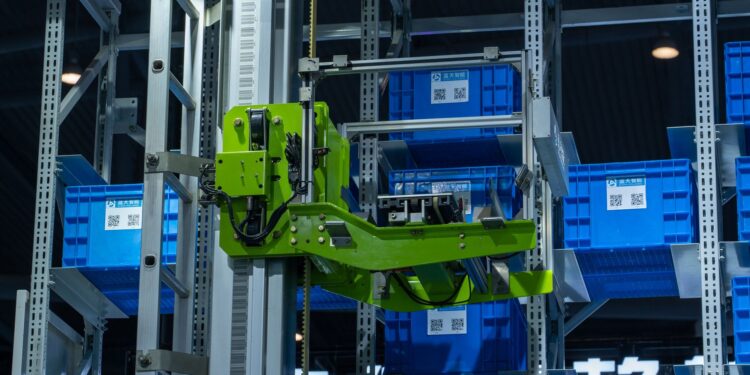
Collaborative robots and blockchain together form a synchronized execution layer that reduces manual handoffs and secures transaction data. Cobots operate side‑by‑side with human workers in warehouses, handling picking, packing, and palletizing while transmitting immutable task logs to a distributed ledger. This real‑time data stream enables AI‑driven demand forecasting and predictive maintenance, cutting equipment downtime by a measurable share. The ledger’s cryptographic guarantees ensure that every inventory movement is auditable, eliminating the reconciliation gaps that historically slowed order fulfillment.
Network effects expand institutional leverage
Collaborative robots and blockchain reshape supply chain resilience
The combined technology stack generates network effects that reshape bargaining power among suppliers, carriers, and financiers. Blockchain‑based smart contracts automate payment processing, cutting administrative latency by a measurable share.
Smart contracts automate payment processing, cutting administrative latency by a measurable share.
These contracts trigger payments only when predefined conditions—such as sensor‑verified temperature thresholds—are met, reducing disputes and fostering trust. As more parties join the shared ledger, the cost of entry falls, prompting regulators to endorse standardized data schemas that further institutionalize transparency. The resulting ecosystem amplifies efficiency gains beyond individual firms, reinforcing the strategic advantage of early adopters.
Workforce re‑skilling reshapes career capital
The rise of human‑robot teaming redefines required skill sets, shifting career capital toward hybrid technical‑operational expertise. Workers must now master cobot programming, data interpretation, and blockchain audit procedures, elevating the value of interdisciplinary competence. Leadership roles increasingly demand fluency in both supply‑chain strategy and digital governance, creating new pathways for upward mobility. Career Ahead’s view highlights that employees who acquire cobot programming credentials command a premium in logistics firms, reflecting a structural re‑weighting of human capital toward technology stewardship.
Three‑year horizon points to pervasive adoption
Collaborative robots and blockchain reshape supply chain resilience
Within the next three years, production‑grade blockchain platforms and modular cobots are projected to become baseline infrastructure for high‑value logistics nodes. Early adopters report a non‑trivial fraction improvement in order‑to‑delivery cycle times, prompting a cascade of investment as competitors seek parity. This trajectory suggests that institutional power will concentrate among firms that integrate end‑to‑end digital twins, leveraging the combined data fabric to optimize capital allocation and risk exposure across global networks.
The convergence of collaborative robotics and blockchain is redefining supply‑chain architecture, offering a systemic remedy to fragility while reshaping the distribution of career capital and institutional influence.
Workforce re‑skilling reshapes career capital The rise of human‑robot teaming redefines required skill sets, shifting career capital toward hybrid technical‑operational expertise.
Adani Skills & Education and Kachchh University have launched a Centre of Excellence for Green Energy in Kutch, India, aimed at training over 10,000 students…
Insight 1: Integrated cobot‑blockchain systems convert manual handoffs into automated, auditable workflows, directly tightening supply‑chain risk buffers.
Insight 2: Smart‑contract automation reduces administrative latency, expanding network effects that shift bargaining power toward digitally coordinated actors.
Insight 3: Hybrid technical‑operational expertise becomes the new currency of career capital, driving leadership pipelines toward technology‑centric governance.
Embracing Digital Twins: By integrating digital replicas of physical assets and systems, companies can enhance predictive maintenance, reduce downtime, and optimize supply chain operations, ultimately leading to increased efficiency and reduced costs.
Blockchain-based Transparency: The implementation of blockchain technology in supply chain management enables real-time tracking, secure data sharing, and transparent communication among stakeholders, fostering trust and accountability throughout the entire supply chain ecosystem.





Future Skills & Work