No products in the cart.

Digital Mirrors Reshape Beauty: From Consumer Confidence to Institutional Power
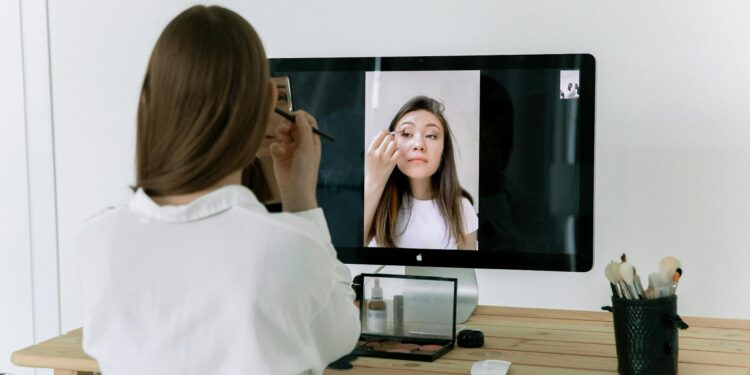
Virtual try-on technology is turning aesthetic uncertainty into a data engine, reshaping beauty firms’ institutional hierarchies and creating a new career capital centered on AI fluency and sustainability.

Virtual try-on technology has turned the beauty aisle into a data-rich, AI-driven arena, redefining career capital and institutional hierarchies while accelerating the industry’s structural shift toward sustainable, low-friction consumption.
Macro‑Scale Growth and the AR‑Enabled Consumer
The global beauty market is projected to reach $511.4 billion by 2027, expanding at a 5.3% CAGR—a trajectory powered as much by cultural shifts as by technology adoption[^1]. Social-media amplification of aesthetic standards, combined with rising discretionary income in emerging economies, has deepened demand for personalized appearance solutions.
Within this expansion, augmented-reality (AR) and artificial-intelligence (AI) try-on platforms now influence 71% of purchase intent among digitally native shoppers[^2]. The pandemic acted as an inflection point: 60% of consumers increased online beauty purchases after lockdowns curtailed in-store sampling[^4]. Companies responded by allocating capital to virtual mirrors, with L’Oréal’s 2018 acquisition of ModiFace alone representing a $300 million strategic investment that accelerated its AI-driven personalization pipeline.
These macro forces illustrate a structural realignment: the beauty sector is moving from a product-centric to a consumer-experience-centric model, where digital fidelity substitutes for tactile interaction, reshaping the economics of acquisition and retention.
Algorithmic Mirror: The Core Mechanism of Virtual Try-On
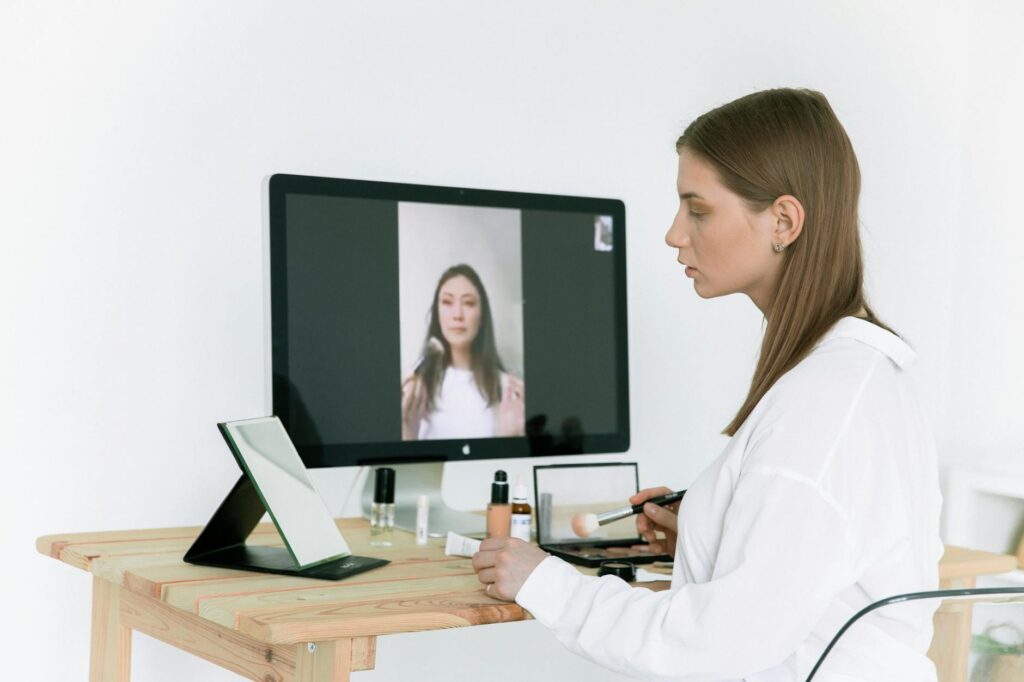
Virtual try-on (VTO) systems integrate computer-vision facial mapping, deep-learning style transfer, and real-time rendering to overlay cosmetics onto a user’s live image. Machine-learning models—trained on millions of annotated facial images—extract key landmarks (e.g., eyelid curvature, lip contour) and calibrate lighting conditions to match the product’s optical properties.
Machine-learning models—trained on millions of annotated facial images—extract key landmarks (e.g., eyelid curvature, lip contour) and calibrate lighting conditions to match the product’s optical properties.
A 2023 quasi-experimental study of 221 female participants demonstrated that VTO exposure reduced product returns by 25%, directly linking algorithmic realism to purchase confidence[^3]. The same research highlighted a two-point increase in perceived product fit, a metric that correlates with long-term brand loyalty in the beauty sector.
You may also like
 Entrepreneurship & Business
Nike
Nike's recent sales slump has prompted its CEO to reconsider strategies, significantly impacting marketing and product management roles. Understanding the implications for consumer engagement and…
Read More →Beyond the consumer interface, VTO generates granular interaction data: hue selection frequencies, dwell time on specific shades, and conversion pathways. These data streams feed back into product development cycles, enabling rapid A/B testing of pigment formulations and packaging designs without physical prototyping. The feedback loop compresses the innovation timeline from the traditional 18-month cycle to a six-to-nine-month iterative cadence.
Institutional Realignment: Product, Marketing, and Sustainability
Digital Prototyping and Accelerated Time-to-Market
By virtualizing the sampling stage, brands can eliminate up to 40% of physical prototypes, a reduction that translates into lower material costs and shortened supply-chain lead times. Estée Lauder’s “Virtual Shade Finder” reduced its seasonal color-launch budget by $12 million in FY2025, reallocating funds to AI-driven trend analytics.
Marketing Paradigm Shift
VTO platforms double as shoppable content hubs. Influencer collaborations now embed interactive AR filters directly into Instagram Stories, allowing followers to try products with a single tap. This integration blurs the line between advertising and purchase, creating an asymmetric conversion funnel where the cost of acquisition drops while the average order value rises.
Environmental Externalities
A systematic literature review of virtual fitting rooms identified a 30% reduction in carbon emissions linked to lower return rates and minimized packaging waste[^1]. The beauty sector, historically responsible for approximately 4% of global plastic waste, stands to achieve measurable sustainability gains by curtailing sample distribution. Virtual try-on thus functions as a structural lever for both profit and planetary stewardship.
Environmental Externalities A systematic literature review of virtual fitting rooms identified a 30% reduction in carbon emissions linked to lower return rates and minimized packaging waste[^1].
Historical Parallel: The E-Commerce Pivot of the Early 2000s
The diffusion of VTO mirrors the e-commerce adoption curve observed in apparel during the early 2000s. Then, the introduction of size-recommendation algorithms shifted consumer confidence from brick-and-mortar to digital storefronts, catalyzing a $200 billion market expansion over a decade. Similarly, VTO is poised to generate a $45 billion incremental revenue stream for beauty by 2031, according to McKinsey projections[^5].
Human Capital Recalibration: New Skill Sets and Leadership Pathways
You may also like
 AI & Technology
AI‑driven skill churn reshapes career capital
A measurable share of mid‑skill roles face redesign, prompting a race between talent pipelines and corporate retraining.
Read More →The technology stack underpinning VTO demands a hybrid talent pool that blends cosmetic science with data engineering. Companies are creating “Digital Beauty Labs” staffed by AI researchers, UX designers, and dermatological consultants. L’Oréal’s 2024 talent report shows a 57% increase in hires for AI-focused roles within its Consumer Products division, outpacing the industry average by 22 percentage points.
Leadership structures are adapting: Chief Digital Officers (CDOs) now sit alongside traditional Chief Marketing Officers (CMOs), reporting directly to the CEO to ensure alignment between data-driven product pipelines and brand narratives. This shift redistributes institutional power from legacy product development teams to cross-functional digital hubs, altering career trajectories for mid-level managers who must acquire data literacy to remain promotable.
The rise of “Virtual Brand Ambassadors”—AI-generated influencers calibrated by consumer sentiment models—creates novel career pathways in algorithmic content curation. Conversely, the decline of in-store beauty consultants signals a reallocation of career capital toward remote, analytics-centric roles, a trend that intensifies the asymmetry between high-skill, high-pay digital positions and traditional retail employment.
Projected Trajectory: 2026-2031 Market and Workforce Dynamics
- Adoption Rate: By 2028, 85% of top-100 beauty brands will have integrated VTO into their e-commerce platforms, up from 58% in 2024.
- Return Reduction: Industry-wide return rates are expected to fall from 12% to 7%, delivering an estimated $3.2 billion cost saving annually.
- Sustainability Impact: Cumulative carbon emission reductions could reach 150 million metric tons by 2031, equivalent to removing 30 million passenger cars from the road.
- Workforce Evolution: The proportion of AI-related roles within beauty firms is projected to climb to 18% of total headcount, while traditional retail staffing will contract by 12%, prompting a reskilling imperative for displaced workers.
- Revenue Upside: McKinsey estimates a 12-15% uplift in average basket size for brands that combine VTO with personalized recommendation engines, translating to $45-$55 billion in incremental sales by 2031.
These projections underscore a systemic trajectory where digital try-on becomes a competitive moat, reshaping the industry’s structural economics and redefining the skill sets that constitute career capital.
Workforce Evolution: The proportion of AI-related roles within beauty firms is projected to climb to 18% of total headcount, while traditional retail staffing will contract by 12%, prompting a reskilling imperative for displaced workers.
Key Structural Insights
[Insight 1]: Virtual try-on converts aesthetic uncertainty into quantifiable data, shifting institutional power toward AI-centric product teams.
[Insight 2]: The technology’s waste-reduction externalities embed sustainability into the core profit model, creating a structural incentive for broader adoption.
[Insight 3]: Career pathways are being reengineered; data fluency now underpins leadership eligibility, accelerating the migration of talent from retail to digital hubs.
Sources
You may also like
 AI & Technology
Apple’s AI Strategy Excluded from Trump’s Guest List
This absence is notable for several reasons. First, it highlights Apple's unique approach to AI compared to its competitors.
Read More →[1] “A systematic literature review and analysis of try-on technology” — Data and Information Management
[2] “The Role of Virtual Try-On Technology in Enhancing Customer Experience and Decision-Making” — ResearchGate
[3] “The Impact of Virtual Try-On Tools for Beauty Products on Consumer Behavior” — Springer
[4] “How Virtual Try-On Technology Is Changing Online Shopping in 2026” — Style3D.ai
[5] “Beauty Industry Outlook 2026-2031” — McKinsey & Company*