The standard view is that AI-powered coding assistants have turned software development into a high-velocity sport; proponents point to headline numbers—87% of developers claim dramatically faster cycles and a 41% lift on routine tasks—as proof that the old bottlenecks of debugging, boilerplate, and code review are fading into the background.
We think this is wrong, and here is why: the very metrics that fuel the hype conceal a shifting obstruction that is already throttling delivery, inflating long-term costs, and eroding the very expertise that made those early gains possible.
The illusion of speed hides a hidden slowdown
When a team celebrates a productivity boost on repetitive coding, the celebration often stops before the next sprint, when the same code must be integrated, tested, and maintained. A meta-analysis of studies on coding assistants revealed that while the majority of developers experience an initial sprint-level acceleration, 20% of teams actually see a net slowdown as the AI-generated output demands more human review than the original hand-written code. The paradox is that the same tool that promises “significantly faster development cycles” also injects ambiguity—syntactically correct but semantically fragile snippets that multiply the cognitive load of reviewers. In practice, the time saved in the editor is reclaimed in pull-request discussions, static-analysis false positives, and the inevitable need to rewrite AI-suggested sections that do not align with architectural standards. The result is a latency that is not captured by headline percentages but becomes visible in delivery predictability and defect rates.
AI as an amplifier of organizational health—and dysfunction
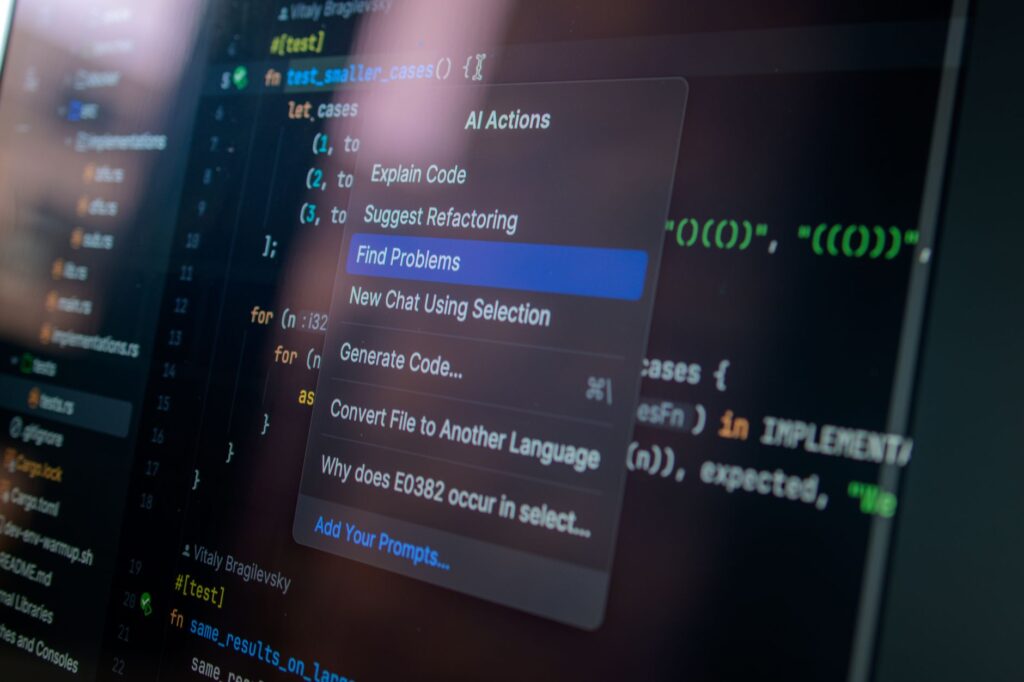
Engineering Leaders Confront Coding Model Bottlenecks Photo: pexels
“AI coding assistants amplify your organization’s strengths—and its dysfunctions.”
The paradox is that the same tool that promises “significantly faster development cycles” also injects ambiguity—syntactically correct but semantically fragile snippets that multiply the cognitive load of reviewers.
The quote above encapsulates a reality that the consensus narrative refuses to acknowledge: AI does not level the playing field, it magnifies the existing terrain. High-performing teams with mature CI/CD pipelines, strong code-ownership cultures, and rigorous testing frameworks see their velocity climb; struggling teams, however, watch their technical debt balloon as the assistant dutifully reproduces poor patterns, inconsistent naming conventions, and undocumented shortcuts. The consequence is not merely a modest dip in efficiency; a recent survey of 400 engineering leaders warned that a significant number of AI-augmented coding projects will be canceled due to escalating maintenance costs and unclear business value outweighing the early gains. The cancellation rate is a direct symptom of the amplifier effect: the same AI that can churn out a prototype in minutes also propagates hidden defects that later become expensive to fix, leading decision-makers to pull the plug on projects that appear unsustainable.
Data quality, training bottlenecks, and the hidden cost of oversight
Our analysis shows that the efficiency of any coding model is only as good as the data it has ingested. Organizations that feed their assistants with proprietary codebases, legacy modules, and inconsistent documentation create a feedback loop where the model learns to reproduce the very inconsistencies that slow human developers. The result is a rising need for human oversight that scales faster than the purported productivity gains. In a study of 2,000 software engineering teams worldwide, teams that invested in data-curation pipelines—cleaning, annotating, and version-controlling the training corpus—reported a higher net productivity than those that relied on out-of-the-box models. The extra effort required to maintain a high-quality training set is rarely counted in the headline metrics, yet it constitutes a substantial portion of the total cost of ownership.
We have argued before that the “AI-first” playbook must be treated as a continuous engineering discipline, not a one-off plug-in; see [as we examined in our earlier analysis](https://careeraheadonline.com/). When the data pipeline is weak, the model’s suggestions become a source of rework rather than a shortcut, turning the assistant into a bottleneck rather than a lever.
Skills erosion and the maturity curve of coding models
Engineering Leaders Confront Coding Model Bottlenecks Photo: unsplash
The long-term risk of over-reliance on AI-generated code is a gradual erosion of core development skills. As engineers spend more time accepting suggestions than crafting solutions, their ability to reason about algorithmic complexity, design patterns, and system architecture wanes. We introduce the Coding Model Maturity Curve to describe this trajectory: at the early stage, developers use AI as a supplemental tool, preserving skill depth; at the mid stage, reliance grows, and the organization begins to experience the first signs of skill decay; at the late stage, the model becomes the primary source of code, and the team’s capacity to innovate without AI collapses, leaving the organization vulnerable to any disruption in the model’s availability or performance. The curve is not inevitable, but it is a predictable outcome when the “AI-only” mindset is adopted without safeguards such as regular code-ownership rotations, pair-programming with AI-assisted and manual modes, and institutionalized learning pathways that reinforce fundamentals.
In our view, the solution lies not in abandoning AI assistants but in re-architecting their role within the development lifecycle: treat them as “drafting partners” whose output must pass through the same rigor as any human contribution, allocate dedicated resources to data hygiene, and embed skill-preservation metrics into performance reviews. Only then can the organization harvest the genuine speed gains without paying the hidden price of a bottleneck that threatens both delivery and talent.
Skills erosion and the maturity curve of coding models Engineering Leaders Confront Coding Model Bottlenecks Photo: unsplash The long-term risk of over-reliance on AI-generated code is a gradual erosion of core development skills.
The consensus gets one thing right: AI coding assistants can indeed shave minutes off routine tasks, and for teams that already excel at code quality and governance, the boost can be a competitive edge. The cost of believing the consensus uncritically, however, is a systematic underestimation of the downstream slowdown, the escalation of maintenance debt, and the gradual loss of developer expertise—an erosion that can turn today’s productivity miracle into tomorrow’s strategic liability.




AI & Technology
 AI & Technology