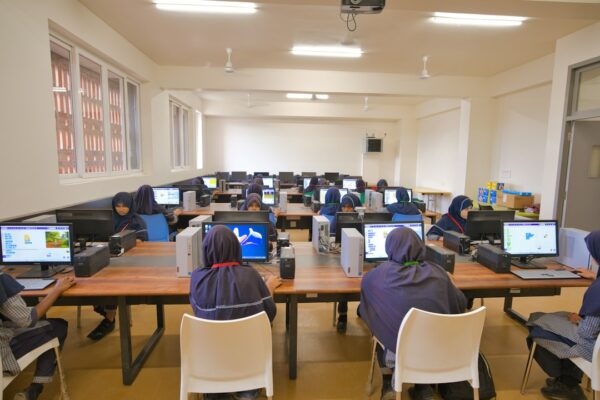
At The PIE Live Germany in Berlin on October 30, university leaders discussed recruiting international students and retaining international talent.
Humboldt-Universität zu Berlin is recruiting in STEM
Rebecca Ferreboeuf, head of the welcome centre – international department at Humboldt-Universität zu Berlin, said international interest at the institution had remained steady rather than spiking. That steady level of interest is the backdrop to the university’s strategic recruitment, which receives funding from the German Academic Exchange Service. Ferreboeuf described an approach built around active recruitment while interest remains consistent, rather than a sudden surge in demand.¹
The university is actively recruiting master’s and PhD students in STEM subjects, Ferreboeuf said. She explained that the effort was not necessarily driven by a need to increase the number of international students in those programmes. Instead, the institution saw an opportunity to engage with students proactively against a backdrop of labour market shortages. The distinction she drew is between recruiting to fill a specific enrolment need and making use of an opportunity to reach students amid broader workforce pressures.¹
The distinction she drew is between recruiting to fill a specific enrolment need and making use of an opportunity to reach students amid broader workforce pressures.¹
Universities describe recruitment as part of talent retention
Ferreboeuf said universities have a role in both attracting international talent and retaining it. She connected that responsibility to labour market challenges, warning that they would worsen over the next ten to twenty years. Her comments place recruitment and retention in the same discussion: universities are involved in bringing international talent in, and she said they also have a part to play in keeping that talent. The longer-term workforce concern gives that role its context.¹
 Education & University Insights
International Universities Face a Value Test in India
A mapping counted 13 international universities admitting students across 14 Indian campuses in 2026/27, as surveys indicate interest in India-based programs.
Read More →Julian Davies, CEO at Gisma University of Applied Sciences, said German universities were increasingly keen to recruit students who were right for their institution, rather than prioritising growth over suitability. That preference puts the fit between a student and a university ahead of simply expanding student numbers. Davies’s point adds a selection principle to the recruitment discussion: universities are paying attention to who suits their institution, not treating growth as the only measure of recruitment.¹

Student support is divided across the university system
Responsibility for support across Germany’s university system is spread across federal states, universities, faculties and campus services. That means support is handled across several parts of the system rather than sitting with one body alone. Ferreboeuf said the help students need can differ according to their programme, language ability and academic background. Those differences make the kind of support relevant to a student depend on their circumstances, rather than on international status alone.¹
The factors Ferreboeuf identified point to varied support needs within the international student population. A student’s programme, language ability and academic background each shape what help may be appropriate, she said. The system’s spread of responsibility across states, universities, faculties and campus services sits alongside that variation. Together, those details describe a support structure in which multiple parts of the university system have responsibility, while students may need different kinds of assistance depending on their situation.¹
German-language preparation can take months
Lucia Krizaj, manager of academic programs and summer initiatives at EF (Education First), said intensive study could take around nine to eleven months to move a student from beginner level to C1 German. She argued that students should learn the language in the country. Her explanation was that learning German in Germany immerses students in everyday life and bureaucracy. The language timeline and the opportunity to use German in daily settings form two parts of her account of preparation.¹
Students do not all follow the same route into university, Krizaj said. Some pursue English-taught programmes, while others may need additional preparation before entering university. Her description sets out those different starting points without suggesting that one route applies to every student. Alongside her account of intensive German study and learning in Germany, the distinction shows that language and academic preparation depend on the programme a student pursues and the preparation they need before university entry.¹
 Education & University Insights
Kotak Scholarship Combines Student Aid with Mentoring
The programme includes entrance examination preparation, exposure visits, home visits and academic reviews alongside its financial award.
Read More →Alongside her account of intensive German study and learning in Germany, the distinction shows that language and academic preparation depend on the programme a student pursues and the preparation they need before university entry.¹
Plan for German Talent Demand
If you are considering a STEM master's or PhD in Germany, universities are recruiting proactively because of labour market shortages, not because they lack applicants. This means your application competes against a steady pool, and institutions may value fit over growth. Research each university's priorities and tailor your application to show suitability, since recruiters increasingly select students who match their institution's needs.¹
German language preparation takes nine to eleven months from beginner to C1, and learning in the country offers immersion in daily life and bureaucracy. If your programme is English-taught, you may skip that route, but for others, budget that time before entry. Support varies by programme, language ability, and academic background, so identify which services you need and confirm who provides them, as responsibility is split across states, universities, faculties, and campus services.¹
Sources
Written by Career Ahead AI. AI can make mistakes, so verify key facts. Report errors to support@careeraheadonline.com