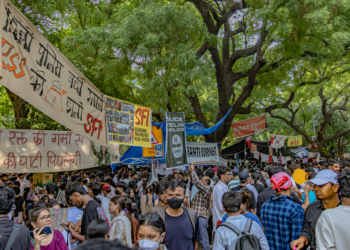
JNU released a formal advisory on July 24 2026 directing students, faculty and staff to stay away from Jantar Mantar protests and to exercise caution on social media.
Jawaharlal Nehru University released a formal advisory on July 24 2026 directing students, faculty and staff to stay away from gatherings at Jantar Mantar and to exercise caution on social media.
The advisory was posted on the university’s official X (formerly Twitter) account and circulated among the campus community amid ongoing demonstrations over the alleged NEET‑UG 2026 paper leak [1].
The university’s statement referenced recent Supreme Court directions concerning public assemblies and warned of possible legal and disciplinary consequences for participants who ignore the guidance [2].
Advisory Details and Institutional Context
The advisory, dated July 24 2026, explicitly instructed all members of the JNU academic community to refrain from traveling to Jantar Mantar, a historic protest site in Delhi, until the situation stabilizes [1]. It further urged students and staff to “exercise restraint on social media” and to prioritize personal safety [2].
JNU’s administration cited the Supreme Court’s recent orders that require demonstrators to obtain prior permission for large gatherings and to adhere to prescribed safety protocols [3]. The university framed the advisory as a precautionary measure aligned with legal obligations and campus security policies.
The communication was disseminated through multiple channels, including the university’s official website, email bulletins to students and faculty, and the X platform, ensuring broad reach across the institution [1][2].
The communication was disseminated through multiple channels, including the university’s official website, email bulletins to students and faculty, and the X platform, ensuring broad reach across the institution [1][2].
Background of the Jantar Mantar Demonstrations
JNU Issues Advisory Urging Students to Avoid Jantar Mantar Protest
The protests at Jantar Mantar began in early July 2026 following allegations of a leak of the NEET‑UG 2026 examination paper [1]. Student groups, civil society organizations, and political activists gathered at the site to demand a transparent investigation and accountability from the National Testing Agency [1][2].
Law enforcement agencies deployed additional personnel to the area, and the Delhi Police issued advisories to the public regarding crowd control measures [3]. The Supreme Court subsequently issued interim directions mandating that any public demonstration in the capital must be preceded by a formal application to the district magistrate [3].
JNU’s advisory was issued shortly after Delhi University released a similar warning to its constituents, indicating a coordinated response among major Delhi higher‑education institutions to the evolving protest environment [3].
Institutional Response and Enforcement Measures
JNU’s Vice‑Chancellor, Prof. M. N. Sanjay, signed the advisory, emphasizing the university’s responsibility to safeguard its community and to comply with judicial directives [2]. The university’s disciplinary committee was instructed to monitor any violations of the advisory and to initiate proceedings in accordance with the JNU Regulations [3].
The advisory also highlighted that students found participating in the Jantar Mantar gatherings could face academic penalties, including suspension or expulsion, as well as potential legal action under the Public Premises (Eviction of Unauthorised Persons) Act [3].
Campus security teams were briefed to enforce the advisory, and a hotline was established for students to report any incidents of non‑compliance or safety concerns [1].
Students planning to travel to Jantar Mantar for the NEET‑UG protest must now seek alternative avenues for expression, such as campus‑based forums or virtual platforms [2].
Impact on Students, Faculty and the Wider Academic Community
JNU Issues Advisory Urging Students to Avoid Jantar Mantar Protest
The advisory directly affects approximately 30,000 JNU students, along with faculty and support staff, by restricting their participation in a high‑visibility public protest [1]. Students planning to travel to Jantar Mantar for the NEET‑UG protest must now seek alternative avenues for expression, such as campus‑based forums or virtual platforms [2].
Faculty members are advised to refrain from accompanying students to the protest site and to incorporate discussions of the issue within classroom settings, subject to university guidelines [3]. The directive also cautions staff to avoid posting or sharing protest‑related content that could be interpreted as incitement, aligning with the university’s social‑media policy [2].
Legal scholars note that the advisory reinforces the Supreme Court’s stance on regulated assemblies, potentially reducing the risk of arrests or confrontations for JNU affiliates [3]. However, the measure also limits on‑campus activism, prompting student groups to organize petitions and digital campaigns within the parameters set by the university [1].
Broader Educational Implications
The JNU advisory illustrates how higher‑education institutions are responding to nationwide protests that intersect with academic concerns. By aligning its guidance with judicial orders, JNU seeks to mitigate legal exposure for its community while maintaining institutional order [2].
Other universities in Delhi, including Delhi University, have issued comparable advisories, suggesting a trend toward coordinated institutional risk management during large‑scale civic actions [3]. The situation underscores the importance for students and educators to stay informed about legal frameworks governing public demonstrations and to adapt advocacy strategies accordingly [1].
Key Facts
The situation underscores the importance for students and educators to stay informed about legal frameworks governing public demonstrations and to adapt advocacy strategies accordingly [1].
What: JNU released an advisory urging its community to avoid Jantar Mantar protests over the alleged NEET‑UG 2026 paper leak.
The anonymous professional networking platform Blind released survey results on 7 July 2026 indicating that two‑thirds of AI and machine learning professionals based
Impact: Students, faculty and staff are directed to stay away from the protest site and to exercise caution on social media, with potential disciplinary and legal consequences for non‑compliance.
Sources
JNU Issues Advisory Amid Jantar Mantar Protest, Urges Students To ‘Act Responsibly’ – News18.com
JNU advises students to avoid Jantar Mantar amid NEET protest – Organiser.org
‘Warns Of Legal And Disciplinary Action’: JNU Issues Advisory Asking … – Free Press Journal



 News
News
 News
NewsNews