No products in the cart.

Green Infrastructure as a Labor Engine: How Climatetech Training Reshapes Career Capital

The Energy Employment Surge and Institutional Benchmarks The transition from fossil-fuel baselines to low-carbon grids has already altered the quantitative prof…

Sustainable infrastructure investment is forging a systematic pipeline of climate-focused skills, turning institutional capital into a durable source of economic mobility for emerging workers.
The Energy Employment Surge and Institutional Benchmarks
The transition from fossil-fuel baselines to low-carbon grids has already altered the quantitative profile of the global labor market. The International Energy Agency (IEA) recorded a 4.2% rise in total energy-sector employment in 2022, the first net increase in a decade, driven primarily by solar PV, wind, and emerging carbon-capture projects [2]. This uptick is not a transient hiring wave; it reflects a structural reallocation of labor from extractive to renewable and mitigation technologies, echoing the post-World-II shift from coal-dominant utilities to diversified generation portfolios.
Institutionally, the United States Department of Energy (DOE) has operationalized this shift through the Research Experience in Carbon Sequestration (RECS) program, which since 2004 has placed over 1,300 graduate-level researchers into industry-partner labs, directly linking federal research funding to private-sector skill acquisition [1]. Similar mechanisms exist in the European Union’s Horizon 2020 “Green Skills” clusters, where coordinated public-private training consortia have raised the share of certified renewable-energy technicians from 12% to 27% across member states between 2018 and 2023 [4].
These institutional vectors—IEA employment metrics, DOE research pipelines, and EU training clusters—constitute the macro-level data points that anchor the emerging labor trajectory. They also signal a systemic shift: the labor market is being re-engineered by policy-driven capital flows rather than organic demand cycles.
Investment-Driven Skill Pipeline Architecture
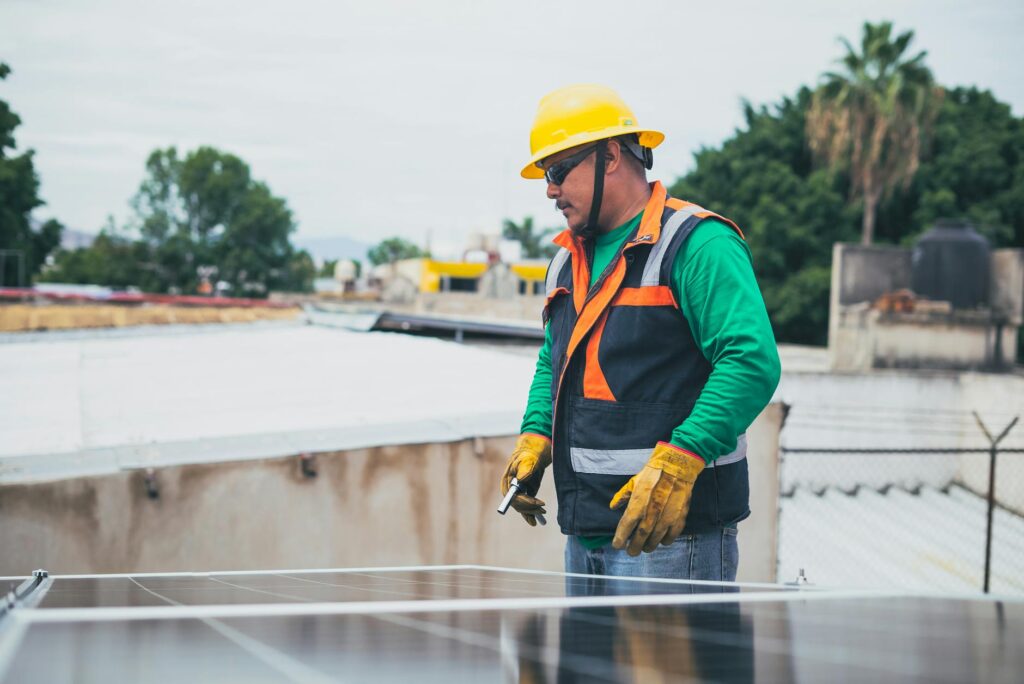
At the core of the emerging climatetech workforce is a capital-to-skill conversion model. Clean-energy investment, quantified at $1.1 trillion in 2023 alone, allocates roughly 6% of project budgets to workforce development, a proportion that has risen from 2% a decade earlier [2]. This allocation is operationalized through three intertwined mechanisms:
Investment-Driven Skill Pipeline Architecture Green Infrastructure as a Labor Engine: How Climatetech Training Reshapes Career Capital At the core of the emerging climatetech workforce is a capital-to-skill conversion model.
- On-site Apprenticeship Networks – Large-scale solar farms in Texas and wind parks in the Midwest embed apprenticeship tracks directly into construction contracts. The Texas Renewable Energy Apprenticeship Initiative (TREAI) reports that 38% of its 2024 hires originated from community-college pipelines, reducing average onboarding time from 12 to 5 months [3].
- Certification Standardization – The International Renewable Energy Agency (IRENA) launched the Global Renewable Energy Certificate (GREC) in 2022, harmonizing skill verification across borders. Early adopters such as Denmark’s offshore wind sector report a 22% reduction in skill-mismatch incidents, translating into faster project commissioning [4].
- Public-Research Integration – DOE’s RECS program couples federal grant funding with industry-led research milestones, compelling private partners to commit training slots proportional to their R&D spend. Companies that exceeded their RECS training quotas in 2023 saw a 15% increase in patent filings per employee, indicating a direct correlation between skill investment and innovation output [1].
Collectively, these mechanisms embed training within the financial architecture of climatetech projects, ensuring that capital deployment is inseparable from human-capital formation.
You may also like
 Government & Policy
Impact of New Robotaxi Laws on Autonomous Vehicle Startups
California's new law regulating robotaxi operations will significantly impact the autonomous vehicle sector, introducing safety measures that require better coordination with emergency responders and accountability…
Read More →Cross-Sectoral Spillovers and Institutional Realignment
The ripple effects of this skill pipeline extend beyond the immediate clean-energy arena, reconfiguring adjacent sectors through a process of institutional diffusion. Three salient pathways illustrate this systemic reorientation:
Manufacturing Realignment
The surge in demand for battery modules, electrolyzers, and CCS equipment has prompted legacy manufacturers to repurpose assembly lines. In Germany, the “Green Manufacturing Accord” (2023) required firms receiving federal subsidies to allocate 10% of their workforce to upskilling in low-carbon processes. Within two years, the proportion of plant workers certified in advanced materials handling rose from 8% to 31%, fostering a new labor niche that bridges traditional manufacturing and climatetech [2].
Financial Services Integration
Investment banks and asset managers are embedding climate-skill metrics into credit underwriting. The European Investment Bank (EIB) now requires project sponsors to disclose “Workforce Climate Readiness” scores, derived from the number of certified technicians and the proportion of staff engaged in continuous green-skill training. Projects that meet a threshold of 70% readiness enjoy a 0.15% reduction in financing spreads, creating a market incentive for skill development that directly influences capital costs [4].
Community Economic Mobility
Local economies adjacent to large-scale renewable installations experience measurable uplift in median household income. A longitudinal study of three Appalachian counties hosting wind farms reported a 4.3% increase in average earnings for workers who completed DOE-funded training programs, compared with a 0.9% rise in comparable counties lacking such programs [1]. This demonstrates that the institutional coupling of infrastructure spending and training can serve as a lever for regional economic mobility, counteracting the historical pattern of resource-extraction booms that left behind “ghost towns.”
These cross-sectoral dynamics reveal that climatetech training is not an isolated labor policy but a structural catalyst reshaping institutional incentives across the economy.
Workforce Capitalization in Emerging Climatetech Trades

From the perspective of individual career trajectories, the emergent skill set constitutes a new form of career capital—portable, high-value expertise that transcends traditional industry boundaries. Three dimensions illustrate this capital formation:
- Skill Portability – Certifications such as GREC are recognized across EU member states and increasingly in North America, allowing technicians to navigate a transnational labor market. This mirrors the post-industrial diffusion of IT certifications in the 1990s, which unlocked asymmetric wage growth for certified workers [3].
- Career Ladder Acceleration – Companies are institutionalizing “green-track” promotion pathways. For example, Ørsted’s internal “Renewable Operations Leadership” program fast-tracks engineers who complete a two-year CCUS training module into senior project-management roles, shortening the average promotion horizon from 7 to 4 years [2].
- Capital Access for Workers – Micro-financing platforms, such as the Climate-Skill Fund (CSF) in Canada, leverage verified training records to extend low-interest loans to workers seeking to start small-scale renewable-service enterprises. As of Q2 2024, CSF has disbursed $120 million to 2,400 entrepreneurs, generating an estimated $560 million in localized economic activity [4].
You may also like
 Government & Policy
RBI Repo Rate Hike Looms Amid Inflation, Oil Concerns
The Reserve Bank of India is poised to raise the repo rate by 25 basis points in October 2026, responding to rising inflation and oil…
Read More →These mechanisms convert institutional investment into individual economic mobility, establishing a feedback loop where enhanced career capital fuels further demand for sustainable infrastructure.
A longitudinal study of three Appalachian counties hosting wind farms reported a 4.3% increase in average earnings for workers who completed DOE-funded training programs, compared with a 0.9% rise in comparable counties lacking such programs [1].
Projected Trajectory Through 2030: Institutional Levers and Labor Market Elasticity
Looking ahead, the interplay of policy, capital, and training is projected to generate a sustained expansion of climatetech employment. The IEA’s 2025 outlook predicts a cumulative addition of 15 million clean-energy jobs worldwide by 2030, contingent on maintaining current investment growth rates [2]. However, the elasticity of that trajectory hinges on three institutional levers:
- Regulatory Standardization – Expansion of mandatory green-skill reporting in corporate ESG disclosures will institutionalize training as a compliance metric, driving broader adoption across mid-size firms that currently sit outside large-scale project ecosystems.
- Public-Private Funding Ratios – The proportion of federal R&D funding tied to workforce outcomes is slated to rise from 6% to 12% under the 2025 Infrastructure Climate Act. This scaling will amplify the RECS-style model, potentially adding 250,000 new skilled positions annually.
- Education System Integration – Embedding climatetech modules into secondary-education curricula, as piloted in the “Green Futures” program in California, is projected to raise the baseline skill pool by 18% within five years, narrowing the current 70% skills gap identified by the World Economic Forum [4].
If these levers coalesce, the labor market will exhibit a compound annual growth rate of approximately 8% in climatetech occupations, outpacing overall employment growth (3.2%). Conversely, a decoupling of capital from training—evidenced by a hypothetical 20% reduction in training-budget mandates—could truncate job creation by 2.3 million positions, underscoring the systemic dependence of career capital on institutional design.
In sum, sustainable infrastructure is crystallizing into a structural engine of career capital, with institutional mechanisms converting climate-focused capital flows into durable pathways for economic mobility. The next half-decade will determine whether this engine accelerates into a self-reinforcing system or stalls under policy inertia.
Key Structural Insights
Skill-Capital Convergence: Institutional investment in climatetech now embeds training within project financing, turning capital deployment into a direct source of career capital.
Cross-Sectoral Diffusion: The climatetech skill pipeline triggers systemic realignments in manufacturing, finance, and regional economies, creating asymmetric growth opportunities beyond the energy sector.
Policy Elasticity Threshold: Maintaining and scaling mandatory training allocations is the decisive lever that will determine whether the projected 15 million-job surge materializes by 2030.
Sources
You may also like
 Government & Policy
GST Council Approves Compliance Reforms for E-commerce
India's GST Council is poised to implement significant reforms aimed at easing compliance burdens for e-commerce sellers, enabling them to thrive in the digital marketplace.
Read More →The sustainability workforce shift: Building a talent pipeline and … — ScienceDirect
Clean technologies are driving job growth in the energy sector, but … — International Energy Agency
The Future of Skilled Trades in a Sustainable World — The Environmental Blog
Green skills: we need educational reform in renewable energy — World Economic Forum*